

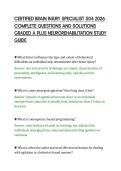
CERTIFIED BRAIN INJURY SPECIALIST 504 2026
COMPLETE QUESTIONS AND SOLUTIONS
GRADED A PLUS NEUROREHABILITATION STUDY
GUIDE
◉ What factors influence the type and extent of behavioral
difficulties an individual may demonstrate after brain injury?
Answer: site and severity of damage; pre-injury characteristics of
personality, intelligence, and learning style, and the current
environment
◉ What is coma-emergent agitation? How long does it last?
Answer: episode of agitation that may occur as an individual
emerges from coma that is usually brief, lasting less than 10 days in
duration
◉ What is consequence-based programming?
Answer: interventions focused on learning; not indicated for
individuals emerging from coma and demonstrating agitation or
confusion
◉ What is often the safest and most efficient technique for dealing
with agitation in a behavior-based manner?
,Answer: through environmental management, where the focus is on
offering a quiet, organized, and structured environment with limited
and carefully managed stimulation
◉ What is the Stability Triangle?
Answer: Is a construct which is useful when identifying treatment
priorities and establishing the treatment plan; contains the
following: establish medical stability, promote behavior stability, and
develop a stable activity plan
◉ What is applied behavior analysis?
Answer: the science of prediction and change of socially significant
behaviors
◉ What is behavior?
Answer: anything an individual does that can be measured, NOT
necessarily yelling/hitting/spitting/etc.
◉ What is the goal of applied behavior analysis?
Answer: to discover variables that reliably influence behavior to
either predict behavior change or promote behavior change
◉ What are indirect methods of behavior assessment?
,Answer: interviews, checklists, may be reviewed with caregivers,
family members, and the individual themselves; can be subject to
bias d/t self-reporting
◉ What are direct methods of behavior assessment?
Answer: direct observations of an individual, either in a naturally-
occurring situation or one in which specific variables have been
controlled or manipulated for assessment purposes
◉ What is Functional Analysis/Functional Assessment
Answer: methods of direct observation within the field of behavior
analysis conducted by BCBA to pinpoint the potential function or
purpose of a behavior via experimental manipulation
◉ What is a functionally equivalent alternative?
Answer: a behavior that serves the same function as the target
behavior but is safer or more appropriate and thus more useful for
the individual (e.g., instead of yelling resulting in d/c of a non-
preferred task, request a break)
◉ What is an operational definition?
Answer: a definition that outlines what exactly will be counted as an
occurrence or episode of the behavior; must be observable and
measurable, and the definition must be specific enough such that
, multiple observers can agree upon what would count as an
occurrence
◉ What are two dimensions of a behavior that will be important to
take into account when developing an operational definition?
Answer: topography (what the behavior looks like physically) and
intensity (describing the measure of force)
◉ What are five variables of interest when measuring behavior?
Answer: frequency, rate, duration, latency, and % correct
◉ What is the four-term contingency within the field of behavior
analysis?
Answer: establishing operation; discriminative stimulus;
response/behavior; consequence
◉ What is A-B-C analysis?
Answer: A=antecedent, B=behavior/response, C=consequence
◉ What is positive reinforcement?
Answer: adding something makes a response more likely to occur in
the future (e.g., if you do your chores, I'll give you $5)
COMPLETE QUESTIONS AND SOLUTIONS
GRADED A PLUS NEUROREHABILITATION STUDY
GUIDE
◉ What factors influence the type and extent of behavioral
difficulties an individual may demonstrate after brain injury?
Answer: site and severity of damage; pre-injury characteristics of
personality, intelligence, and learning style, and the current
environment
◉ What is coma-emergent agitation? How long does it last?
Answer: episode of agitation that may occur as an individual
emerges from coma that is usually brief, lasting less than 10 days in
duration
◉ What is consequence-based programming?
Answer: interventions focused on learning; not indicated for
individuals emerging from coma and demonstrating agitation or
confusion
◉ What is often the safest and most efficient technique for dealing
with agitation in a behavior-based manner?
,Answer: through environmental management, where the focus is on
offering a quiet, organized, and structured environment with limited
and carefully managed stimulation
◉ What is the Stability Triangle?
Answer: Is a construct which is useful when identifying treatment
priorities and establishing the treatment plan; contains the
following: establish medical stability, promote behavior stability, and
develop a stable activity plan
◉ What is applied behavior analysis?
Answer: the science of prediction and change of socially significant
behaviors
◉ What is behavior?
Answer: anything an individual does that can be measured, NOT
necessarily yelling/hitting/spitting/etc.
◉ What is the goal of applied behavior analysis?
Answer: to discover variables that reliably influence behavior to
either predict behavior change or promote behavior change
◉ What are indirect methods of behavior assessment?
,Answer: interviews, checklists, may be reviewed with caregivers,
family members, and the individual themselves; can be subject to
bias d/t self-reporting
◉ What are direct methods of behavior assessment?
Answer: direct observations of an individual, either in a naturally-
occurring situation or one in which specific variables have been
controlled or manipulated for assessment purposes
◉ What is Functional Analysis/Functional Assessment
Answer: methods of direct observation within the field of behavior
analysis conducted by BCBA to pinpoint the potential function or
purpose of a behavior via experimental manipulation
◉ What is a functionally equivalent alternative?
Answer: a behavior that serves the same function as the target
behavior but is safer or more appropriate and thus more useful for
the individual (e.g., instead of yelling resulting in d/c of a non-
preferred task, request a break)
◉ What is an operational definition?
Answer: a definition that outlines what exactly will be counted as an
occurrence or episode of the behavior; must be observable and
measurable, and the definition must be specific enough such that
, multiple observers can agree upon what would count as an
occurrence
◉ What are two dimensions of a behavior that will be important to
take into account when developing an operational definition?
Answer: topography (what the behavior looks like physically) and
intensity (describing the measure of force)
◉ What are five variables of interest when measuring behavior?
Answer: frequency, rate, duration, latency, and % correct
◉ What is the four-term contingency within the field of behavior
analysis?
Answer: establishing operation; discriminative stimulus;
response/behavior; consequence
◉ What is A-B-C analysis?
Answer: A=antecedent, B=behavior/response, C=consequence
◉ What is positive reinforcement?
Answer: adding something makes a response more likely to occur in
the future (e.g., if you do your chores, I'll give you $5)


