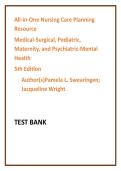
All-in-One Nursing Care Planning
Resource
Medical-Surgical, Pediatric,
Maternity, and Psychiatric-Mental
Health
5th Edition
• Author(s)Pamela L. Swearingen;
Jacqueline Wright
TEST BANK
,Question 1 (MCQ)
Clinical Scenario
A 62-year-old patient newly diagnosed with metastatic lung
cancer expresses uncertainty about the treatment plan and
states, "I don't know where to start."
Question
Which nursing action best supports patient-centered cancer
care?
A. Provide extensive written information and leave the room.
B. Encourage the patient to identify immediate concerns and
participate in goal setting.
C. Advise the patient to rely on family members for decision
making.
D. Delay education until chemotherapy begins.
Correct Answer
B
Rationale
Shared decision-making promotes patient autonomy, improves
understanding, and establishes individualized care priorities.
Incorrect Option Analysis
, • A: Overwhelming information reduces comprehension.
• C: Decision making should remain patient centered unless
the patient requests otherwise.
• D: Education should begin early.
Nursing Process
Planning
NCJMM
Recognize Cues • Generate Solutions • Take Action
Difficulty
Easy
Bloom Level
Apply
NCLEX Category
Management of Care
Nursing Diagnosis
Knowledge Deficit related to unfamiliar cancer diagnosis as
evidenced by expressed uncertainty.
Expected Outcome
Patient identifies two treatment goals before discharge.
Learning Objective
, Apply patient-centered care planning principles.
Question 2 (SATA)
Clinical Scenario
A patient receiving chemotherapy develops neutropenia.
Question
Which nursing interventions should be included?
Select all that apply.
A. Monitor temperature regularly
B. Encourage raw seafood consumption
C. Reinforce hand hygiene
D. Assess for signs of infection
E. Limit exposure to ill visitors
Correct Answers
A, C, D, E
Rationale
Neutropenic patients require infection prevention through
surveillance, hygiene, and exposure reduction.
Incorrect Option Analysis
Resource
Medical-Surgical, Pediatric,
Maternity, and Psychiatric-Mental
Health
5th Edition
• Author(s)Pamela L. Swearingen;
Jacqueline Wright
TEST BANK
,Question 1 (MCQ)
Clinical Scenario
A 62-year-old patient newly diagnosed with metastatic lung
cancer expresses uncertainty about the treatment plan and
states, "I don't know where to start."
Question
Which nursing action best supports patient-centered cancer
care?
A. Provide extensive written information and leave the room.
B. Encourage the patient to identify immediate concerns and
participate in goal setting.
C. Advise the patient to rely on family members for decision
making.
D. Delay education until chemotherapy begins.
Correct Answer
B
Rationale
Shared decision-making promotes patient autonomy, improves
understanding, and establishes individualized care priorities.
Incorrect Option Analysis
, • A: Overwhelming information reduces comprehension.
• C: Decision making should remain patient centered unless
the patient requests otherwise.
• D: Education should begin early.
Nursing Process
Planning
NCJMM
Recognize Cues • Generate Solutions • Take Action
Difficulty
Easy
Bloom Level
Apply
NCLEX Category
Management of Care
Nursing Diagnosis
Knowledge Deficit related to unfamiliar cancer diagnosis as
evidenced by expressed uncertainty.
Expected Outcome
Patient identifies two treatment goals before discharge.
Learning Objective
, Apply patient-centered care planning principles.
Question 2 (SATA)
Clinical Scenario
A patient receiving chemotherapy develops neutropenia.
Question
Which nursing interventions should be included?
Select all that apply.
A. Monitor temperature regularly
B. Encourage raw seafood consumption
C. Reinforce hand hygiene
D. Assess for signs of infection
E. Limit exposure to ill visitors
Correct Answers
A, C, D, E
Rationale
Neutropenic patients require infection prevention through
surveillance, hygiene, and exposure reduction.
Incorrect Option Analysis