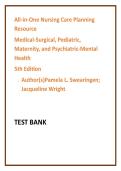
All-in-One Nursing Care Planning
Resource
Medical-Surgical, Pediatric,
Maternity, and Psychiatric-Mental
Health
5th Edition
• Author(s)Pamela L. Swearingen;
Jacqueline Wright
TEST BANK
,1) MCQ — Cancer Care: Febrile Neutropenia Risk
Clinical Scenario:
A 58-year-old patient receiving cycle 2 of chemotherapy for
lymphoma reports chills. The temperature is 38.4°C (101.1°F),
ANC is 480/mm³, and the patient looks flushed and fatigued.
Stem:
What is the nurse’s priority action?
Options:
A. Give acetaminophen and reassess temperature in 1 hour.
B. Implement neutropenic precautions and notify the oncology
provider immediately.
C. Encourage oral fluids and discharge teaching.
D. Hold the next chemotherapy dose without reporting the
fever.
Correct Answer: B
Detailed Rationale:
Fever with neutropenia is a medical emergency because
infection may progress rapidly with minimal early signs. The
nurse should immediately reduce exposure risk, initiate
protective precautions, and notify the oncology team for urgent
evaluation, cultures, and likely broad-spectrum antibiotics.
Incorrect Option Analysis:
, • A: Incorrect because antipyretic treatment alone delays
urgent evaluation. Misconception: treating the symptom
fixes the cause.
• C: Incorrect because hydration is useful but not the
priority. Safety concern: delayed sepsis recognition.
• D: Incorrect because the nurse must report fever promptly,
not independently withhold treatment without escalation.
Nursing Process Linkage: Assessment → Implementation
NCJMM: Recognize Cues, Take Action
Difficulty: Difficult
Bloom’s Level: Analyze
NCLEX Client Needs: Reduction of Risk Potential / Physiological
Adaptation
Nursing Diagnosis Integration:
• Priority Nursing Diagnosis: Risk for Infection
• Risk Factors: neutropenia, cytotoxic chemotherapy,
impaired immune response
Expected Outcome: Patient remains afebrile and receives
antibiotics/interventions within the expected institutional
time frame.
Key Learning Objective: Prioritize life-threatening
complications of chemotherapy.
, 2) SATA — Cancer Care: Radiation Skin Care
Clinical Scenario:
A patient receiving external-beam radiation to the neck has
mild erythema and dry skin in the treatment field.
Stem:
Which teaching points should the nurse include? Select all that
apply.
Options:
A. Clean the area with lukewarm water and mild soap.
B. Wear loose, soft cotton clothing over the site.
C. Apply heating pads to decrease discomfort.
D. Avoid scrubbing, rubbing, or using adhesive tape on the area.
E. Protect the area from direct sunlight.
F. Apply lotion immediately before each radiation treatment
unless the patient prefers not to.
Correct Answers: A, B, D, E
Detailed Rationale:
Radiation commonly causes skin irritation and breakdown.
Gentle cleansing, loose clothing, avoiding friction/adhesives,
and sun protection help reduce tissue injury and preserve skin
integrity.
Incorrect Option Analysis:
Resource
Medical-Surgical, Pediatric,
Maternity, and Psychiatric-Mental
Health
5th Edition
• Author(s)Pamela L. Swearingen;
Jacqueline Wright
TEST BANK
,1) MCQ — Cancer Care: Febrile Neutropenia Risk
Clinical Scenario:
A 58-year-old patient receiving cycle 2 of chemotherapy for
lymphoma reports chills. The temperature is 38.4°C (101.1°F),
ANC is 480/mm³, and the patient looks flushed and fatigued.
Stem:
What is the nurse’s priority action?
Options:
A. Give acetaminophen and reassess temperature in 1 hour.
B. Implement neutropenic precautions and notify the oncology
provider immediately.
C. Encourage oral fluids and discharge teaching.
D. Hold the next chemotherapy dose without reporting the
fever.
Correct Answer: B
Detailed Rationale:
Fever with neutropenia is a medical emergency because
infection may progress rapidly with minimal early signs. The
nurse should immediately reduce exposure risk, initiate
protective precautions, and notify the oncology team for urgent
evaluation, cultures, and likely broad-spectrum antibiotics.
Incorrect Option Analysis:
, • A: Incorrect because antipyretic treatment alone delays
urgent evaluation. Misconception: treating the symptom
fixes the cause.
• C: Incorrect because hydration is useful but not the
priority. Safety concern: delayed sepsis recognition.
• D: Incorrect because the nurse must report fever promptly,
not independently withhold treatment without escalation.
Nursing Process Linkage: Assessment → Implementation
NCJMM: Recognize Cues, Take Action
Difficulty: Difficult
Bloom’s Level: Analyze
NCLEX Client Needs: Reduction of Risk Potential / Physiological
Adaptation
Nursing Diagnosis Integration:
• Priority Nursing Diagnosis: Risk for Infection
• Risk Factors: neutropenia, cytotoxic chemotherapy,
impaired immune response
Expected Outcome: Patient remains afebrile and receives
antibiotics/interventions within the expected institutional
time frame.
Key Learning Objective: Prioritize life-threatening
complications of chemotherapy.
, 2) SATA — Cancer Care: Radiation Skin Care
Clinical Scenario:
A patient receiving external-beam radiation to the neck has
mild erythema and dry skin in the treatment field.
Stem:
Which teaching points should the nurse include? Select all that
apply.
Options:
A. Clean the area with lukewarm water and mild soap.
B. Wear loose, soft cotton clothing over the site.
C. Apply heating pads to decrease discomfort.
D. Avoid scrubbing, rubbing, or using adhesive tape on the area.
E. Protect the area from direct sunlight.
F. Apply lotion immediately before each radiation treatment
unless the patient prefers not to.
Correct Answers: A, B, D, E
Detailed Rationale:
Radiation commonly causes skin irritation and breakdown.
Gentle cleansing, loose clothing, avoiding friction/adhesives,
and sun protection help reduce tissue injury and preserve skin
integrity.
Incorrect Option Analysis: