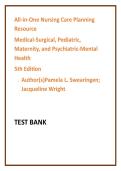
All-in-One Nursing Care Planning
Resource
Medical-Surgical, Pediatric,
Maternity, and Psychiatric-Mental
Health
5th Edition
• Author(s)Pamela L. Swearingen;
Jacqueline Wright
TEST BANK
,1) MCQ — Cancer Care
Clinical scenario: A 58-year-old patient receiving chemotherapy
for colon cancer calls the clinic and reports a temperature of
38.4°C (101.1°F), chills, and new fatigue. The most recent
absolute neutrophil count was 650/mm³.
Question stem: What is the nurse’s priority action?
Answer options:
A. Advise the patient to take acetaminophen and rest at home
B. Instruct the patient to increase oral fluids and call back
tomorrow
C. Notify the provider immediately and prepare for blood
cultures and IV antibiotics
D. Reassure the patient that mild fever is common during
chemotherapy
Correct answer: C
Rationale: Fever with neutropenia is a medical emergency
because the patient may deteriorate rapidly from sepsis. The
nurse should treat this as febrile neutropenia, notify the
provider, and prepare for cultures and prompt broad-spectrum
antibiotics.
Incorrect options:
A: Antipyretics may mask fever and delay care; this reflects the
misconception that fever can be managed at home in
neutropenia.
,B: Hydration is helpful, but waiting is unsafe; this ignores sepsis
risk.
D: Fever is not considered benign in a neutropenic patient and
requires urgent evaluation.
Nursing process linkage: Implementation
NCJMM: Recognize Cues; Prioritize Hypotheses; Take Action
Difficulty: Difficult
Bloom’s level: Analyze
NCLEX client needs: Physiological Adaptation
Nursing diagnosis integration:
• Priority nursing diagnosis: Risk for Infection
• Risk factors: Chemotherapy-induced neutropenia, fever,
chills
Expected outcome: The patient receives timely sepsis
evaluation and IV antibiotics within the facility’s
neutropenic fever protocol.
Key learning objective: Identify life-threatening infection
cues in cancer care and act quickly.
2) SATA — Cancer Care
Clinical scenario: A patient receiving immune checkpoint
inhibitor therapy for melanoma reports new symptoms after
the third infusion.
, Question stem: Which findings should the nurse instruct the
patient to report immediately? Select all that apply.
Answer options:
A. New cough and shortness of breath
B. Watery diarrhea
C. Dark urine and yellowing of the eyes
D. Mild fatigue after treatment
E. Localized redness at the injection site
F. Increased thirst and frequent urination
Correct answers: A, B, C, F
Rationale: Immune-related adverse effects can involve the
lungs, bowel, liver, and endocrine system. New respiratory
symptoms, diarrhea, jaundice/dark urine, and hyperglycemia
symptoms can signal serious toxicity and need urgent
evaluation.
Incorrect options:
D: Fatigue is common and nonspecific; it still should be
monitored, but it is not the strongest immediate danger cue.
E: Mild local redness is usually expected with minor irritation
and is less concerning than systemic toxicity.
Nursing process linkage: Assessment
NCJMM: Recognize Cues; Analyze Cues
Difficulty: Moderate
Bloom’s level: Apply
Resource
Medical-Surgical, Pediatric,
Maternity, and Psychiatric-Mental
Health
5th Edition
• Author(s)Pamela L. Swearingen;
Jacqueline Wright
TEST BANK
,1) MCQ — Cancer Care
Clinical scenario: A 58-year-old patient receiving chemotherapy
for colon cancer calls the clinic and reports a temperature of
38.4°C (101.1°F), chills, and new fatigue. The most recent
absolute neutrophil count was 650/mm³.
Question stem: What is the nurse’s priority action?
Answer options:
A. Advise the patient to take acetaminophen and rest at home
B. Instruct the patient to increase oral fluids and call back
tomorrow
C. Notify the provider immediately and prepare for blood
cultures and IV antibiotics
D. Reassure the patient that mild fever is common during
chemotherapy
Correct answer: C
Rationale: Fever with neutropenia is a medical emergency
because the patient may deteriorate rapidly from sepsis. The
nurse should treat this as febrile neutropenia, notify the
provider, and prepare for cultures and prompt broad-spectrum
antibiotics.
Incorrect options:
A: Antipyretics may mask fever and delay care; this reflects the
misconception that fever can be managed at home in
neutropenia.
,B: Hydration is helpful, but waiting is unsafe; this ignores sepsis
risk.
D: Fever is not considered benign in a neutropenic patient and
requires urgent evaluation.
Nursing process linkage: Implementation
NCJMM: Recognize Cues; Prioritize Hypotheses; Take Action
Difficulty: Difficult
Bloom’s level: Analyze
NCLEX client needs: Physiological Adaptation
Nursing diagnosis integration:
• Priority nursing diagnosis: Risk for Infection
• Risk factors: Chemotherapy-induced neutropenia, fever,
chills
Expected outcome: The patient receives timely sepsis
evaluation and IV antibiotics within the facility’s
neutropenic fever protocol.
Key learning objective: Identify life-threatening infection
cues in cancer care and act quickly.
2) SATA — Cancer Care
Clinical scenario: A patient receiving immune checkpoint
inhibitor therapy for melanoma reports new symptoms after
the third infusion.
, Question stem: Which findings should the nurse instruct the
patient to report immediately? Select all that apply.
Answer options:
A. New cough and shortness of breath
B. Watery diarrhea
C. Dark urine and yellowing of the eyes
D. Mild fatigue after treatment
E. Localized redness at the injection site
F. Increased thirst and frequent urination
Correct answers: A, B, C, F
Rationale: Immune-related adverse effects can involve the
lungs, bowel, liver, and endocrine system. New respiratory
symptoms, diarrhea, jaundice/dark urine, and hyperglycemia
symptoms can signal serious toxicity and need urgent
evaluation.
Incorrect options:
D: Fatigue is common and nonspecific; it still should be
monitored, but it is not the strongest immediate danger cue.
E: Mild local redness is usually expected with minor irritation
and is less concerning than systemic toxicity.
Nursing process linkage: Assessment
NCJMM: Recognize Cues; Analyze Cues
Difficulty: Moderate
Bloom’s level: Apply