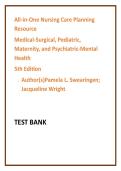
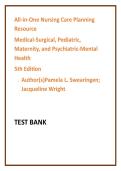
All-in-One Nursing Care Planning
Resource
Medical-Surgical, Pediatric,
Maternity, and Psychiatric-Mental
Health
5th Edition
• Author(s)Pamela L. Swearingen;
Jacqueline Wright
TEST BANK
,1) MCQ
Clinical scenario: A 58-year-old patient is 8 days post-
chemotherapy and reports chills, sore throat, and a
temperature of 38.6°C. The ANC is 400/mm³.
Question stem: What is the nurse’s priority action?
Answer options:
A. Give acetaminophen and recheck the temperature in 1 hour
B. Encourage oral fluids and rest
C. Notify the provider immediately and prepare for blood
cultures and broad-spectrum IV antibiotics
D. Place the patient on a regular diet and monitor intake
Correct answer: C
Detailed rationale: Fever with profound neutropenia is a
medical emergency. The nurse must act quickly to support
timely cultures and antibiotics. Delay increases the risk of sepsis
and death.
Incorrect option analysis:
• A is incorrect because acetaminophen may mask
worsening fever and delays definitive treatment.
• B is incorrect because rest and fluids do not address the
immediate infection risk.
, • D is incorrect because diet is not the priority when febrile
neutropenia is suspected.
Nursing process linkage: Implementation
NCJMM competencies: Recognize Cues, Prioritize Hypotheses,
Take Action
Difficulty level: Difficult
Bloom’s level: Analyze
NCLEX client needs category: Physiological Adaptation
Nursing diagnosis integration: Risk for infection related to
immunosuppression secondary to chemotherapy
Expected outcome: The patient receives cultures and IV
antibiotics promptly, and temperature stabilizes without
progression to sepsis.
Key learning objective: Prioritize emergency actions for febrile
neutropenia.
2) MCQ
Clinical scenario: A patient receiving external beam radiation to
the breast asks about skin care.
Question stem: Which statement shows correct understanding?
Answer options:
A. “I will wash the area gently with lukewarm water and mild
soap.”
B. “I will scrub off the marked area after each treatment.”
, C. “I will use a heating pad if the skin feels sore.”
D. “I will wear rough fabric to keep the area dry.”
Correct answer: A
Detailed rationale: Gentle cleansing with mild soap and
lukewarm water protects fragile irradiated skin. Avoiding
friction, heat, and irritation helps prevent skin breakdown.
Incorrect option analysis:
• B is incorrect because treatment markings should not be
scrubbed off.
• C is incorrect because heat increases skin injury risk.
• D is incorrect because rough fabric increases friction and
irritation.
Nursing process linkage: Implementation
NCJMM competencies: Generate Solutions, Take Action
Difficulty level: Moderate
Bloom’s level: Apply
NCLEX client needs category: Safety and Infection Control
Nursing diagnosis integration: Risk for impaired skin integrity
related to radiation therapy
Expected outcome: The patient maintains intact skin in the
radiation field throughout treatment.
Key learning objective: Apply evidence-informed radiation skin
precautions.
Resource
Medical-Surgical, Pediatric,
Maternity, and Psychiatric-Mental
Health
5th Edition
• Author(s)Pamela L. Swearingen;
Jacqueline Wright
TEST BANK
,1) MCQ
Clinical scenario: A 58-year-old patient is 8 days post-
chemotherapy and reports chills, sore throat, and a
temperature of 38.6°C. The ANC is 400/mm³.
Question stem: What is the nurse’s priority action?
Answer options:
A. Give acetaminophen and recheck the temperature in 1 hour
B. Encourage oral fluids and rest
C. Notify the provider immediately and prepare for blood
cultures and broad-spectrum IV antibiotics
D. Place the patient on a regular diet and monitor intake
Correct answer: C
Detailed rationale: Fever with profound neutropenia is a
medical emergency. The nurse must act quickly to support
timely cultures and antibiotics. Delay increases the risk of sepsis
and death.
Incorrect option analysis:
• A is incorrect because acetaminophen may mask
worsening fever and delays definitive treatment.
• B is incorrect because rest and fluids do not address the
immediate infection risk.
, • D is incorrect because diet is not the priority when febrile
neutropenia is suspected.
Nursing process linkage: Implementation
NCJMM competencies: Recognize Cues, Prioritize Hypotheses,
Take Action
Difficulty level: Difficult
Bloom’s level: Analyze
NCLEX client needs category: Physiological Adaptation
Nursing diagnosis integration: Risk for infection related to
immunosuppression secondary to chemotherapy
Expected outcome: The patient receives cultures and IV
antibiotics promptly, and temperature stabilizes without
progression to sepsis.
Key learning objective: Prioritize emergency actions for febrile
neutropenia.
2) MCQ
Clinical scenario: A patient receiving external beam radiation to
the breast asks about skin care.
Question stem: Which statement shows correct understanding?
Answer options:
A. “I will wash the area gently with lukewarm water and mild
soap.”
B. “I will scrub off the marked area after each treatment.”
, C. “I will use a heating pad if the skin feels sore.”
D. “I will wear rough fabric to keep the area dry.”
Correct answer: A
Detailed rationale: Gentle cleansing with mild soap and
lukewarm water protects fragile irradiated skin. Avoiding
friction, heat, and irritation helps prevent skin breakdown.
Incorrect option analysis:
• B is incorrect because treatment markings should not be
scrubbed off.
• C is incorrect because heat increases skin injury risk.
• D is incorrect because rough fabric increases friction and
irritation.
Nursing process linkage: Implementation
NCJMM competencies: Generate Solutions, Take Action
Difficulty level: Moderate
Bloom’s level: Apply
NCLEX client needs category: Safety and Infection Control
Nursing diagnosis integration: Risk for impaired skin integrity
related to radiation therapy
Expected outcome: The patient maintains intact skin in the
radiation field throughout treatment.
Key learning objective: Apply evidence-informed radiation skin
precautions.