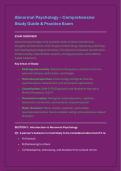
Abnormal Psychology – Comprehensive
Study Guide & Practice Exam
EXAM OVERVIEW
Abnormal psychology is the scientific study of abnormal behavior,
thoughts, and emotions, with the goal of describing, explaining, predicting,
and treating psychological disorders. The field encompasses the definition
of abnormality, classification systems, etiology (causes), and evidence-
based treatments.
Key Areas of Study
• Defining abnormality: Statistical infrequency, violation of norms,
personal distress, dysfunction, and danger
• Historical perspectives: Demonology, biological theories,
psychoanalysis, behaviorism, and humanistic approaches
• Classification: DSM-5-TR (Diagnostic and Statistical Manual of
Mental Disorders), ICD-11
• Theoretical models: Biological, psychodynamic, cognitive-
behavioral, humanistic, sociocultural, biopsychosocial
• Major disorders: Mood, anxiety, psychotic, personality,
neurodevelopmental, trauma-related, eating, and substance-related
disorders
SECTION 1: Introduction to Abnormal Psychology
Q1. A person's behavior is most likely to be considered abnormal if it is:
• A) Unusual
• B) Distressing to others
• C) Maladaptive, distressing, and deviates from cultural norms
, • D) Illegal
Answer: C – Abnormality is generally defined by a combination of factors:
statistical deviance, violation of social norms, personal distress,
dysfunction (maladaptive behavior), and danger to self or others. No single
criterion is sufficient.
Q2. The concept of "cultural relativism" in abnormal psychology refers
to:
• A) The idea that mental disorders are universal across all cultures
• B) The belief that abnormal behavior can only be understood within
the context of a specific culture
• C) The superiority of Western diagnostic systems
• D) The biological basis of mental disorders
Answer: B – Cultural relativism recognizes that what is considered
"normal" or "abnormal" varies across cultures and that abnormal behavior
must be evaluated in the context of the individual's cultural background .
Q3. The term "psychopathology" is best defined as:
• A) The biological causes of mental disorders
• B) The scientific study of psychological disorders
• C) The treatment of mental illness
• D) The legal definition of insanity
Answer: B – Psychopathology is the scientific study of psychological
disorders, including their causes, symptoms, and treatments .
Q4. The diathesis-stress model proposes that:
• A) Mental disorders are caused entirely by genetic factors
, • B) Mental disorders are caused by a combination of a genetic
vulnerability (diathesis) and environmental stress
• C) Mental disorders are caused by childhood trauma alone
• D) Mental disorders are caused by brain chemistry imbalances
Answer: B – The diathesis-stress model suggests that individuals inherit a
predisposition (diathesis) for a disorder, which may be triggered by
environmental stressors .
Q5. Which of the following is NOT one of the four D's used to define
abnormality?
• A) Deviance
• B) Distress
• C) Dysfunction
• D) Dementia
Answer: D – The four D's are Deviance (atypical behavior), Distress
(personal suffering), Dysfunction (impairment in daily life), and Danger (risk
to self or others). Dementia is a specific disorder, not a criterion for
abnormality .
Q6. The DSM-5-TR (Diagnostic and Statistical Manual of Mental
Disorders) is published by the:
• A) World Health Organization (WHO)
• B) American Psychological Association (APA)
• C) American Psychiatric Association (APA)
• D) National Institute of Mental Health (NIMH)
Answer: C – The DSM-5-TR is published by the American Psychiatric
Association. The ICD (International Classification of Diseases) is published
by the WHO .
, Q7. A key difference between the DSM-5-TR and the ICD-11 is:
• A) The DSM-5-TR is used only in the United States
• B) The DSM-5-TR provides diagnostic criteria, while the ICD focuses
only on medical conditions
• C) The DSM-5-TR emphasizes etiology, while the ICD focuses on
symptoms
• D) The DSM-5-TR includes only psychological disorders
Answer: A – While the DSM-5-TR is the primary diagnostic system in the
United States, the ICD-11 is used internationally and includes all health
conditions, not just mental disorders .
Q8. The cultural formulation interview (CFI) in the DSM-5-TR is designed
to:
• A) Assess a patient's genetic predisposition to mental illness
• B) Understand the cultural context of a patient's symptoms and
experiences
• C) Determine if a patient is faking symptoms
• D) Identify the biological causes of a disorder
Answer: B – The CFI is a set of questions designed to help clinicians
understand the cultural context of a patient's symptoms, including their
cultural identity, explanatory models, and stressors .
Q9. Which of the following describes the "presenting problem" in a
clinical assessment?
• A) The underlying cause of the disorder
• B) The reason the patient sought treatment
• C) The patient's family history
Study Guide & Practice Exam
EXAM OVERVIEW
Abnormal psychology is the scientific study of abnormal behavior,
thoughts, and emotions, with the goal of describing, explaining, predicting,
and treating psychological disorders. The field encompasses the definition
of abnormality, classification systems, etiology (causes), and evidence-
based treatments.
Key Areas of Study
• Defining abnormality: Statistical infrequency, violation of norms,
personal distress, dysfunction, and danger
• Historical perspectives: Demonology, biological theories,
psychoanalysis, behaviorism, and humanistic approaches
• Classification: DSM-5-TR (Diagnostic and Statistical Manual of
Mental Disorders), ICD-11
• Theoretical models: Biological, psychodynamic, cognitive-
behavioral, humanistic, sociocultural, biopsychosocial
• Major disorders: Mood, anxiety, psychotic, personality,
neurodevelopmental, trauma-related, eating, and substance-related
disorders
SECTION 1: Introduction to Abnormal Psychology
Q1. A person's behavior is most likely to be considered abnormal if it is:
• A) Unusual
• B) Distressing to others
• C) Maladaptive, distressing, and deviates from cultural norms
, • D) Illegal
Answer: C – Abnormality is generally defined by a combination of factors:
statistical deviance, violation of social norms, personal distress,
dysfunction (maladaptive behavior), and danger to self or others. No single
criterion is sufficient.
Q2. The concept of "cultural relativism" in abnormal psychology refers
to:
• A) The idea that mental disorders are universal across all cultures
• B) The belief that abnormal behavior can only be understood within
the context of a specific culture
• C) The superiority of Western diagnostic systems
• D) The biological basis of mental disorders
Answer: B – Cultural relativism recognizes that what is considered
"normal" or "abnormal" varies across cultures and that abnormal behavior
must be evaluated in the context of the individual's cultural background .
Q3. The term "psychopathology" is best defined as:
• A) The biological causes of mental disorders
• B) The scientific study of psychological disorders
• C) The treatment of mental illness
• D) The legal definition of insanity
Answer: B – Psychopathology is the scientific study of psychological
disorders, including their causes, symptoms, and treatments .
Q4. The diathesis-stress model proposes that:
• A) Mental disorders are caused entirely by genetic factors
, • B) Mental disorders are caused by a combination of a genetic
vulnerability (diathesis) and environmental stress
• C) Mental disorders are caused by childhood trauma alone
• D) Mental disorders are caused by brain chemistry imbalances
Answer: B – The diathesis-stress model suggests that individuals inherit a
predisposition (diathesis) for a disorder, which may be triggered by
environmental stressors .
Q5. Which of the following is NOT one of the four D's used to define
abnormality?
• A) Deviance
• B) Distress
• C) Dysfunction
• D) Dementia
Answer: D – The four D's are Deviance (atypical behavior), Distress
(personal suffering), Dysfunction (impairment in daily life), and Danger (risk
to self or others). Dementia is a specific disorder, not a criterion for
abnormality .
Q6. The DSM-5-TR (Diagnostic and Statistical Manual of Mental
Disorders) is published by the:
• A) World Health Organization (WHO)
• B) American Psychological Association (APA)
• C) American Psychiatric Association (APA)
• D) National Institute of Mental Health (NIMH)
Answer: C – The DSM-5-TR is published by the American Psychiatric
Association. The ICD (International Classification of Diseases) is published
by the WHO .
, Q7. A key difference between the DSM-5-TR and the ICD-11 is:
• A) The DSM-5-TR is used only in the United States
• B) The DSM-5-TR provides diagnostic criteria, while the ICD focuses
only on medical conditions
• C) The DSM-5-TR emphasizes etiology, while the ICD focuses on
symptoms
• D) The DSM-5-TR includes only psychological disorders
Answer: A – While the DSM-5-TR is the primary diagnostic system in the
United States, the ICD-11 is used internationally and includes all health
conditions, not just mental disorders .
Q8. The cultural formulation interview (CFI) in the DSM-5-TR is designed
to:
• A) Assess a patient's genetic predisposition to mental illness
• B) Understand the cultural context of a patient's symptoms and
experiences
• C) Determine if a patient is faking symptoms
• D) Identify the biological causes of a disorder
Answer: B – The CFI is a set of questions designed to help clinicians
understand the cultural context of a patient's symptoms, including their
cultural identity, explanatory models, and stressors .
Q9. Which of the following describes the "presenting problem" in a
clinical assessment?
• A) The underlying cause of the disorder
• B) The reason the patient sought treatment
• C) The patient's family history