
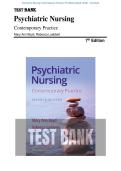
Psychiatric Nursing: Contemporary Practice 7th Edition (Boyd, 2022) - Test Bank
TEST BANK
Psychiatric Nursing
Contemporary Practice
Mary Ann Boyd, Rebecca Luebbert
7th Edition
, Psychiatric Nursing: Contemporary Practice 7th Edition (Boyd, 2022) - Test Bank
Table of Contents
Unit I Mental Health Care in Contemporary Society
Chapter 1. Psychiatric–Mental Health Nursing and Evidence-Based Practice
Chapter 2. Mental Health and Mental Disorders: Fighting Stigma & Promoting Recovery
Chapter 3. Cultural and Spiritual Issues Related to Mental Health Care
Chapter 4. Patient Rights and Legal Issues
Chapter 5. Mental Health Care in the Community
Unit II Foundations of Psychiatric Nursing
Chapter 6. Ethics, Standards, and Nursing Frameworks
Chapter 7. Psychosocial Theoretic Basis of Psychiatric Nursing
Chapter 8. Biologic Foundations of Psychiatric Nursing
Chapter 9. Recovery Framework (NEW)
Unit III Contemporary Psychiatric Nursing Practice
Chapter 10. Communication and the Therapeutic Relationship
Chapter 11. The Psychiatric–Mental Health Nursing Process
Chapter 12. Psychopharmacology, Dietary Supplements, and Biologic Interventions
Chapter 13. Cognitive Interventions in Psychiatric Nursing
Chapter 14. Group Interventions
Chapter 15. Family Assessment and Interventions
Unit IV Mental Health Across the Life Span
Chapter 16. Mental Health Promotion for Children and Adolescents
Chapter 17. Mental Health Promotion for Young and Middle-Aged Adults
Chapter 18. Mental Health Promotion for Older Adults
, Psychiatric Nursing: Contemporary Practice 7th Edition (Boyd, 2022) - Test Bank
Unit V Prevention of Mental Disorders
Chapter 19. Stress and Mental Health
Chapter 20. Management of Anger, Aggression, and Violence
Chapter 21. Crisis, Loss, Grief, Response, Bereavement, and Disaster Management
Chapter 22. Suicide Prevention: Screening, Assessment, and Intervention
Chapter 23. Mental Health Care for Survivors of Violence
Unit VI Care and Recovery for Persons with Mental Disorders
Chapter 24. Schizophrenia and Related Disorders: Nursing Care of Persons with Thought
Disorders
Chapter 25. Depression: Management of Depressive Moods and Suicidal Behavior
Chapter 26. Bipolar Disorders: Management of Mood Lability
Chapter 27. Anxiety Disorders: Management of Anxiety, Phobia, and Panic
Chapter 28. Obsessive Compulsive and Related Disorders: Management of Obsessions
and Compulsions
Chapter 29. Trauma- and Stressor-Related Disorders: Nursing Care of Persons with
Posttraumatic Stress and Other Trauma-Related Disorders
Chapter 30. Personality and Impulse-Control Disorders Nursing Care of Persons with
Personality and Impulse-Control Disorders
Chapter 31. Addiction and Substance Use-Related Disorders: Nursing Care of Persons
with Alcohol and Drug Use Disorders
Chapter 32. Eating Disorders: Nursing Care of Persons with Eating and Weight-Related
Disorders
Chapter 33. Somatic Symptom and Dissociative Disorders: Nursing Care of Persons with
Somatization
Chapter 34. Sleep–Wake Disorders: Nursing Care of Persons with Insomnia and Sleep
Problems
Chapter 35. Sexual Disorders: Management of Sexual Dysfunction and Paraphilias
, Psychiatric Nursing: Contemporary Practice 7th Edition (Boyd, 2022) - Test Bank
Unit VII Care of Children and Adolescents
Chapter 36. Mental Health Assessment of Children and Adolescents
Chapter 37. Mental Health Disorders of Childhood and Adolescence
Unit VIII Care of Older Adults
Chapter 38. Mental Health Assessment of Older Adults
Chapter 39. Neurocognitive Disorders
Unit IX Care of Special Populations
Chapter 40. Care for Veterans with Mental Health Needs (NEW)
Chapter 41. Caring for Persons Who Are Experiencing Homelessness and Mentally
Illness
Chapter 42. Caring for Persons Experiencing Co-Occurring Mental Disorders
Chapter 43. Caring for the Medically Compromised Person
, Psychiatric Nursing: Contemporary Practice 7th Edition (Boyd, 2022) - Test Bank
Chapter 01: Psychiatric–Mental Health Nursing and Evidence-Based Practice
Format: Multiple Choice
Client Needs: Psychosocial Integrity
Cognitive Level: Remember Integrated
Process: Teaching/Learning Objective: 5
Page and Header: 9, A New National Objective: Community Treatment
1. A group of nurses are reviewing information about the evolution of mental health
care and are discussing the recommendations of the final report of the Joint
Commission on Mental Illness and Health. The nurses demonstrate an
understanding of this information when they identify that the report recommended
an increase in what?
A) Number of mental health hospitals
B) Institutionalization of clients with mental health problems
C) Number of clinics supplemented by general hospital units
D) Use of psychotherapy by psychiatrists
Ans: C
Feedback:
The final report of the Joint Commission on Mental Illness and Health, called Action
for Mental Health, recommended increased numbers of community clinics
supplemented by general hospital units for mental illness care. The ideas in the
report shifted responsibility for mental health care to the federal, state, and local
governments.
Format: Multiple Choice
, Psychiatric Nursing: Contemporary Practice 7th Edition (Boyd, 2022) - Test Bank
Client Needs: Psychosocial Integrity
Cognitive Level: Analyze
Integrated Process: Integrated Process: Nursing Process
Objective: 2
Page and Header: 2–3, Emergence of Modern Nursing Perspectives
2. A nurse is reviewing literature that sanctions the involvement of psychiatric–
mental health nurses in the provision of holistic nursing care. Integrating
knowledge of the various theories and views of mental health and illness, the nurse
identifies which as most strongly linked to this holistic approach?
A) Sigmund Freud’s psychoanalytic theory
B) Florence Nightingale’s Notes on Nursing
C) Lavinia Lloyd Dock’s Materia Medica for Nurses
D) Clifford Beers’ A Mind That Found Itself
Ans: B
Feedback:
The American Nurses Association’s Statement on Psychiatric Nursing Practice
(1967) officially sanctioned a holistic approach to nursing care for the first time.
The roots of this contemporary psychiatric–mental health nursing thought can be
traced to Florence Nightingale’s Notes on Nursing, which presented a holistic view
of the patient, with the view of the patient as living within a family and community.
Freud’s psychoanalytic theory focused on personality development and unconscious
motivations for drives. Beers’ autobiography described the inhumane treatments
used for mental illness, which led to the formation of a National Committee for
Mental Hygiene.
Format: Multiple Choice
Client Needs: Health Promotion and Maintenance
Cognitive Level: Apply
, Psychiatric Nursing: Contemporary Practice 7th Edition (Boyd, 2022) - Test Bank
Integrated Process: Teaching/Learning
Objective: 4
Page and Header: 8, National Action
3. A psychiatric–mental health nurse is preparing a presentation about key events
and people that influenced the development of contemporary mental health and
illness care. When describing the effects of World War II, which would the nurse
most likely include?
A) People began to view mental illness as more commonplace and acceptable.
B) The biologic understanding of mental illness was almost fully developed.
C) Deinstitutionalization occurred in response to the community health movement.
D) Mental illnesses became categorized as psychoses or neuroses.
Ans: A
Feedback:
During World War II, mental illness was beginning to be seen as a problem that
could happen to anyone. Many “normal” people who volunteered for service were
disqualified on the grounds that they were psychologically unfit to serve. Others
who had already served a tour of duty developed psychiatric and emotional
problems related to their wartime experiences. The biologic understanding of
mental illness continues to evolve. Deinstitutionalization and the community mental
health movement occurred during the 1960s. In the early 20th century, Freud
categorized mental illness as either a psychosis or neurosis.
Format: Multiple Choice
Client Needs: Psychosocial Integrity
Cognitive Level: Analysis
Integrated Process: Teaching/Learning
Objective: 2
Page and Header: 3, Box 1.2 History of Psychiatric–Mental Health Nursing
, Psychiatric Nursing: Contemporary Practice 7th Edition (Boyd, 2022) - Test Bank
4. A nurse is presenting a discussion of the history of psychiatric–mental health
nursing and its place within nursing history. Which would be most appropriate to
include?
A) Certification for the psychiatric–mental health nursing specialty was first
emphasized by Mary Adelaide Nutting.
B) Psychiatric nurses played a part in seeing that all deinstitutionalized clients got
treatment at community mental health centers.
C) There is a historical link between the first nursing program to admit male
students and the first training school for psychiatric nursing.
D) The first graduate program in psychiatric nursing was established in response to
the publication of psychiatric nursing specialty journals.
Ans: C
Feedback:
In 1882, the first training school for psychiatric nursing was established at the
McLean Asylum by E. Cowles; this was also the first nursing program to admit men.
Nutting emphasized psychiatric–mental health nursing role development.
Unfortunately, deinstitutionalization failed. Hildegard E. Peplau was responsible for
establishing the first graduate program in psychiatric–mental health nursing, in
1954. Publication of journals soon followed, beginning in the 1960s.
Format: Multiple Choice
Client Needs: Psychosocial Integrity
Cognitive Level: Apply
Integrated Process: Nursing Process
Objective: 2
Page and Header: 5, Table 1.1 Premoral Treatment Era
, Psychiatric Nursing: Contemporary Practice 7th Edition (Boyd, 2022) - Test Bank
5. When reviewing the evolution of mental health and illness care, which event is
associated with mental disorders beginning to be viewed as illnesses requiring
treatment?
A) Establishment of Pennsylvania Hospital in Philadelphia
B) Quaker establishment of asylums
C) Creation of the state hospital system
D) Freud’s views on the causes of mental illnesses
Ans: A
Feedback:
Mental disorders began to be viewed as illnesses with the establishment of
Pennsylvania Hospital, the first institution in the United States to receive those with
mental disorders for treatment and cure. The Quaker establishment of asylums
reflected the impetus toward moral treatment. Dorothea L. Dix advocated for the
humane treatment of clients with mental illness with the creation of state hospitals.
Freud believed that the primary causes of mental illnesses were psychological and a
result of disturbed personality development and faulty parenting.
Format: Multiple Choice
Client Needs: Psychosocial Integrity
Cognitive Level: Analysis
Integrated Process: Nursing Process
Objective: 5
Page and Header: 10, National Mental Health Objectives
6. A psychiatric–mental health nurse is working on a committee that is developing
programs that integrate the objectives for mental health and mental disorders, as
identified in Healthy People 2030. Which type of program would be least
appropriate?
A) Single substance abuse treatment programs
, Psychiatric Nursing: Contemporary Practice 7th Edition (Boyd, 2022) - Test Bank
B) Depression-screening programs for primary care providers
C) Mental health programs for the homeless population
D) Employment programs for those with serious mental illness
Ans: A
Feedback:
The objectives of Healthy People 2030 identify the need to increase the proportion
of persons with co-occurring substance abuse and mental disorders receiving
treatment for both disorders. Thus, single substance abuse treatment programs
would be least beneficial. The objectives call for an increase in depression screening
by primary care providers, an increase in the proportion of homeless adults with
mental health problems who receive mental health treatment, and an increase in
the proportion of persons with serious mental illness who are employed.
Format: Multiple Choice
Client Needs: Safe, Effective Care Environment: Management of Care Cognitive
Level: Remember
Integrated Process: Teaching/Learning
Objective: 2
Page and Header: 2, Early Founders
7. The following events are important in the development of psychiatric–mental
health nursing practice. Which event occurred first?
A) Publication of Standards of Psychiatric-Mental Health Nursing by the ANA
B) Publication of Standards of Child and Adolescent Psychiatric and Mental Health
Nursing Practice
C) Establishment of the first graduate program in psychiatric nursing at Rutgers
University
D) Publication of the first psychiatric nursing text, Nursing Mental Disease, by
Harriet Bailey
TEST BANK
Psychiatric Nursing
Contemporary Practice
Mary Ann Boyd, Rebecca Luebbert
7th Edition
, Psychiatric Nursing: Contemporary Practice 7th Edition (Boyd, 2022) - Test Bank
Table of Contents
Unit I Mental Health Care in Contemporary Society
Chapter 1. Psychiatric–Mental Health Nursing and Evidence-Based Practice
Chapter 2. Mental Health and Mental Disorders: Fighting Stigma & Promoting Recovery
Chapter 3. Cultural and Spiritual Issues Related to Mental Health Care
Chapter 4. Patient Rights and Legal Issues
Chapter 5. Mental Health Care in the Community
Unit II Foundations of Psychiatric Nursing
Chapter 6. Ethics, Standards, and Nursing Frameworks
Chapter 7. Psychosocial Theoretic Basis of Psychiatric Nursing
Chapter 8. Biologic Foundations of Psychiatric Nursing
Chapter 9. Recovery Framework (NEW)
Unit III Contemporary Psychiatric Nursing Practice
Chapter 10. Communication and the Therapeutic Relationship
Chapter 11. The Psychiatric–Mental Health Nursing Process
Chapter 12. Psychopharmacology, Dietary Supplements, and Biologic Interventions
Chapter 13. Cognitive Interventions in Psychiatric Nursing
Chapter 14. Group Interventions
Chapter 15. Family Assessment and Interventions
Unit IV Mental Health Across the Life Span
Chapter 16. Mental Health Promotion for Children and Adolescents
Chapter 17. Mental Health Promotion for Young and Middle-Aged Adults
Chapter 18. Mental Health Promotion for Older Adults
, Psychiatric Nursing: Contemporary Practice 7th Edition (Boyd, 2022) - Test Bank
Unit V Prevention of Mental Disorders
Chapter 19. Stress and Mental Health
Chapter 20. Management of Anger, Aggression, and Violence
Chapter 21. Crisis, Loss, Grief, Response, Bereavement, and Disaster Management
Chapter 22. Suicide Prevention: Screening, Assessment, and Intervention
Chapter 23. Mental Health Care for Survivors of Violence
Unit VI Care and Recovery for Persons with Mental Disorders
Chapter 24. Schizophrenia and Related Disorders: Nursing Care of Persons with Thought
Disorders
Chapter 25. Depression: Management of Depressive Moods and Suicidal Behavior
Chapter 26. Bipolar Disorders: Management of Mood Lability
Chapter 27. Anxiety Disorders: Management of Anxiety, Phobia, and Panic
Chapter 28. Obsessive Compulsive and Related Disorders: Management of Obsessions
and Compulsions
Chapter 29. Trauma- and Stressor-Related Disorders: Nursing Care of Persons with
Posttraumatic Stress and Other Trauma-Related Disorders
Chapter 30. Personality and Impulse-Control Disorders Nursing Care of Persons with
Personality and Impulse-Control Disorders
Chapter 31. Addiction and Substance Use-Related Disorders: Nursing Care of Persons
with Alcohol and Drug Use Disorders
Chapter 32. Eating Disorders: Nursing Care of Persons with Eating and Weight-Related
Disorders
Chapter 33. Somatic Symptom and Dissociative Disorders: Nursing Care of Persons with
Somatization
Chapter 34. Sleep–Wake Disorders: Nursing Care of Persons with Insomnia and Sleep
Problems
Chapter 35. Sexual Disorders: Management of Sexual Dysfunction and Paraphilias
, Psychiatric Nursing: Contemporary Practice 7th Edition (Boyd, 2022) - Test Bank
Unit VII Care of Children and Adolescents
Chapter 36. Mental Health Assessment of Children and Adolescents
Chapter 37. Mental Health Disorders of Childhood and Adolescence
Unit VIII Care of Older Adults
Chapter 38. Mental Health Assessment of Older Adults
Chapter 39. Neurocognitive Disorders
Unit IX Care of Special Populations
Chapter 40. Care for Veterans with Mental Health Needs (NEW)
Chapter 41. Caring for Persons Who Are Experiencing Homelessness and Mentally
Illness
Chapter 42. Caring for Persons Experiencing Co-Occurring Mental Disorders
Chapter 43. Caring for the Medically Compromised Person
, Psychiatric Nursing: Contemporary Practice 7th Edition (Boyd, 2022) - Test Bank
Chapter 01: Psychiatric–Mental Health Nursing and Evidence-Based Practice
Format: Multiple Choice
Client Needs: Psychosocial Integrity
Cognitive Level: Remember Integrated
Process: Teaching/Learning Objective: 5
Page and Header: 9, A New National Objective: Community Treatment
1. A group of nurses are reviewing information about the evolution of mental health
care and are discussing the recommendations of the final report of the Joint
Commission on Mental Illness and Health. The nurses demonstrate an
understanding of this information when they identify that the report recommended
an increase in what?
A) Number of mental health hospitals
B) Institutionalization of clients with mental health problems
C) Number of clinics supplemented by general hospital units
D) Use of psychotherapy by psychiatrists
Ans: C
Feedback:
The final report of the Joint Commission on Mental Illness and Health, called Action
for Mental Health, recommended increased numbers of community clinics
supplemented by general hospital units for mental illness care. The ideas in the
report shifted responsibility for mental health care to the federal, state, and local
governments.
Format: Multiple Choice
, Psychiatric Nursing: Contemporary Practice 7th Edition (Boyd, 2022) - Test Bank
Client Needs: Psychosocial Integrity
Cognitive Level: Analyze
Integrated Process: Integrated Process: Nursing Process
Objective: 2
Page and Header: 2–3, Emergence of Modern Nursing Perspectives
2. A nurse is reviewing literature that sanctions the involvement of psychiatric–
mental health nurses in the provision of holistic nursing care. Integrating
knowledge of the various theories and views of mental health and illness, the nurse
identifies which as most strongly linked to this holistic approach?
A) Sigmund Freud’s psychoanalytic theory
B) Florence Nightingale’s Notes on Nursing
C) Lavinia Lloyd Dock’s Materia Medica for Nurses
D) Clifford Beers’ A Mind That Found Itself
Ans: B
Feedback:
The American Nurses Association’s Statement on Psychiatric Nursing Practice
(1967) officially sanctioned a holistic approach to nursing care for the first time.
The roots of this contemporary psychiatric–mental health nursing thought can be
traced to Florence Nightingale’s Notes on Nursing, which presented a holistic view
of the patient, with the view of the patient as living within a family and community.
Freud’s psychoanalytic theory focused on personality development and unconscious
motivations for drives. Beers’ autobiography described the inhumane treatments
used for mental illness, which led to the formation of a National Committee for
Mental Hygiene.
Format: Multiple Choice
Client Needs: Health Promotion and Maintenance
Cognitive Level: Apply
, Psychiatric Nursing: Contemporary Practice 7th Edition (Boyd, 2022) - Test Bank
Integrated Process: Teaching/Learning
Objective: 4
Page and Header: 8, National Action
3. A psychiatric–mental health nurse is preparing a presentation about key events
and people that influenced the development of contemporary mental health and
illness care. When describing the effects of World War II, which would the nurse
most likely include?
A) People began to view mental illness as more commonplace and acceptable.
B) The biologic understanding of mental illness was almost fully developed.
C) Deinstitutionalization occurred in response to the community health movement.
D) Mental illnesses became categorized as psychoses or neuroses.
Ans: A
Feedback:
During World War II, mental illness was beginning to be seen as a problem that
could happen to anyone. Many “normal” people who volunteered for service were
disqualified on the grounds that they were psychologically unfit to serve. Others
who had already served a tour of duty developed psychiatric and emotional
problems related to their wartime experiences. The biologic understanding of
mental illness continues to evolve. Deinstitutionalization and the community mental
health movement occurred during the 1960s. In the early 20th century, Freud
categorized mental illness as either a psychosis or neurosis.
Format: Multiple Choice
Client Needs: Psychosocial Integrity
Cognitive Level: Analysis
Integrated Process: Teaching/Learning
Objective: 2
Page and Header: 3, Box 1.2 History of Psychiatric–Mental Health Nursing
, Psychiatric Nursing: Contemporary Practice 7th Edition (Boyd, 2022) - Test Bank
4. A nurse is presenting a discussion of the history of psychiatric–mental health
nursing and its place within nursing history. Which would be most appropriate to
include?
A) Certification for the psychiatric–mental health nursing specialty was first
emphasized by Mary Adelaide Nutting.
B) Psychiatric nurses played a part in seeing that all deinstitutionalized clients got
treatment at community mental health centers.
C) There is a historical link between the first nursing program to admit male
students and the first training school for psychiatric nursing.
D) The first graduate program in psychiatric nursing was established in response to
the publication of psychiatric nursing specialty journals.
Ans: C
Feedback:
In 1882, the first training school for psychiatric nursing was established at the
McLean Asylum by E. Cowles; this was also the first nursing program to admit men.
Nutting emphasized psychiatric–mental health nursing role development.
Unfortunately, deinstitutionalization failed. Hildegard E. Peplau was responsible for
establishing the first graduate program in psychiatric–mental health nursing, in
1954. Publication of journals soon followed, beginning in the 1960s.
Format: Multiple Choice
Client Needs: Psychosocial Integrity
Cognitive Level: Apply
Integrated Process: Nursing Process
Objective: 2
Page and Header: 5, Table 1.1 Premoral Treatment Era
, Psychiatric Nursing: Contemporary Practice 7th Edition (Boyd, 2022) - Test Bank
5. When reviewing the evolution of mental health and illness care, which event is
associated with mental disorders beginning to be viewed as illnesses requiring
treatment?
A) Establishment of Pennsylvania Hospital in Philadelphia
B) Quaker establishment of asylums
C) Creation of the state hospital system
D) Freud’s views on the causes of mental illnesses
Ans: A
Feedback:
Mental disorders began to be viewed as illnesses with the establishment of
Pennsylvania Hospital, the first institution in the United States to receive those with
mental disorders for treatment and cure. The Quaker establishment of asylums
reflected the impetus toward moral treatment. Dorothea L. Dix advocated for the
humane treatment of clients with mental illness with the creation of state hospitals.
Freud believed that the primary causes of mental illnesses were psychological and a
result of disturbed personality development and faulty parenting.
Format: Multiple Choice
Client Needs: Psychosocial Integrity
Cognitive Level: Analysis
Integrated Process: Nursing Process
Objective: 5
Page and Header: 10, National Mental Health Objectives
6. A psychiatric–mental health nurse is working on a committee that is developing
programs that integrate the objectives for mental health and mental disorders, as
identified in Healthy People 2030. Which type of program would be least
appropriate?
A) Single substance abuse treatment programs
, Psychiatric Nursing: Contemporary Practice 7th Edition (Boyd, 2022) - Test Bank
B) Depression-screening programs for primary care providers
C) Mental health programs for the homeless population
D) Employment programs for those with serious mental illness
Ans: A
Feedback:
The objectives of Healthy People 2030 identify the need to increase the proportion
of persons with co-occurring substance abuse and mental disorders receiving
treatment for both disorders. Thus, single substance abuse treatment programs
would be least beneficial. The objectives call for an increase in depression screening
by primary care providers, an increase in the proportion of homeless adults with
mental health problems who receive mental health treatment, and an increase in
the proportion of persons with serious mental illness who are employed.
Format: Multiple Choice
Client Needs: Safe, Effective Care Environment: Management of Care Cognitive
Level: Remember
Integrated Process: Teaching/Learning
Objective: 2
Page and Header: 2, Early Founders
7. The following events are important in the development of psychiatric–mental
health nursing practice. Which event occurred first?
A) Publication of Standards of Psychiatric-Mental Health Nursing by the ANA
B) Publication of Standards of Child and Adolescent Psychiatric and Mental Health
Nursing Practice
C) Establishment of the first graduate program in psychiatric nursing at Rutgers
University
D) Publication of the first psychiatric nursing text, Nursing Mental Disease, by
Harriet Bailey


