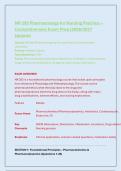
NR 293 Pharmacology for Nursing Practice –
Comprehensive Exam Prep (2026/2027
Update)
Course: NR 293 Pharmacology for Nursing Practice (Chamberlain
University)
Format: Multiple Choice
Total Questions: 100+
Focus: Pharmacokinetics/pharmacodynamics, antibiotics, cardiovascular
drugs, endocrine medications, GI agents, and nursing implications
EXAM OVERVIEW
NR 293 is a foundational pharmacology course that builds upon principles
from Anatomy & Physiology and Pathophysiology. The course covers
pharmacokinetics (what the body does to the drug) and
pharmacodynamics (what the drug does to the body), along with major
drug classifications, adverse effects, and nursing implications.
Feature Details
Pharmacokinetics/Pharmacodynamics, Antibiotics, Cardiovascular,
Focus Areas
Endocrine, GI
Key ADME (Absorption, Distribution, Metabolism, Excretion), Drug interacti
Concepts Nursing process
Emphasis Clinical application, scenario-based questions, medication safety
SECTION 1: Foundational Principles – Pharmacokinetics &
Pharmacodynamics (Questions 1-20)
,Q1. Which term describes what the BODY does to the drug?
• A) Pharmacodynamics
• B) Pharmacotherapeutics
• C) Pharmacokinetics
• D) Pharmacognosy
Answer: C – Pharmacokinetics is the study of what the body does to the
drug, including the processes of absorption, distribution, metabolism, and
excretion (ADME). Pharmacodynamics is what the drug does to the body.
Q2. Which term describes what the DRUG does to the body?
• A) Pharmacokinetics
• B) Pharmacodynamics
• C) Pharmacotherapeutics
• D) Pharmacognosy
Answer: B – Pharmacodynamics is the study of what the drug does to the
body—the biochemical and physiological effects of drugs and their
mechanisms of action.
Q3. The "first-pass effect" refers to:
• A) The drug being metabolized by the liver before reaching systemic
circulation
• B) The drug binding to plasma proteins
• C) The drug being excreted by the kidneys
• D) The drug crossing the blood-brain barrier
Answer: A – The first-pass effect refers to the metabolism of an oral drug by
the liver before it reaches systemic circulation, reducing bioavailability.
,Q4. Bioavailability is defined as:
• A) The time it takes for a drug to reach its maximum therapeutic
response
• B) The amount of the drug that is actually available after being
metabolized
• C) The time it takes for a drug to elicit a therapeutic response
• D) The time a drug concentration is sufficient to elicit a response
Answer: B – Bioavailability is the extent of drug absorption for a given drug
and route—the amount of active drug that reaches systemic circulation.
Q5. What is the term for the time it takes for a drug to reach its
maximum therapeutic response?
• A) Onset
• B) Duration
• C) Peak
• D) Half-life
Answer: C – Peak is the time it takes for a drug to reach its maximum
therapeutic response. Onset is the time to first response; duration is how
long the response lasts.
Q6. The time it takes for one-half of the original amount of a drug to
leave the body is called:
• A) Onset
• B) Peak
• C) Half-life
• D) Duration
, Answer: C – Half-life is the time required for the serum concentration of a
drug to decrease by 50%. It helps determine dosing intervals.
Q7. A drug that binds to a receptor and produces a response is called
a(n):
• A) Antagonist
• B) Agonist
• C) Enzyme
• D) Inhibitor
Answer: B – An agonist is a drug that binds to a receptor and produces a
response. An antagonist binds but produces no response.
Q8. Which route of administration has the FASTEST onset of action?
• A) Oral
• B) Subcutaneous
• C) Intramuscular
• D) Intravenous
Answer: D – IV administration delivers the drug directly into the
bloodstream, providing the fastest onset of action. Oral, IM, and SQ routes
require absorption.
Q9. A drug is highly protein-bound (95%). A second highly protein-
bound drug is added. What should the nurse monitor for?
• A) Decreased effect of the first drug
• B) Increased free drug levels and possible toxicity
• C) No significant interaction
• D) Increased renal excretion
Comprehensive Exam Prep (2026/2027
Update)
Course: NR 293 Pharmacology for Nursing Practice (Chamberlain
University)
Format: Multiple Choice
Total Questions: 100+
Focus: Pharmacokinetics/pharmacodynamics, antibiotics, cardiovascular
drugs, endocrine medications, GI agents, and nursing implications
EXAM OVERVIEW
NR 293 is a foundational pharmacology course that builds upon principles
from Anatomy & Physiology and Pathophysiology. The course covers
pharmacokinetics (what the body does to the drug) and
pharmacodynamics (what the drug does to the body), along with major
drug classifications, adverse effects, and nursing implications.
Feature Details
Pharmacokinetics/Pharmacodynamics, Antibiotics, Cardiovascular,
Focus Areas
Endocrine, GI
Key ADME (Absorption, Distribution, Metabolism, Excretion), Drug interacti
Concepts Nursing process
Emphasis Clinical application, scenario-based questions, medication safety
SECTION 1: Foundational Principles – Pharmacokinetics &
Pharmacodynamics (Questions 1-20)
,Q1. Which term describes what the BODY does to the drug?
• A) Pharmacodynamics
• B) Pharmacotherapeutics
• C) Pharmacokinetics
• D) Pharmacognosy
Answer: C – Pharmacokinetics is the study of what the body does to the
drug, including the processes of absorption, distribution, metabolism, and
excretion (ADME). Pharmacodynamics is what the drug does to the body.
Q2. Which term describes what the DRUG does to the body?
• A) Pharmacokinetics
• B) Pharmacodynamics
• C) Pharmacotherapeutics
• D) Pharmacognosy
Answer: B – Pharmacodynamics is the study of what the drug does to the
body—the biochemical and physiological effects of drugs and their
mechanisms of action.
Q3. The "first-pass effect" refers to:
• A) The drug being metabolized by the liver before reaching systemic
circulation
• B) The drug binding to plasma proteins
• C) The drug being excreted by the kidneys
• D) The drug crossing the blood-brain barrier
Answer: A – The first-pass effect refers to the metabolism of an oral drug by
the liver before it reaches systemic circulation, reducing bioavailability.
,Q4. Bioavailability is defined as:
• A) The time it takes for a drug to reach its maximum therapeutic
response
• B) The amount of the drug that is actually available after being
metabolized
• C) The time it takes for a drug to elicit a therapeutic response
• D) The time a drug concentration is sufficient to elicit a response
Answer: B – Bioavailability is the extent of drug absorption for a given drug
and route—the amount of active drug that reaches systemic circulation.
Q5. What is the term for the time it takes for a drug to reach its
maximum therapeutic response?
• A) Onset
• B) Duration
• C) Peak
• D) Half-life
Answer: C – Peak is the time it takes for a drug to reach its maximum
therapeutic response. Onset is the time to first response; duration is how
long the response lasts.
Q6. The time it takes for one-half of the original amount of a drug to
leave the body is called:
• A) Onset
• B) Peak
• C) Half-life
• D) Duration
, Answer: C – Half-life is the time required for the serum concentration of a
drug to decrease by 50%. It helps determine dosing intervals.
Q7. A drug that binds to a receptor and produces a response is called
a(n):
• A) Antagonist
• B) Agonist
• C) Enzyme
• D) Inhibitor
Answer: B – An agonist is a drug that binds to a receptor and produces a
response. An antagonist binds but produces no response.
Q8. Which route of administration has the FASTEST onset of action?
• A) Oral
• B) Subcutaneous
• C) Intramuscular
• D) Intravenous
Answer: D – IV administration delivers the drug directly into the
bloodstream, providing the fastest onset of action. Oral, IM, and SQ routes
require absorption.
Q9. A drug is highly protein-bound (95%). A second highly protein-
bound drug is added. What should the nurse monitor for?
• A) Decreased effect of the first drug
• B) Increased free drug levels and possible toxicity
• C) No significant interaction
• D) Increased renal excretion