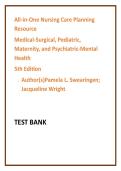
All-in-One Nursing Care Planning
Resource
Medical-Surgical, Pediatric,
Maternity, and Psychiatric-Mental
Health
5th Edition
• Author(s)Pamela L. Swearingen;
Jacqueline Wright
TEST BANK
,Cancer Care (Questions 1–10)
1) MCQ — Febrile Neutropenia
Clinical scenario:
A 61-year-old patient receiving myelosuppressive
chemotherapy for lymphoma reports chills and weakness. The
oral temperature is 38.4°C (101.1°F), heart rate is 110/min, and
the absolute neutrophil count from this morning is 420/mm³.
Question stem:
Which nursing action is the priority?
Answer options:
A. Encourage oral fluids and recheck temperature in 4 hours
B. Administer acetaminophen and document the fever
C. Notify the oncology provider and prepare for blood cultures
and IV broad-spectrum antibiotics
D. Place the patient on a low-stimulation diet and rest the
patient quietly
Correct answer:
C
Detailed rationale:
This patient has febrile neutropenia, a medical emergency
because infection can progress rapidly without a normal
inflammatory response. The nurse should escalate care
,immediately, anticipate blood cultures, and prepare for
prompt IV antibiotics.
Incorrect option analysis:
• A: Incorrect. Delaying care is unsafe in neutropenia. Fever
may be the only sign of serious infection.
• B: Incorrect. Acetaminophen may mask fever and delay
treatment. Treating the symptom without evaluation is
unsafe.
• D: Incorrect. Rest is supportive but not priority. This
reflects the misconception that fever in cancer treatment
is “expected.”
Nursing process link: Implementation
NCJMM competencies: Recognize Cues, Prioritize Hypotheses,
Take Action
Difficulty: Moderate
Bloom’s level: Apply
NCLEX client needs: Safety and Infection Control; Physiological
Adaptation
Nursing diagnosis focus: Risk for infection / Infection
Expected patient outcome: The patient will receive cultures
and antibiotics within the facility protocol timeframe and
remain hemodynamically stable.
Key learning objective: Prioritize urgent response to suspected
infection in immunocompromised patients.
, 2) SATA — Chemotherapy Nausea and Nutrition
Clinical scenario:
A patient receiving outpatient chemotherapy reports nausea
that is worst in the morning and says, “Food smells make it
worse.”
Question stem:
Which teaching points should the nurse include? Select all that
apply.
Answer options:
A. Eat small, frequent meals
B. Take the antiemetic before nausea becomes severe
C. Avoid greasy or strongly scented foods
D. Drink large amounts of fluid with meals
E. Keep crackers or dry toast by the bedside
F. Skip all meals until nausea stops
Correct answers:
A, B, C, E
Detailed rationale:
Small meals, prophylactic antiemetics, avoiding triggers, and dry
bland foods help reduce nausea and support intake. This is
consistent with symptom management and nutrition
preservation during chemotherapy.
Resource
Medical-Surgical, Pediatric,
Maternity, and Psychiatric-Mental
Health
5th Edition
• Author(s)Pamela L. Swearingen;
Jacqueline Wright
TEST BANK
,Cancer Care (Questions 1–10)
1) MCQ — Febrile Neutropenia
Clinical scenario:
A 61-year-old patient receiving myelosuppressive
chemotherapy for lymphoma reports chills and weakness. The
oral temperature is 38.4°C (101.1°F), heart rate is 110/min, and
the absolute neutrophil count from this morning is 420/mm³.
Question stem:
Which nursing action is the priority?
Answer options:
A. Encourage oral fluids and recheck temperature in 4 hours
B. Administer acetaminophen and document the fever
C. Notify the oncology provider and prepare for blood cultures
and IV broad-spectrum antibiotics
D. Place the patient on a low-stimulation diet and rest the
patient quietly
Correct answer:
C
Detailed rationale:
This patient has febrile neutropenia, a medical emergency
because infection can progress rapidly without a normal
inflammatory response. The nurse should escalate care
,immediately, anticipate blood cultures, and prepare for
prompt IV antibiotics.
Incorrect option analysis:
• A: Incorrect. Delaying care is unsafe in neutropenia. Fever
may be the only sign of serious infection.
• B: Incorrect. Acetaminophen may mask fever and delay
treatment. Treating the symptom without evaluation is
unsafe.
• D: Incorrect. Rest is supportive but not priority. This
reflects the misconception that fever in cancer treatment
is “expected.”
Nursing process link: Implementation
NCJMM competencies: Recognize Cues, Prioritize Hypotheses,
Take Action
Difficulty: Moderate
Bloom’s level: Apply
NCLEX client needs: Safety and Infection Control; Physiological
Adaptation
Nursing diagnosis focus: Risk for infection / Infection
Expected patient outcome: The patient will receive cultures
and antibiotics within the facility protocol timeframe and
remain hemodynamically stable.
Key learning objective: Prioritize urgent response to suspected
infection in immunocompromised patients.
, 2) SATA — Chemotherapy Nausea and Nutrition
Clinical scenario:
A patient receiving outpatient chemotherapy reports nausea
that is worst in the morning and says, “Food smells make it
worse.”
Question stem:
Which teaching points should the nurse include? Select all that
apply.
Answer options:
A. Eat small, frequent meals
B. Take the antiemetic before nausea becomes severe
C. Avoid greasy or strongly scented foods
D. Drink large amounts of fluid with meals
E. Keep crackers or dry toast by the bedside
F. Skip all meals until nausea stops
Correct answers:
A, B, C, E
Detailed rationale:
Small meals, prophylactic antiemetics, avoiding triggers, and dry
bland foods help reduce nausea and support intake. This is
consistent with symptom management and nutrition
preservation during chemotherapy.