
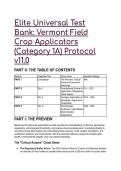
Elite Universal Test
Bank: Vermont Field
Crop Applicators
(Category 1A) Protocol
v11.0
PART 0: THE TABLE OF CONTENTS
Section Cognitive Tier Focus Area Question Range
PART I Conceptual The Preview: Critical N/A
Axioms & Executive
Directives
PART II Tier 1 Foundational Syntax & Q1 – Q12
Application: Regulatory
"Hard Decks"
PART II Tier 2 Complex Application & Q13 – Q24
Simulation: Agronomic
Thresholds
PART II Tier 3 Grandmaster Q25 – Q35
Synthesis: High-Stakes
Multi-Variable
Diagnostics
PART I: THE PREVIEW
Mastering this test bank guarantees an elite operational understanding of Vermont agricultural
regulations, entomological thresholds, and precise chemical deployment, translating directly to
uncompromising field mastery. By internalizing these rigorous, multi-variable simulations, the
practitioner replaces rote memorization with the analytical reflexes required to protect public
health, environmental integrity, and crop yields seamlessly.
The "Critical Axioms" Cheat Sheet
● The Regulatory Buffer Axiom: The 2023 Vermont Rule for Control of Pesticides dictates
an absolute 50-foot buffer for potable water sources and a 200-foot buffer for public water
, intakes. These supersede label instructions unless the label demands a greater distance.
● The Required Agricultural Practices (RAP) Axiom: Under Vermont's RAPs, adjacent
surface waters and open inlets require a 25-foot perennial vegetation buffer from
croplands. Ditches require a 10-foot buffer. Mechanical manure application within these
zones is strictly prohibited.
● The Calibration Axiom: Accurate sprayer output demands the universal equation: GPM
= (GPA × MPH × W) / 5940, where W is the nozzle spacing in inches.
● The Worker Protection Standard (WPS) Axiom: Early-entry workers and pesticide
handlers must be at least 18 years old. For pesticides designated as "Danger-Poison"
(skull and crossbones), the employer must monitor the handler via sight or voice every
two hours.
● The Record Retention Axiom: Certified Commercial, Non-commercial, and Class A
Dealers must retain exhaustive operational and transaction records for a minimum of
three years.
Elite Agronomic Thresholds (Category 1A)
Target Pest Host Crop Scouting Economic Action Citation
Methodology Threshold
Potato Alfalfa 15-inch Sweep Net 0.2/sweep (3"
Leafhopper (100 sweeps) plant), 0.5/sweep
(6" plant),
1.0/sweep (8-11"
plant), 2.0/sweep
(>12" plant)
Alfalfa Weevil Alfalfa 180-degree Sweep Average of 20
Net larvae per sweep
Western Corn Field Corn Direct Visual Plant 0.75 beetles per
Rootworm Count plant (indicates
need for rotation
next season)
Western Corn Field Corn Node-Injury Score NIS > 0.25
Rootworm (NIS) indicates
economic injury
has occurred
True Armyworm Field Corn Visual Inspection 25% of plants
(Late Spring) damaged AND
larvae currently
present
PART II: THE ELITE TEST BANK
Tier 1: Foundational Syntax & Application
Q1: A certified commercial applicator is preparing to apply a Class A herbicide to a field crop
bordering a residential zone. The product label specifies a 25-foot buffer from any drinking water
well. Based on the 2023 Vermont Rule for Control of Pesticides, which action is the MOST
ACCURATE? A) Adhere strictly to the 25-foot label buffer, as federal label requirements legally
, supersede state regulations. B) Establish a 200-foot buffer because the adjacent well is located
on a residential property. C) Maintain a minimum 50-foot buffer from the potable water source,
as state law requires a larger buffer than the label. D) Maintain a 25-foot buffer but utilize
low-drift nozzles and an anti-siphoning device during mixing.
● The Answer: C (Maintain a minimum 50-foot buffer from the potable water source, as
state law requires a larger buffer than the label.)
● Distractor Analysis:
○ A is incorrect: While the label is the law, the 2023 Vermont Rule mandates a 50-foot
minimum buffer for potable water sources unless the label requires a greater
distance. State law can be more restrictive than federal labels.
○ B is incorrect: A 200-foot buffer is specifically required for public community drinking
water sources and surface water public non-community intakes, not a standard
private potable well.
○ D is incorrect: While anti-siphoning devices are required by operational standards ,
mitigating drift does not bypass the strict, statutory 50-foot physical buffer
requirement.
The Mentor's Analysis: The fundamental hierarchy of pesticide law dictates that an applicator
must follow the most restrictive regulation available. When facing buffer zone conflicts, the
immediate priority is identifying whether the state has instituted a stricter baseline. By utilizing
Section 5.02(m) of the 2023 Rule, you bypass the common trap of assuming federal labels act
as the ultimate ceiling of restriction. Professional/Academic Intuition: Always default to the
most restrictive physical distance; in Vermont, the "Hard Deck" for any potable water well
is 50 feet.
Q2: Following an application of a restricted-use pesticide (Class A), a commercial applicator
files their daily operational records. To comply with the amended 2023 Vermont pesticide
regulations, how long MUST these specific operational records be retained by the applicator? A)
One year B) Two years C) Three years D) Five years
● The Answer: C (Three years)
● Distractor Analysis:
○ A is incorrect: One year is the waiting period for retaking an exam after a third
failure , not a record-keeping standard.
○ B is incorrect: Two years is the legacy standard prior to the 2023 amendments, and
remains the standard for the federal EPA Worker Protection Standard (WPS)
training records. It is no longer valid for Vermont commercial application records.
○ D is incorrect: Five years is the validity period for the pesticide certification license
itself and organic farm traceability records , not the standard operational record
retention period for conventional pesticides.
The Mentor's Analysis: Regulatory compliance relies heavily on creating an auditable forensic
history. When facing a record-keeping audit, the immediate priority is ensuring all application
data spans the legally required timeframe. By utilizing the three-year retention mandate, you
bypass the common trap of relying on outdated legacy rules (the former two-year rule).
Professional/Academic Intuition: The 2023 amendment synchronized commercial,
non-commercial, and Class A dealer record retention to a strict three-year minimum.
Q3: A farm manager intends to hire a new employee to mix, load, and apply pesticides on an
agricultural establishment. Under the federal Worker Protection Standard (WPS), what is the
absolute MINIMUM age requirement for this non-family pesticide handler? A) 16 years old,
provided they work under the direct supervision of a certified family member. B) 18 years old,
with no exceptions for non-family employees. C) 21 years old, if handling restricted-use (Class
Bank: Vermont Field
Crop Applicators
(Category 1A) Protocol
v11.0
PART 0: THE TABLE OF CONTENTS
Section Cognitive Tier Focus Area Question Range
PART I Conceptual The Preview: Critical N/A
Axioms & Executive
Directives
PART II Tier 1 Foundational Syntax & Q1 – Q12
Application: Regulatory
"Hard Decks"
PART II Tier 2 Complex Application & Q13 – Q24
Simulation: Agronomic
Thresholds
PART II Tier 3 Grandmaster Q25 – Q35
Synthesis: High-Stakes
Multi-Variable
Diagnostics
PART I: THE PREVIEW
Mastering this test bank guarantees an elite operational understanding of Vermont agricultural
regulations, entomological thresholds, and precise chemical deployment, translating directly to
uncompromising field mastery. By internalizing these rigorous, multi-variable simulations, the
practitioner replaces rote memorization with the analytical reflexes required to protect public
health, environmental integrity, and crop yields seamlessly.
The "Critical Axioms" Cheat Sheet
● The Regulatory Buffer Axiom: The 2023 Vermont Rule for Control of Pesticides dictates
an absolute 50-foot buffer for potable water sources and a 200-foot buffer for public water
, intakes. These supersede label instructions unless the label demands a greater distance.
● The Required Agricultural Practices (RAP) Axiom: Under Vermont's RAPs, adjacent
surface waters and open inlets require a 25-foot perennial vegetation buffer from
croplands. Ditches require a 10-foot buffer. Mechanical manure application within these
zones is strictly prohibited.
● The Calibration Axiom: Accurate sprayer output demands the universal equation: GPM
= (GPA × MPH × W) / 5940, where W is the nozzle spacing in inches.
● The Worker Protection Standard (WPS) Axiom: Early-entry workers and pesticide
handlers must be at least 18 years old. For pesticides designated as "Danger-Poison"
(skull and crossbones), the employer must monitor the handler via sight or voice every
two hours.
● The Record Retention Axiom: Certified Commercial, Non-commercial, and Class A
Dealers must retain exhaustive operational and transaction records for a minimum of
three years.
Elite Agronomic Thresholds (Category 1A)
Target Pest Host Crop Scouting Economic Action Citation
Methodology Threshold
Potato Alfalfa 15-inch Sweep Net 0.2/sweep (3"
Leafhopper (100 sweeps) plant), 0.5/sweep
(6" plant),
1.0/sweep (8-11"
plant), 2.0/sweep
(>12" plant)
Alfalfa Weevil Alfalfa 180-degree Sweep Average of 20
Net larvae per sweep
Western Corn Field Corn Direct Visual Plant 0.75 beetles per
Rootworm Count plant (indicates
need for rotation
next season)
Western Corn Field Corn Node-Injury Score NIS > 0.25
Rootworm (NIS) indicates
economic injury
has occurred
True Armyworm Field Corn Visual Inspection 25% of plants
(Late Spring) damaged AND
larvae currently
present
PART II: THE ELITE TEST BANK
Tier 1: Foundational Syntax & Application
Q1: A certified commercial applicator is preparing to apply a Class A herbicide to a field crop
bordering a residential zone. The product label specifies a 25-foot buffer from any drinking water
well. Based on the 2023 Vermont Rule for Control of Pesticides, which action is the MOST
ACCURATE? A) Adhere strictly to the 25-foot label buffer, as federal label requirements legally
, supersede state regulations. B) Establish a 200-foot buffer because the adjacent well is located
on a residential property. C) Maintain a minimum 50-foot buffer from the potable water source,
as state law requires a larger buffer than the label. D) Maintain a 25-foot buffer but utilize
low-drift nozzles and an anti-siphoning device during mixing.
● The Answer: C (Maintain a minimum 50-foot buffer from the potable water source, as
state law requires a larger buffer than the label.)
● Distractor Analysis:
○ A is incorrect: While the label is the law, the 2023 Vermont Rule mandates a 50-foot
minimum buffer for potable water sources unless the label requires a greater
distance. State law can be more restrictive than federal labels.
○ B is incorrect: A 200-foot buffer is specifically required for public community drinking
water sources and surface water public non-community intakes, not a standard
private potable well.
○ D is incorrect: While anti-siphoning devices are required by operational standards ,
mitigating drift does not bypass the strict, statutory 50-foot physical buffer
requirement.
The Mentor's Analysis: The fundamental hierarchy of pesticide law dictates that an applicator
must follow the most restrictive regulation available. When facing buffer zone conflicts, the
immediate priority is identifying whether the state has instituted a stricter baseline. By utilizing
Section 5.02(m) of the 2023 Rule, you bypass the common trap of assuming federal labels act
as the ultimate ceiling of restriction. Professional/Academic Intuition: Always default to the
most restrictive physical distance; in Vermont, the "Hard Deck" for any potable water well
is 50 feet.
Q2: Following an application of a restricted-use pesticide (Class A), a commercial applicator
files their daily operational records. To comply with the amended 2023 Vermont pesticide
regulations, how long MUST these specific operational records be retained by the applicator? A)
One year B) Two years C) Three years D) Five years
● The Answer: C (Three years)
● Distractor Analysis:
○ A is incorrect: One year is the waiting period for retaking an exam after a third
failure , not a record-keeping standard.
○ B is incorrect: Two years is the legacy standard prior to the 2023 amendments, and
remains the standard for the federal EPA Worker Protection Standard (WPS)
training records. It is no longer valid for Vermont commercial application records.
○ D is incorrect: Five years is the validity period for the pesticide certification license
itself and organic farm traceability records , not the standard operational record
retention period for conventional pesticides.
The Mentor's Analysis: Regulatory compliance relies heavily on creating an auditable forensic
history. When facing a record-keeping audit, the immediate priority is ensuring all application
data spans the legally required timeframe. By utilizing the three-year retention mandate, you
bypass the common trap of relying on outdated legacy rules (the former two-year rule).
Professional/Academic Intuition: The 2023 amendment synchronized commercial,
non-commercial, and Class A dealer record retention to a strict three-year minimum.
Q3: A farm manager intends to hire a new employee to mix, load, and apply pesticides on an
agricultural establishment. Under the federal Worker Protection Standard (WPS), what is the
absolute MINIMUM age requirement for this non-family pesticide handler? A) 16 years old,
provided they work under the direct supervision of a certified family member. B) 18 years old,
with no exceptions for non-family employees. C) 21 years old, if handling restricted-use (Class


