
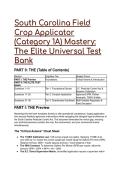
South Carolina Field
Crop Applicator
(Category 1A) Mastery:
The Elite Universal Test
Bank
PART 0: THE (Table of Contents)
Section Cognitive Tier Subject Focus
PART I: THE Preview Foundations Critical Axioms & Introduction
PART II: THE ELITE TEST
BANK
Questions 1–10 Tier 1: Foundational Syntax S.C. Pesticide Control Act &
Baseline Calibration
Questions 11–20 Tier 2: Complex Application Agronomic IPM, Palmer
Amaranth, TSWV & Math
Questions 21–30 Tier 3: Grandmaster Synthesis Multi-Variable Regulatory &
Field Simulation
PART I: THE Preview
Mastering this test bank translates directly to elite operational competence, forging applicators
who execute flawless agronomic interventions while navigating the stringent legal architecture of
the South Carolina Pesticide Control Act. This document eliminates the novice gap, ensuring
your technical precision protects the crop, the environment, and your commercial license
simultaneously.
The "Critical Axioms" Cheat Sheet
● The 1/128th Calibration Law: 128 ounces equals one gallon. Spraying 1/128th of an
acre (340 sq. ft.) means the ounces caught per nozzle equal the Gallons Per Acre (GPA).
Distance formula: 4080 ÷ nozzle spacing (inches) = travel distance in feet.
● The 5940 Constant: To determine Gallons Per Minute (GPM) per nozzle, utilize the
formula: GPM = (GPA × MPH × W) ÷ 5940.
● The S.C. Direct Supervision Matrix: Uncertified applicators require a supervisor within
, 30 miles for Restricted Use Pesticides (RUPs) , 60 miles for Danger or Warning labels ,
and 100 miles for Caution labels.
● The Liability & Record Mandate: Category 1A Commercial Applicators must maintain
$25,000 in property/public liability insurance and preserve application records for exactly
two years.
● The Elite Agronomic Thresholds: Palmer Amaranth requires shading via high-biomass
cover crops (cereal rye) due to Group 2, 3, and 9 resistance. Tomato Spotted Wilt Virus
(TSWV) is vectored by thrips and mitigated by avoiding April planting dates and utilizing
in-furrow phorate.
PART II: THE ELITE TEST BANK
Q1: A nineteen-year-old farmhand in South Carolina is seeking a Commercial Pesticide
Applicator License for Category 1A to spray neighbors' fields for compensation. Based on the
principles of the South Carolina Pesticide Control Act, which conclusion regarding his eligibility
is MOST ACCURATE? A) He is ineligible because commercial applicators must be at least 21
years old to apply pesticides for compensation on the property of another. B) He is eligible to
apply for a Private Applicator License only, as Category 1A is restricted to government and
university extension personnel. C) He is eligible to test for a Commercial Applicator License, as
the minimum age requirement is 18, provided he passes the Core and Category 1A exams and
demonstrates financial responsibility. D) He is eligible to apply immediately but must operate
under the direct supervision of a licensed applicator within a 10-mile radius for the first two
years.
● The Answer: C (He is eligible to test for a Commercial Applicator License, as the
minimum age requirement is 18, provided he passes the Core and Category 1A exams
and demonstrates financial responsibility.)
● Distractor Analysis:
○ A is incorrect: The South Carolina Department of Pesticide Regulation (DPR)
mandates a minimum age of 18, not 21, for commercial licensure.
○ B is incorrect: Category 1A (Agricultural Plant Pest Control) is the exact commercial
category designed for those applying restricted use pesticides to agricultural crops
for hire. It is not restricted to non-commercial or government personnel.
○ D is incorrect: There is no probationary 10-mile radius rule for newly licensed
commercial applicators under South Carolina regulation. Once licensed and
insured, he operates independently.
The Mentor's Analysis: The threshold for entering the commercial pesticide arena is firmly set
at 18 years of age. When establishing a commercial enterprise, the immediate priority is
securing the proper categorical license (Category 1A) and proving financial responsibility,
entirely separating the applicator from Private status (which only covers one’s own land). By
utilizing Commercial Certification, you bypass the common trap of operating illegally for
compensation. Professional/Academic Intuition: A commercial license is triggered by
compensation on another's land; 18 is the legal age of entry.
Q2: A licensed commercial applicator in South Carolina delegates the application of a
Restricted Use Pesticide (RUP) to an uncertified handler. Based on the principles of Direct
Supervision governed by Clemson University DPR, which parameter is NON-NEGOTIABLE? A)
The supervising licensed applicator must remain within a 60-mile radius by ordinary ground
transportation. B) The supervising licensed applicator must be physically present on the
, application site for the entire duration of the spray event. C) The supervising licensed applicator
must be within 30 miles by ordinary ground transportation and immediately accessible by
telephone or radio. D) The supervising licensed applicator must ensure the uncertified handler
carries a provisional Category 1A certificate.
● The Answer: C (The supervising licensed applicator must be within 30 miles by ordinary
ground transportation and immediately accessible by telephone or radio.)
● Distractor Analysis:
○ A is incorrect: The 60-mile radius applies specifically to unclassified or general-use
pesticides bearing the signal words Danger or Warning, not RUPs.
○ B is incorrect: Physical on-site presence is only required if explicitly stated on the
specific pesticide product label; state law defaults to the mileage radius.
○ D is incorrect: South Carolina does not issue "provisional" Category 1A certificates
for uncertified handlers under the state regulatory framework.
The Mentor's Analysis: Supervision distances are aggressively tiered based on the regulatory
status and acute toxicity of the chemical. When facing an RUP application, the immediate
priority is proximity and communication. By utilizing the 30-mile standard, you bypass the
common trap of defaulting to the more lenient 60-mile or 100-mile rules reserved for
general-use chemicals. Professional/Academic Intuition: Restricted Use Pesticides
demand a 30-mile tether; Danger/Warning demands 60; Caution demands 100.
Q3: An agricultural pest control firm (Category 1A) operates a fleet of sprayers across three
counties. To maintain compliance with the South Carolina Pesticide Control Act, what is the
MINIMUM level of financial responsibility the business must actively maintain? A) $100,000
combined single limit liability coverage, including both bodily injury and property damage. B)
$50,000 general liability with an annual aggregate claims limit of not less than $100,000. C)
$25,000 minimum general liability coverage for property damage and public liability. D) A
$10,000 surety bond filed directly with the State Crop Pest Commission.
● The Answer: C ($25,000 minimum general liability coverage for property damage and
public liability.)
● Distractor Analysis:
○ A is incorrect: The $100,000 combined single limit is strictly mandated for Category
7 applicators (Industrial, Institutional, Structural), not field crop applicators.
○ B is incorrect: The $50,000 minimum applies uniquely to Categories 3, 5, and 8
(Ornamental/Turf, Aquatic, Public Health).
○ D is incorrect: While surety bonds can serve as financial responsibility, the statutory
minimum for a Category 1A commercial applicator is $25,000, rendering $10,000
grossly insufficient.
The Mentor's Analysis: Financial responsibility shields both the public and the applicator from
catastrophic financial ruin following chemical drift or misapplication. When establishing a
Category 1A operation, the immediate priority is securing the baseline general liability
insurance. By utilizing the $25,000 statutory minimum, you bypass the common novice trap of
over-insuring to Category 7 structural standards or under-insuring below legal limits.
Professional/Academic Intuition: Agricultural plant control (1A) requires a $25,000 shield;
structural control requires four times that amount.
Q4: A commercial applicator successfully completes an application of an RUP on a client's
soybean field. Based on the principles of South Carolina pesticide recordkeeping, how long
MUST these specific application records be maintained and readily available for DPR
inspection? A) One year from the date of the chemical purchase. B) Two years from the exact
date of the application. C) Three years from the end of the calendar year in which the crop was
Crop Applicator
(Category 1A) Mastery:
The Elite Universal Test
Bank
PART 0: THE (Table of Contents)
Section Cognitive Tier Subject Focus
PART I: THE Preview Foundations Critical Axioms & Introduction
PART II: THE ELITE TEST
BANK
Questions 1–10 Tier 1: Foundational Syntax S.C. Pesticide Control Act &
Baseline Calibration
Questions 11–20 Tier 2: Complex Application Agronomic IPM, Palmer
Amaranth, TSWV & Math
Questions 21–30 Tier 3: Grandmaster Synthesis Multi-Variable Regulatory &
Field Simulation
PART I: THE Preview
Mastering this test bank translates directly to elite operational competence, forging applicators
who execute flawless agronomic interventions while navigating the stringent legal architecture of
the South Carolina Pesticide Control Act. This document eliminates the novice gap, ensuring
your technical precision protects the crop, the environment, and your commercial license
simultaneously.
The "Critical Axioms" Cheat Sheet
● The 1/128th Calibration Law: 128 ounces equals one gallon. Spraying 1/128th of an
acre (340 sq. ft.) means the ounces caught per nozzle equal the Gallons Per Acre (GPA).
Distance formula: 4080 ÷ nozzle spacing (inches) = travel distance in feet.
● The 5940 Constant: To determine Gallons Per Minute (GPM) per nozzle, utilize the
formula: GPM = (GPA × MPH × W) ÷ 5940.
● The S.C. Direct Supervision Matrix: Uncertified applicators require a supervisor within
, 30 miles for Restricted Use Pesticides (RUPs) , 60 miles for Danger or Warning labels ,
and 100 miles for Caution labels.
● The Liability & Record Mandate: Category 1A Commercial Applicators must maintain
$25,000 in property/public liability insurance and preserve application records for exactly
two years.
● The Elite Agronomic Thresholds: Palmer Amaranth requires shading via high-biomass
cover crops (cereal rye) due to Group 2, 3, and 9 resistance. Tomato Spotted Wilt Virus
(TSWV) is vectored by thrips and mitigated by avoiding April planting dates and utilizing
in-furrow phorate.
PART II: THE ELITE TEST BANK
Q1: A nineteen-year-old farmhand in South Carolina is seeking a Commercial Pesticide
Applicator License for Category 1A to spray neighbors' fields for compensation. Based on the
principles of the South Carolina Pesticide Control Act, which conclusion regarding his eligibility
is MOST ACCURATE? A) He is ineligible because commercial applicators must be at least 21
years old to apply pesticides for compensation on the property of another. B) He is eligible to
apply for a Private Applicator License only, as Category 1A is restricted to government and
university extension personnel. C) He is eligible to test for a Commercial Applicator License, as
the minimum age requirement is 18, provided he passes the Core and Category 1A exams and
demonstrates financial responsibility. D) He is eligible to apply immediately but must operate
under the direct supervision of a licensed applicator within a 10-mile radius for the first two
years.
● The Answer: C (He is eligible to test for a Commercial Applicator License, as the
minimum age requirement is 18, provided he passes the Core and Category 1A exams
and demonstrates financial responsibility.)
● Distractor Analysis:
○ A is incorrect: The South Carolina Department of Pesticide Regulation (DPR)
mandates a minimum age of 18, not 21, for commercial licensure.
○ B is incorrect: Category 1A (Agricultural Plant Pest Control) is the exact commercial
category designed for those applying restricted use pesticides to agricultural crops
for hire. It is not restricted to non-commercial or government personnel.
○ D is incorrect: There is no probationary 10-mile radius rule for newly licensed
commercial applicators under South Carolina regulation. Once licensed and
insured, he operates independently.
The Mentor's Analysis: The threshold for entering the commercial pesticide arena is firmly set
at 18 years of age. When establishing a commercial enterprise, the immediate priority is
securing the proper categorical license (Category 1A) and proving financial responsibility,
entirely separating the applicator from Private status (which only covers one’s own land). By
utilizing Commercial Certification, you bypass the common trap of operating illegally for
compensation. Professional/Academic Intuition: A commercial license is triggered by
compensation on another's land; 18 is the legal age of entry.
Q2: A licensed commercial applicator in South Carolina delegates the application of a
Restricted Use Pesticide (RUP) to an uncertified handler. Based on the principles of Direct
Supervision governed by Clemson University DPR, which parameter is NON-NEGOTIABLE? A)
The supervising licensed applicator must remain within a 60-mile radius by ordinary ground
transportation. B) The supervising licensed applicator must be physically present on the
, application site for the entire duration of the spray event. C) The supervising licensed applicator
must be within 30 miles by ordinary ground transportation and immediately accessible by
telephone or radio. D) The supervising licensed applicator must ensure the uncertified handler
carries a provisional Category 1A certificate.
● The Answer: C (The supervising licensed applicator must be within 30 miles by ordinary
ground transportation and immediately accessible by telephone or radio.)
● Distractor Analysis:
○ A is incorrect: The 60-mile radius applies specifically to unclassified or general-use
pesticides bearing the signal words Danger or Warning, not RUPs.
○ B is incorrect: Physical on-site presence is only required if explicitly stated on the
specific pesticide product label; state law defaults to the mileage radius.
○ D is incorrect: South Carolina does not issue "provisional" Category 1A certificates
for uncertified handlers under the state regulatory framework.
The Mentor's Analysis: Supervision distances are aggressively tiered based on the regulatory
status and acute toxicity of the chemical. When facing an RUP application, the immediate
priority is proximity and communication. By utilizing the 30-mile standard, you bypass the
common trap of defaulting to the more lenient 60-mile or 100-mile rules reserved for
general-use chemicals. Professional/Academic Intuition: Restricted Use Pesticides
demand a 30-mile tether; Danger/Warning demands 60; Caution demands 100.
Q3: An agricultural pest control firm (Category 1A) operates a fleet of sprayers across three
counties. To maintain compliance with the South Carolina Pesticide Control Act, what is the
MINIMUM level of financial responsibility the business must actively maintain? A) $100,000
combined single limit liability coverage, including both bodily injury and property damage. B)
$50,000 general liability with an annual aggregate claims limit of not less than $100,000. C)
$25,000 minimum general liability coverage for property damage and public liability. D) A
$10,000 surety bond filed directly with the State Crop Pest Commission.
● The Answer: C ($25,000 minimum general liability coverage for property damage and
public liability.)
● Distractor Analysis:
○ A is incorrect: The $100,000 combined single limit is strictly mandated for Category
7 applicators (Industrial, Institutional, Structural), not field crop applicators.
○ B is incorrect: The $50,000 minimum applies uniquely to Categories 3, 5, and 8
(Ornamental/Turf, Aquatic, Public Health).
○ D is incorrect: While surety bonds can serve as financial responsibility, the statutory
minimum for a Category 1A commercial applicator is $25,000, rendering $10,000
grossly insufficient.
The Mentor's Analysis: Financial responsibility shields both the public and the applicator from
catastrophic financial ruin following chemical drift or misapplication. When establishing a
Category 1A operation, the immediate priority is securing the baseline general liability
insurance. By utilizing the $25,000 statutory minimum, you bypass the common novice trap of
over-insuring to Category 7 structural standards or under-insuring below legal limits.
Professional/Academic Intuition: Agricultural plant control (1A) requires a $25,000 shield;
structural control requires four times that amount.
Q4: A commercial applicator successfully completes an application of an RUP on a client's
soybean field. Based on the principles of South Carolina pesticide recordkeeping, how long
MUST these specific application records be maintained and readily available for DPR
inspection? A) One year from the date of the chemical purchase. B) Two years from the exact
date of the application. C) Three years from the end of the calendar year in which the crop was


