

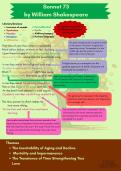
Sonnet 73
by William Shakespeare
Literary Devices
Inversion of sounds Personification the speaker is assumed to
Simile be talking to an unnamed
Symbolism
younger person,
Paradox Auditory Imagery
Metaphor Archaic language
Alliteration
The poet metaphorically compares himself
That time of year thou mayst in me behold to the season of Autumn. It signals the
impending winter. The speaker is in late
When yellow leaves, or none, or few, do hang
middle age like the season of autumn.
Upon those boughs which shake against the cold, Age is like a time of the year.
Bare ruin’d choirs where late the sweet birds sang.
Twilight serves as a metaphor for the
In me thou see’st the twilight of such day
gradual approach of death. Everyone will
As after sunset fadeth in the west,
eventually be sealed by it.
Which by and by black night doth take away,
Death’s second self, that seals up all in rest. Night is personified, and "Sleep" is defined as
"Death's second self" because it temporarily
In me thou see’st the glowing of such fire rests and quietens everyone just as death does
permanently.
That on the ashes of his youth doth lie, jjjjjjj
As the death-bed whereon it must expire,
Consum’d with that which it was nourish’d by.
The glowing fire represents the lingering
emotions, passions, desires, and happiness
This thou perceiv’st which makes thy of a younger self.
love more strong,
To love that well which thou must leave Fire consumes and fire is consumed. Life is
ere long. consumed by the same intense passions
and energy that originally sustained and
nourished it in youth.
The couplet establishes the profound paradox that
impending loss strengthens attachment.speaker states
that knowing they must part "ere long" forces the youth
to value and cherish the remaining time even more
fiercely
Themes
The Inevitability of Aging and Decline
Mortality and Impermanence
The Transience of Time Strengthening True
VINDY
Love
CREATIONS
by William Shakespeare
Literary Devices
Inversion of sounds Personification the speaker is assumed to
Simile be talking to an unnamed
Symbolism
younger person,
Paradox Auditory Imagery
Metaphor Archaic language
Alliteration
The poet metaphorically compares himself
That time of year thou mayst in me behold to the season of Autumn. It signals the
impending winter. The speaker is in late
When yellow leaves, or none, or few, do hang
middle age like the season of autumn.
Upon those boughs which shake against the cold, Age is like a time of the year.
Bare ruin’d choirs where late the sweet birds sang.
Twilight serves as a metaphor for the
In me thou see’st the twilight of such day
gradual approach of death. Everyone will
As after sunset fadeth in the west,
eventually be sealed by it.
Which by and by black night doth take away,
Death’s second self, that seals up all in rest. Night is personified, and "Sleep" is defined as
"Death's second self" because it temporarily
In me thou see’st the glowing of such fire rests and quietens everyone just as death does
permanently.
That on the ashes of his youth doth lie, jjjjjjj
As the death-bed whereon it must expire,
Consum’d with that which it was nourish’d by.
The glowing fire represents the lingering
emotions, passions, desires, and happiness
This thou perceiv’st which makes thy of a younger self.
love more strong,
To love that well which thou must leave Fire consumes and fire is consumed. Life is
ere long. consumed by the same intense passions
and energy that originally sustained and
nourished it in youth.
The couplet establishes the profound paradox that
impending loss strengthens attachment.speaker states
that knowing they must part "ere long" forces the youth
to value and cherish the remaining time even more
fiercely
Themes
The Inevitability of Aging and Decline
Mortality and Impermanence
The Transience of Time Strengthening True
VINDY
Love
CREATIONS


