
North Carolina Field
Crop Applicators Test:
Elite Universal Test Bank
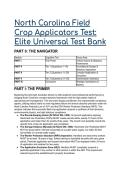
PART 0: THE NAVIGATOR
Section Cognitive Tier Focus Area
PART I The Primer Critical Axioms & Statutory
Frameworks
PART II Tier 1 (Questions 1–10) Foundational Syntax &
Statutory Application
PART II Tier 2 (Questions 11–20) Complex Application &
Simulation
PART II Tier 3 (Questions 21–30) Grandmaster Synthesis
PART III Conclusion Strategic Implications &
Mastery
PART I: THE PRIMER
Mastering this test bank translates directly to elite academic and professional performance by
bridging North Carolina's complex statutory frameworks with the high-stakes reality of
agricultural pest management. This document forges practitioners into impenetrable compliance
agents, utilizing radical clarity to avert regulatory failure and ensure absolute precision under the
North Carolina Pesticide Law of 1971 and the EPA Worker Protection Standard (WPS). The
analysis indicates that successful field crop application requires a synthesis of fluid dynamics,
environmental physics, and rigid statutory compliance.
● The Record-Keeping Axiom (02 NCAC 09L.1402): All ground applicators applying
Restricted Use Pesticides (RUPs) MUST create records within exactly 72 hours of the
application and retain them for exactly three years. The record must explicitly include the
specific time of day the application was completed.
● The Storage Distance Mandate (02 NCAC 09L.1905): Restricted Use Pesticides MUST
NOT be stored within 100 feet horizontally of a public water supply, nor within 50 feet
horizontally of a private water supply.
● The Worker Protection Standard (WPS) Imperative: Handlers and early-entry workers
MUST be at least 18 years of age. Safety training is mandated annually with zero grace
period. Pesticide application and hazard information MUST be displayed within 24 hours
of application and retained for two years.
● The Application Exclusion Zone (AEZ): Handlers MUST completely suspend a
pesticide application if any worker or other person is within the AEZ. This requirement
extends beyond the establishment's property boundaries.
, ● The Calibration Formula: The universal calculation for Gallons Per Acre (GPA) is (GPM
× 5,940) / (MPH × Width in inches). For the 1/128th acre method, the calibration area
equals 340 square feet.
● The Apiary Notification Protocol (02 NCAC 09L.1009): Aerial applicators MUST notify
registered apiaries located within one mile of the target area no less than 48 hours and no
more than 10 days prior to application.
PART II: THE ELITE TEST BANK
Tier 1: Foundational Syntax & Statutory Application
Q1: A commercial applicator in the Category O - Agricultural Pest Plant classification finishes
applying a Restricted Use Pesticide (RUP) to a 50-acre soybean field using a ground boom
sprayer. Based on the North Carolina Pesticide Law (02 NCAC 09L.1402), what are the EXACT
parameters for documenting and retaining this application? A) Records must be created within
24 hours and retained for two years to align with EPA Worker Protection Standard guidelines. B)
Records must be created within 72 hours and retained for three years, including the specific
time of day the application was completed. C) Records must be created within 7 days and
retained for three years, noting only the date of the application. D) Records must be created
immediately upon completion and retained for five years to satisfy NCDA&CS commercial
licensing requirements.
● The Answer: B (Records must be created within 72 hours and retained for three years,
including the specific time of day the application was completed.)
● Distractor Analysis:
○ A is incorrect: While the federal WPS requires application information to be
displayed for workers within 24 hours and kept for two years , the North Carolina
statutory requirement for ground RUP application records explicitly mandates
retention for three years. Confusing state and federal timelines is a critical novice
error.
○ C is incorrect: The 7-day window is a legacy misconception from outdated internal
agricultural practices; the law mandates formal creation within 72 hours.
Furthermore, the specific time of day must be documented, not merely the date, to
allow forensic correlation with meteorological data.
○ D is incorrect: Five years represents the commercial license renewal cycle (CEU
period) for Category O applicators , which governs professional standing, not the
physical application record-retention mandate.
The Mentor's Analysis: Regulatory compliance relies on strict temporal boundaries that
establish legal liability and environmental traceability. When documenting Restricted Use
Pesticide applications, the immediate priority is locking the operational data within the statutory
72-hour window to preserve the integrity of the event. By utilizing the 3-year/72-hour rule, the
practitioner bypasses the common trap of confusing federal WPS hazard display requirements
with state-level ground applicator retention laws. Professional/Academic Intuition: North
Carolina RUP application records demand a 72-hour creation window, a 3-year retention
protocol, and the explicit recording of the application's precise completion time.
Q2: A farming operation is constructing a new dedicated storage facility for Restricted Use
Pesticides (RUPs). The property contains both a municipal water line and a private well used for
irrigation and drinking. Based on 02 NCAC 09L.1905, what is the MINIMUM legal horizontal
, distance the facility must be placed from these water sources? A) 50 feet from the municipal line
and 50 feet from the private well. B) 100 feet from the municipal line and 100 feet from the
private well. C) 100 feet from the municipal line and 50 feet from the private well. D) 50 feet from
the municipal line and 100 feet from the private well.
● The Answer: C (100 feet from the municipal line and 50 feet from the private well.)
● Distractor Analysis:
○ A is incorrect: Applying the 50-foot minimum to a public water supply violates state
environmental protection statutes designed to safeguard municipal aquifers from
catastrophic chemical leaching.
○ B is incorrect: While technically safer from an environmental standpoint, requiring
100 feet for a private well over-regulates the property boundaries and
misrepresents the statutory minimum established by the NCDA&CS.
○ D is incorrect: This reverses the statutory distances. Public water supplies require
double the buffer zone (100 feet) compared to private supplies (50 feet) due to the
exponentially larger population at risk of systemic exposure.
The Mentor's Analysis: Environmental protection statutes prioritize public infrastructure over
private installations due to the sheer volume of potential human exposure during a leaching
event. When siting a pesticide storage facility, the immediate priority is isolating the
concentrated chemical load from primary groundwater access points. By utilizing the 100/50
horizontal setback rule, the facility architect bypasses the common trap of encroaching on
municipal safety buffers, ensuring compliance with point-source pollution mitigation strategies.
Professional/Academic Intuition: RUP storage architecture demands a 100-foot horizontal
buffer from public water supplies and a 50-foot buffer from private water supplies.
Q3: An agricultural employer hires three new employees to handle and mix pesticides on a
farm. Two of the employees are 19 years old, and one is 17 years old. None have received
pesticide safety training. According to the current EPA Worker Protection Standard (WPS), what
is the MOST APPROPRIATE immediate action? A) All three employees may begin handling
pesticides immediately, provided they receive safety training within the 5-day grace period. B)
The employer must train the 19-year-olds before they handle pesticides, but the 17-year-old is
strictly prohibited from handling pesticides regardless of training. C) The employer must train all
three employees before they handle pesticides, as the WPS age restriction only applies to
early-entry workers. D) All three employees must be trained by a Certified Applicator within 30
days, provided they wear all required PPE in the interim.
● The Answer: B (The employer must train the 19-year-olds before they handle pesticides,
but the 17-year-old is strictly prohibited from handling pesticides regardless of training.)
● Distractor Analysis:
○ A is incorrect: The revised EPA WPS explicitly abolished the legacy 5-day grace
period; rigorous safety training must occur before any chemical handling activities
commence, shifting the paradigm from provisional exposure to absolute
pre-exposure readiness.
○ C is incorrect: The minimum age requirement of 18 applies unilaterally to BOTH
handlers and early-entry workers, recognizing the profound neurological and
physiological risks pesticides pose to developing metabolisms.
○ D is incorrect: There is zero grace period for untrained handlers, and the provision
of Personal Protective Equipment (PPE) does not negate the foundational safety
training mandate. PPE is a secondary defense, not a replacement for cognitive
awareness.
The Mentor's Analysis: Occupational safety under the modern WPS relies on absolute
Crop Applicators Test:
Elite Universal Test Bank
PART 0: THE NAVIGATOR
Section Cognitive Tier Focus Area
PART I The Primer Critical Axioms & Statutory
Frameworks
PART II Tier 1 (Questions 1–10) Foundational Syntax &
Statutory Application
PART II Tier 2 (Questions 11–20) Complex Application &
Simulation
PART II Tier 3 (Questions 21–30) Grandmaster Synthesis
PART III Conclusion Strategic Implications &
Mastery
PART I: THE PRIMER
Mastering this test bank translates directly to elite academic and professional performance by
bridging North Carolina's complex statutory frameworks with the high-stakes reality of
agricultural pest management. This document forges practitioners into impenetrable compliance
agents, utilizing radical clarity to avert regulatory failure and ensure absolute precision under the
North Carolina Pesticide Law of 1971 and the EPA Worker Protection Standard (WPS). The
analysis indicates that successful field crop application requires a synthesis of fluid dynamics,
environmental physics, and rigid statutory compliance.
● The Record-Keeping Axiom (02 NCAC 09L.1402): All ground applicators applying
Restricted Use Pesticides (RUPs) MUST create records within exactly 72 hours of the
application and retain them for exactly three years. The record must explicitly include the
specific time of day the application was completed.
● The Storage Distance Mandate (02 NCAC 09L.1905): Restricted Use Pesticides MUST
NOT be stored within 100 feet horizontally of a public water supply, nor within 50 feet
horizontally of a private water supply.
● The Worker Protection Standard (WPS) Imperative: Handlers and early-entry workers
MUST be at least 18 years of age. Safety training is mandated annually with zero grace
period. Pesticide application and hazard information MUST be displayed within 24 hours
of application and retained for two years.
● The Application Exclusion Zone (AEZ): Handlers MUST completely suspend a
pesticide application if any worker or other person is within the AEZ. This requirement
extends beyond the establishment's property boundaries.
, ● The Calibration Formula: The universal calculation for Gallons Per Acre (GPA) is (GPM
× 5,940) / (MPH × Width in inches). For the 1/128th acre method, the calibration area
equals 340 square feet.
● The Apiary Notification Protocol (02 NCAC 09L.1009): Aerial applicators MUST notify
registered apiaries located within one mile of the target area no less than 48 hours and no
more than 10 days prior to application.
PART II: THE ELITE TEST BANK
Tier 1: Foundational Syntax & Statutory Application
Q1: A commercial applicator in the Category O - Agricultural Pest Plant classification finishes
applying a Restricted Use Pesticide (RUP) to a 50-acre soybean field using a ground boom
sprayer. Based on the North Carolina Pesticide Law (02 NCAC 09L.1402), what are the EXACT
parameters for documenting and retaining this application? A) Records must be created within
24 hours and retained for two years to align with EPA Worker Protection Standard guidelines. B)
Records must be created within 72 hours and retained for three years, including the specific
time of day the application was completed. C) Records must be created within 7 days and
retained for three years, noting only the date of the application. D) Records must be created
immediately upon completion and retained for five years to satisfy NCDA&CS commercial
licensing requirements.
● The Answer: B (Records must be created within 72 hours and retained for three years,
including the specific time of day the application was completed.)
● Distractor Analysis:
○ A is incorrect: While the federal WPS requires application information to be
displayed for workers within 24 hours and kept for two years , the North Carolina
statutory requirement for ground RUP application records explicitly mandates
retention for three years. Confusing state and federal timelines is a critical novice
error.
○ C is incorrect: The 7-day window is a legacy misconception from outdated internal
agricultural practices; the law mandates formal creation within 72 hours.
Furthermore, the specific time of day must be documented, not merely the date, to
allow forensic correlation with meteorological data.
○ D is incorrect: Five years represents the commercial license renewal cycle (CEU
period) for Category O applicators , which governs professional standing, not the
physical application record-retention mandate.
The Mentor's Analysis: Regulatory compliance relies on strict temporal boundaries that
establish legal liability and environmental traceability. When documenting Restricted Use
Pesticide applications, the immediate priority is locking the operational data within the statutory
72-hour window to preserve the integrity of the event. By utilizing the 3-year/72-hour rule, the
practitioner bypasses the common trap of confusing federal WPS hazard display requirements
with state-level ground applicator retention laws. Professional/Academic Intuition: North
Carolina RUP application records demand a 72-hour creation window, a 3-year retention
protocol, and the explicit recording of the application's precise completion time.
Q2: A farming operation is constructing a new dedicated storage facility for Restricted Use
Pesticides (RUPs). The property contains both a municipal water line and a private well used for
irrigation and drinking. Based on 02 NCAC 09L.1905, what is the MINIMUM legal horizontal
, distance the facility must be placed from these water sources? A) 50 feet from the municipal line
and 50 feet from the private well. B) 100 feet from the municipal line and 100 feet from the
private well. C) 100 feet from the municipal line and 50 feet from the private well. D) 50 feet from
the municipal line and 100 feet from the private well.
● The Answer: C (100 feet from the municipal line and 50 feet from the private well.)
● Distractor Analysis:
○ A is incorrect: Applying the 50-foot minimum to a public water supply violates state
environmental protection statutes designed to safeguard municipal aquifers from
catastrophic chemical leaching.
○ B is incorrect: While technically safer from an environmental standpoint, requiring
100 feet for a private well over-regulates the property boundaries and
misrepresents the statutory minimum established by the NCDA&CS.
○ D is incorrect: This reverses the statutory distances. Public water supplies require
double the buffer zone (100 feet) compared to private supplies (50 feet) due to the
exponentially larger population at risk of systemic exposure.
The Mentor's Analysis: Environmental protection statutes prioritize public infrastructure over
private installations due to the sheer volume of potential human exposure during a leaching
event. When siting a pesticide storage facility, the immediate priority is isolating the
concentrated chemical load from primary groundwater access points. By utilizing the 100/50
horizontal setback rule, the facility architect bypasses the common trap of encroaching on
municipal safety buffers, ensuring compliance with point-source pollution mitigation strategies.
Professional/Academic Intuition: RUP storage architecture demands a 100-foot horizontal
buffer from public water supplies and a 50-foot buffer from private water supplies.
Q3: An agricultural employer hires three new employees to handle and mix pesticides on a
farm. Two of the employees are 19 years old, and one is 17 years old. None have received
pesticide safety training. According to the current EPA Worker Protection Standard (WPS), what
is the MOST APPROPRIATE immediate action? A) All three employees may begin handling
pesticides immediately, provided they receive safety training within the 5-day grace period. B)
The employer must train the 19-year-olds before they handle pesticides, but the 17-year-old is
strictly prohibited from handling pesticides regardless of training. C) The employer must train all
three employees before they handle pesticides, as the WPS age restriction only applies to
early-entry workers. D) All three employees must be trained by a Certified Applicator within 30
days, provided they wear all required PPE in the interim.
● The Answer: B (The employer must train the 19-year-olds before they handle pesticides,
but the 17-year-old is strictly prohibited from handling pesticides regardless of training.)
● Distractor Analysis:
○ A is incorrect: The revised EPA WPS explicitly abolished the legacy 5-day grace
period; rigorous safety training must occur before any chemical handling activities
commence, shifting the paradigm from provisional exposure to absolute
pre-exposure readiness.
○ C is incorrect: The minimum age requirement of 18 applies unilaterally to BOTH
handlers and early-entry workers, recognizing the profound neurological and
physiological risks pesticides pose to developing metabolisms.
○ D is incorrect: There is zero grace period for untrained handlers, and the provision
of Personal Protective Equipment (PPE) does not negate the foundational safety
training mandate. PPE is a secondary defense, not a replacement for cognitive
awareness.
The Mentor's Analysis: Occupational safety under the modern WPS relies on absolute


