

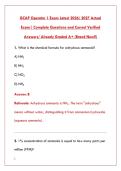
GCAP Operator 1 Exam Latest 2026/ 2027 Actual
Exam| Complete Questions and Correct Verified
Answers/ Already Graded A+ (Brand New!!)
1. What is the chemical formula for anhydrous ammonia?
A) NH₂
B) NH₃
C) NO₂
D) NH₄
Answer: B
Rationale: Anhydrous ammonia is NH₃. The term "anhydrous"
means without water, distinguishing it from ammonium hydroxide
(aqueous ammonia) .
2. 1% concentration of ammonia is equal to how many parts per
million (PPM)?
1
,A) 10 PPM
B) 100 PPM
C) 1,000 PPM
D) 10,000 PPM
Answer: D
Rationale: 1% concentration equals 10,000 PPM (1% × 10,000
= 10,000) .
3. True or False: ½% (0.5%) concentration of ammonia is a
deadly concentration.
A) True
B) False
Answer: A
Rationale: 0.5% ammonia concentration (5,000 PPM) is
considered deadly with rapid exposure, causing severe
respiratory damage and death within minutes .
2
,4. Ammonia is what on the pH scale?
A) 3.7
B) 5.2
C) 7.0
D) 11.6
Answer: D
Rationale: Ammonia is highly alkaline with a pH of 11.6, making
it caustic and capable of causing severe chemical burns .
5. True or False: More than a 100 lb release of NH₃ in 24 hours
is a reportable release.
A) True
B) False
3
, Answer: A
Rationale: The EPA requires that any ammonia release of 100 lb
or more within a 24-hour period be reported to the National
Response Center .
6. What are the four primary types of injury/burns with
exposure to liquid ammonia?
A) First, second, third, fourth degree
B) Caustic, thermal, dehydration, respiratory
C) Chemical, electrical, friction, radiation
D) Contact, inhalation, ingestion, injection
Answer: B
Rationale: Liquid ammonia causes four distinct types of injury:
caustic burns (alkaline corrosion), thermal burns (rapid freezing
upon evaporation), dehydration burns (moisture absorption), and
respiratory damage (inhalation of vapors) .
4
Exam| Complete Questions and Correct Verified
Answers/ Already Graded A+ (Brand New!!)
1. What is the chemical formula for anhydrous ammonia?
A) NH₂
B) NH₃
C) NO₂
D) NH₄
Answer: B
Rationale: Anhydrous ammonia is NH₃. The term "anhydrous"
means without water, distinguishing it from ammonium hydroxide
(aqueous ammonia) .
2. 1% concentration of ammonia is equal to how many parts per
million (PPM)?
1
,A) 10 PPM
B) 100 PPM
C) 1,000 PPM
D) 10,000 PPM
Answer: D
Rationale: 1% concentration equals 10,000 PPM (1% × 10,000
= 10,000) .
3. True or False: ½% (0.5%) concentration of ammonia is a
deadly concentration.
A) True
B) False
Answer: A
Rationale: 0.5% ammonia concentration (5,000 PPM) is
considered deadly with rapid exposure, causing severe
respiratory damage and death within minutes .
2
,4. Ammonia is what on the pH scale?
A) 3.7
B) 5.2
C) 7.0
D) 11.6
Answer: D
Rationale: Ammonia is highly alkaline with a pH of 11.6, making
it caustic and capable of causing severe chemical burns .
5. True or False: More than a 100 lb release of NH₃ in 24 hours
is a reportable release.
A) True
B) False
3
, Answer: A
Rationale: The EPA requires that any ammonia release of 100 lb
or more within a 24-hour period be reported to the National
Response Center .
6. What are the four primary types of injury/burns with
exposure to liquid ammonia?
A) First, second, third, fourth degree
B) Caustic, thermal, dehydration, respiratory
C) Chemical, electrical, friction, radiation
D) Contact, inhalation, ingestion, injection
Answer: B
Rationale: Liquid ammonia causes four distinct types of injury:
caustic burns (alkaline corrosion), thermal burns (rapid freezing
upon evaporation), dehydration burns (moisture absorption), and
respiratory damage (inhalation of vapors) .
4


