NURS 6501 Advanced
Pathophysiology Final Exam Prep
Pack (2026/2027) | Week 11
Comprehensive Final | 400 High-
Yield Solved Q&As
Dominate your graduate nursing
curriculum with this premium, 400-
question practice test bank
customized for the NURS 6501
Advanced Pathophysiology
comprehensive final exam. This
master study guide contains fully
solved and verified questions
featuring bold-italic answers and
detailed advanced rationales to
help you master challenging
neurological, cardiovascular,
endocrine, and oncology pathways.
Optimized for quick scanning and
active recall, this file ensures an
A+ grade on your Week 11 final
assessment.
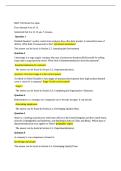
,Question 1
A 58-year-old man with a history of chronic hypertension presents for his annual
physical. His left ventricular wall thickness is noted to be increased on echocardiogram.
This cellular adaptation represents which of the following processes?
A) Hyperplasia, characterized by an increase in the number of cardiac myocytes
B) Hypertrophy, an increase in cell size without an increase in cell number
C) Metaplasia, the replacement of cardiac muscle with fibrous connective tissue
D) Dysplasia, representing a pre-neoplastic change in ventricular tissue
Answer: B) Hypertrophy, an increase in cell size without an increase in cell
number
Rationale: Hypertrophy refers to an increase in cell size, not cell number. In response to
chronic pressure overload from hypertension, cardiac myocytes increase their
contractile protein content and organelle mass, leading to thicker ventricular walls.
Question 2
A biopsy of a bronchus from a long-term smoker shows that normal ciliated columnar
epithelium has been replaced by stratified squamous epithelium. What is this cellular
alteration?
A) Atypical dysplasia
B) Anaplastic transformation
&C) Metaplasia
D) Endogenous hyperplasia
Answer: C) Metaplasia
Rationale: Metaplasia is the reversible replacement of one mature cell type by another
cell type. It occurs in response to chronic irritation or inflammation, providing a cell type
better able to survive.
Question 3
Which physiological event directly causes cellular swelling during an acute hypoxic
injury?
A) Increased active efflux of intracellular sodium ions
B) Accelerated mitochondrial oxidative phosphorylation
C) Influx of sodium and water due to failure of the ATP-dependent Na+/K+ pump
D) Excessive extracellular accumulation of potassium ions
Answer: C) Influx of sodium and water due to failure of the ATP-dependent Na+/K+
pump
,Rationale: Hypoxia deprives the cell of oxygen, stopping ATP production. Without ATP,
the sodium-potassium active transport pump fails. Sodium accumulates inside the cell,
pulling water with it osmotically, causing cellular swelling.
Question 4
Which mechanism describes apoptosis, distinguishing it from necrotic cellular death?
A) Profound enzymatic digestion of surrounding healthy tissue matrix
B) Programmed cell death that triggers a massive local inflammatory response
&C) Genetically regulated cell destruction without plasma membrane rupture or
inflammation
D) Passive cellular lysis caused by sudden mechanical or thermal trauma
Answer: C) Genetically regulated cell destruction without plasma membrane
rupture or inflammation
Rationale: Apoptosis is an active, gene-regulated process of cellular self-destruction.
The cell shrinks and breaks into apoptotic bodies. Phagocytes remove these bodies
without releasing intracellular contents, preventing an inflammatory response.
Question 5
A patient presents with a large area of coagulative necrosis in the myocardium following
a myocardial infarction. Which statement describes coagulative necrosis?
A) It occurs primarily in the brain due to high lipid content.
&C) It results from protein denaturation where the structural outline of the tissue is
preserved.
C) It is characterized by a thick, yellowish, cheesy substance.
D) It results from the action of localized lipases on adipose tissue.
Answer: B) It results from protein denaturation where the structural outline of the
tissue is preserved.
Rationale: Coagulative necrosis occurs primarily in kidneys, heart, and adrenal glands
due to severe ischemia. Acidosis denatures structural proteins and cellular enzymes,
blocking autolysis and preserving the basic tissue outline for days.
Question 6
Which type of tissue necrosis is characteristically seen in a patient with pulmonary
tuberculosis?
A) Liquefactive necrosis
B) Caseous necrosis
C) Coagulative necrosis
D) Fat necrosis
Answer: B) Caseous necrosis
, Rationale: Caseous necrosis is a distinct combination of coagulative and liquefactive
necrosis. It typically results from tuberculous pulmonary infections. The dead cells
disintegrate but are not completely digested, leaving a soft, granular, cheesy substance.
Question 7
What type of necrosis is uniquely found in the brain and central nervous system
following ischemic injury?
A) Coagulative necrosis
B) Liquefactive necrosis
C) Fat necrosis
D) Fibrinoid necrosis
Answer: B) Liquefactive necrosis
Rationale: Liquefactive necrosis occurs in the brain because neurons and glial cells
contain high amounts of digestive hydrolytic enzymes and lipids. Ischemic injury triggers
rapid autolysis, turning the dead brain tissue into a soft, liquid mass.
Question 8
During an active inflammatory response, which chemical mediator is primarily
responsible for inducing initial vasodilation and increasing capillary permeability?
A) Interleukin-10
B) Histamine
C) Interferon-gamma
D) Transforming growth factor-beta
Answer: B) Histamine
Rationale: Histamine is released rapidly from mast cell granules during the vascular
phase of inflammation. It causes immediate arteriolar vasodilation and endothelial cell
contraction, widening intercellular junctions to increase capillary permeability.
Question 9
Which component of the plasma complement system serves as a powerful opsonin to
enhance phagocytosis?
A) C3a
B) C5a
C) C3b
D) C9
Answer: C) C3b
Rationale: C3b coats the surface of pathogenic microorganisms (opsonization).
Macrophages and neutrophils express specific surface receptors for C3b, allowing them
to bind, target, and engulf the tagged pathogen efficiently.
Pathophysiology Final Exam Prep
Pack (2026/2027) | Week 11
Comprehensive Final | 400 High-
Yield Solved Q&As
Dominate your graduate nursing
curriculum with this premium, 400-
question practice test bank
customized for the NURS 6501
Advanced Pathophysiology
comprehensive final exam. This
master study guide contains fully
solved and verified questions
featuring bold-italic answers and
detailed advanced rationales to
help you master challenging
neurological, cardiovascular,
endocrine, and oncology pathways.
Optimized for quick scanning and
active recall, this file ensures an
A+ grade on your Week 11 final
assessment.
,Question 1
A 58-year-old man with a history of chronic hypertension presents for his annual
physical. His left ventricular wall thickness is noted to be increased on echocardiogram.
This cellular adaptation represents which of the following processes?
A) Hyperplasia, characterized by an increase in the number of cardiac myocytes
B) Hypertrophy, an increase in cell size without an increase in cell number
C) Metaplasia, the replacement of cardiac muscle with fibrous connective tissue
D) Dysplasia, representing a pre-neoplastic change in ventricular tissue
Answer: B) Hypertrophy, an increase in cell size without an increase in cell
number
Rationale: Hypertrophy refers to an increase in cell size, not cell number. In response to
chronic pressure overload from hypertension, cardiac myocytes increase their
contractile protein content and organelle mass, leading to thicker ventricular walls.
Question 2
A biopsy of a bronchus from a long-term smoker shows that normal ciliated columnar
epithelium has been replaced by stratified squamous epithelium. What is this cellular
alteration?
A) Atypical dysplasia
B) Anaplastic transformation
&C) Metaplasia
D) Endogenous hyperplasia
Answer: C) Metaplasia
Rationale: Metaplasia is the reversible replacement of one mature cell type by another
cell type. It occurs in response to chronic irritation or inflammation, providing a cell type
better able to survive.
Question 3
Which physiological event directly causes cellular swelling during an acute hypoxic
injury?
A) Increased active efflux of intracellular sodium ions
B) Accelerated mitochondrial oxidative phosphorylation
C) Influx of sodium and water due to failure of the ATP-dependent Na+/K+ pump
D) Excessive extracellular accumulation of potassium ions
Answer: C) Influx of sodium and water due to failure of the ATP-dependent Na+/K+
pump
,Rationale: Hypoxia deprives the cell of oxygen, stopping ATP production. Without ATP,
the sodium-potassium active transport pump fails. Sodium accumulates inside the cell,
pulling water with it osmotically, causing cellular swelling.
Question 4
Which mechanism describes apoptosis, distinguishing it from necrotic cellular death?
A) Profound enzymatic digestion of surrounding healthy tissue matrix
B) Programmed cell death that triggers a massive local inflammatory response
&C) Genetically regulated cell destruction without plasma membrane rupture or
inflammation
D) Passive cellular lysis caused by sudden mechanical or thermal trauma
Answer: C) Genetically regulated cell destruction without plasma membrane
rupture or inflammation
Rationale: Apoptosis is an active, gene-regulated process of cellular self-destruction.
The cell shrinks and breaks into apoptotic bodies. Phagocytes remove these bodies
without releasing intracellular contents, preventing an inflammatory response.
Question 5
A patient presents with a large area of coagulative necrosis in the myocardium following
a myocardial infarction. Which statement describes coagulative necrosis?
A) It occurs primarily in the brain due to high lipid content.
&C) It results from protein denaturation where the structural outline of the tissue is
preserved.
C) It is characterized by a thick, yellowish, cheesy substance.
D) It results from the action of localized lipases on adipose tissue.
Answer: B) It results from protein denaturation where the structural outline of the
tissue is preserved.
Rationale: Coagulative necrosis occurs primarily in kidneys, heart, and adrenal glands
due to severe ischemia. Acidosis denatures structural proteins and cellular enzymes,
blocking autolysis and preserving the basic tissue outline for days.
Question 6
Which type of tissue necrosis is characteristically seen in a patient with pulmonary
tuberculosis?
A) Liquefactive necrosis
B) Caseous necrosis
C) Coagulative necrosis
D) Fat necrosis
Answer: B) Caseous necrosis
, Rationale: Caseous necrosis is a distinct combination of coagulative and liquefactive
necrosis. It typically results from tuberculous pulmonary infections. The dead cells
disintegrate but are not completely digested, leaving a soft, granular, cheesy substance.
Question 7
What type of necrosis is uniquely found in the brain and central nervous system
following ischemic injury?
A) Coagulative necrosis
B) Liquefactive necrosis
C) Fat necrosis
D) Fibrinoid necrosis
Answer: B) Liquefactive necrosis
Rationale: Liquefactive necrosis occurs in the brain because neurons and glial cells
contain high amounts of digestive hydrolytic enzymes and lipids. Ischemic injury triggers
rapid autolysis, turning the dead brain tissue into a soft, liquid mass.
Question 8
During an active inflammatory response, which chemical mediator is primarily
responsible for inducing initial vasodilation and increasing capillary permeability?
A) Interleukin-10
B) Histamine
C) Interferon-gamma
D) Transforming growth factor-beta
Answer: B) Histamine
Rationale: Histamine is released rapidly from mast cell granules during the vascular
phase of inflammation. It causes immediate arteriolar vasodilation and endothelial cell
contraction, widening intercellular junctions to increase capillary permeability.
Question 9
Which component of the plasma complement system serves as a powerful opsonin to
enhance phagocytosis?
A) C3a
B) C5a
C) C3b
D) C9
Answer: C) C3b
Rationale: C3b coats the surface of pathogenic microorganisms (opsonization).
Macrophages and neutrophils express specific surface receptors for C3b, allowing them
to bind, target, and engulf the tagged pathogen efficiently.