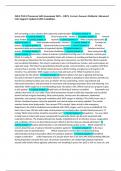
AHA PALS Precourse Self-Assessment 2025 – 100% Correct Answers Pediatric Advanced
Life Support Updated AHA Guidelines
SVT converting to sinus rhythm after adenosine administration << correct answer >> Sinus
bradycardia << correct answer >> Sinus bradycardia - version 2 << correct answer >> Normal
sinus rhythm << correct answer >> Asystole << correct answer >> Wide complex tachycardia <<
correct answer >> Wide complex tachycardia - version 2 << correct answer >> Torsades de
pointes << correct answer >> Supraventricular tachycardia << correct answer >> VF with
successful defib and resumption of organized rhythm << correct answer >> Pulseless electrical
activity << correct answer >> Ventricular fibrillation << correct answer >> Sinus tachycardia <<
correct answer >>Administer a bolus of isotonic crystalloid 20 ml/kg over 5-20 minutes, and also give
D25W 2-4 ml/kg IV A previously healthy infant with a history of vomiting and diarrhea is brought to
the emergency department by her parents. During your assessment, you find that the infant responds
only to painful stimulation. The infant's respiratory rate is 40 breaths per minute, and central pulses are
rapid and weak. The infant has good bilateral breath sounds, cool extremities, and a capillary refill time
of more than 5 seconds. The infant's blood pressure is 85/65 mmHg, and glucose is 30 mg/dL (1.65
mmol/L). You administer 100% oxygen via face mask and start an IV. Which treatment is most
appropriate for this infant? << correct answer >>Albuterol (duh) A 9yo boy is agitated and leaning
forward on the bed in obvious respiratory distress. The patient is speaking in short phrases and tells you
that he has asthma but does not carry an inhaler. He has nasal flaring, severe suprasternal and
intercostal retractions, and decreased air movement with prolonged expiratory time and wheezing. You
administer 100% oxygen by a nonrebreathing mask. His spO2 is 92%. Which med do you prepare to give
to this patient? << correct answer >>Rapid bolus of 20ml/kg of isotonic crystalloid Paramedics are
called to the home of a 1yo child. Their initial assessment reveals a child who responds only to painful
stimuli and has irregular breathing, faint central pulses, bruises over the abdomen, abdominal
distention, and cyanosis. Bag-mask ventilation with 100% oxygen is initiated. The child's heart rate is
36/min. Peripheral pulses cannot be palpated, and central pulses are barely palpable. The cardiac
monitor shows sinus bradycardia. Two-rescuer CPR is started. Upon arrival to the emergency
department, the child is intubated and ventilated with 100% oxygen, and IV access is established. The
heart rate is now 150/min with weak central pulses but no distal pulses. Systolic blood pressure is 74
mmHg. Which intervention should be provided next? << correct answer >>Epinephrine You are called
to help treat an infant with severe symptomatic bradycardia (heart rate 66/min) associated with
respiratory distress. The bradycardia persists despite establishment of an effective airway, oxygenation,
and ventilation. There is no heart block present. Which is the first drug you should administer? <<
correct answer >>Routine administration is not indicated during cardiac arrest Which statement is
correct about the use of calcium chloride in pediatric patients? << correct answer >>It is the least
desirable route of administration Which statement is correct about endotracheal drug
administration during resuscitative efforts for pediatric patients? << correct answer >>Humidified
oxygen as tolerated Initial impression of a 2yo girl shows her to be alert with mild breathing difficulty
during inspiration and pale skin color. On primary assessment, she makes high-pitched inspiratory
sounds (mild stridor) when agitated; otherwise, her breathing is quiet. Her spO2 is 92% on room air, and
, she has mild inspiratory intercostal retractions. Lung auscultation reveals transmitted upper airway
sounds with adequate distal breath sounds bilaterally. Which is the most appropriate initial intervention
for this child? << correct answer >>Amiodarone 5 mg/kg IO You are part of a team attempting to
resuscitate a child with ventricular fibrillation cardiac arrest. You delivered 2 unsynchronized shocks. A
team member established IO access, so you give a dose of epinephrine, 0.01 mg/kg IO. At the next
rhythm check, persistent ventricular fibrillation is present. You administer a 4 J/kg shock and resume
CPR. Which drug and dose should be administered next? << correct answer >>Nonrebreathing face mask
Which oxygen delivery system most reliably delivers a high (90% or greater) concentration of
inspired oxygen to a 7yo child? << correct answer >>Epinephrine stimulates spontaneous contractions
when asystole is present Which statement is correct about the effects of epinephrine during
attempted resuscitation? << correct answer >>Epinephrine 0.01 mg/kg IV/IO A 10mo infant boy is
brought to the emergency department. Your initial assessment reveals a lethargic, pale infant with slow
respirations and slow, weak central pulses. One team member begins ventilation with a bag-mask device
with 100% oxygen. A second team member attaches the monitor/defibrillator and obtains vital signs
while a third team member attempts to establish IV/IO access. The patient's heart rate is 38/min with
the rhythm shown here. The infant's blood pressure is 58/38 mmHg, and capillary refill is 4 seconds. His
central pulses remain weak, and distal pulses cannot be palpated. Chest compressions are started and
IO access is obtained. Which medication do you anticipate will be given next? << correct answer
>>Identify and treat reversible causes A 7yo boy is found unresponsive, apneic, and pulseless. CPR is
ongoing. The child is intubated, and vascular access is established. The ECG monitor shows an organized
rhythm with a heart rate of 45/min, but a pulse check reveals no palpable pulses. High quality CPR is
resumed, and an initial IV dose of epinephrine is administered. Which intervention should you perform
next? << correct answer >>Lidocaine 1 mg/kg IV You find a 10yo boy to be unresponsive. You shout for
help, and after finding that he is not breathing and has no pulse, you and a colleague begin CPR. Another
colleague activates the emergency response system, brings the emergency equipment, and places the
child on a cardiac monitor/defibrillator, which reveals the rhythm shown here. You attempt defibrillation
at 2 J/kg and give 2 minutes of CPR. The rhythm persists at the second rhythm check, at which point you
attempt defibrillation with 4 J/kg. A fourth colleague arrives, starts an IV, and administers 1 dose of
epinephrine 0.01 mg/kg. If ventricular fibrillation or pulseless ventricular tachycardia persists after 2
minutes of CPR, you will administer another shock. Which drug and dose should be administered next?
<< correct answer >>While a colleague provides spinal motion restriction, open the airway with a jaw
thrust and provide bag-mask ventilation A 3yo boy presents with multiple-system trauma. The child was
an unrestrained passenger in a high-speed MVC. On primary assessment, he is unresponsive to voice or
painful stimulation. His respiratory rate is 5/min, heart rate and pulses are 170/min, systolic BP is 60
mmHg, capillary refill is 5 seconds, and spO2 is 75% on room air. Which action should you take first? <<
correct answer >>Open the airway with a head tilt-chin lift maneuver and give 2 breaths You are alone
and witness a child suddenly collapse. There is no suspected head or neck injury. A colleague responded
to your shout for help and is activating the emergency response system and is retrieving the
resuscitation equipment, including a defibrillator. After delivering 30 compressions, what would be your
next action? << correct answer >>"You need to compress at a rate of 100-120 per minute." You
and another rescuer begin CPR. Your colleague begins compressions, and you notice that the
compression rate is too slow. What should you say to offer constructive feedback? << correct answer
>>Tracheal tube displacement into the right main bronchus You are caring for a 6yo patient who is
receiving positive-pressure mechanical ventilation via an endotracheal tube. The child begins to move
Life Support Updated AHA Guidelines
SVT converting to sinus rhythm after adenosine administration << correct answer >> Sinus
bradycardia << correct answer >> Sinus bradycardia - version 2 << correct answer >> Normal
sinus rhythm << correct answer >> Asystole << correct answer >> Wide complex tachycardia <<
correct answer >> Wide complex tachycardia - version 2 << correct answer >> Torsades de
pointes << correct answer >> Supraventricular tachycardia << correct answer >> VF with
successful defib and resumption of organized rhythm << correct answer >> Pulseless electrical
activity << correct answer >> Ventricular fibrillation << correct answer >> Sinus tachycardia <<
correct answer >>Administer a bolus of isotonic crystalloid 20 ml/kg over 5-20 minutes, and also give
D25W 2-4 ml/kg IV A previously healthy infant with a history of vomiting and diarrhea is brought to
the emergency department by her parents. During your assessment, you find that the infant responds
only to painful stimulation. The infant's respiratory rate is 40 breaths per minute, and central pulses are
rapid and weak. The infant has good bilateral breath sounds, cool extremities, and a capillary refill time
of more than 5 seconds. The infant's blood pressure is 85/65 mmHg, and glucose is 30 mg/dL (1.65
mmol/L). You administer 100% oxygen via face mask and start an IV. Which treatment is most
appropriate for this infant? << correct answer >>Albuterol (duh) A 9yo boy is agitated and leaning
forward on the bed in obvious respiratory distress. The patient is speaking in short phrases and tells you
that he has asthma but does not carry an inhaler. He has nasal flaring, severe suprasternal and
intercostal retractions, and decreased air movement with prolonged expiratory time and wheezing. You
administer 100% oxygen by a nonrebreathing mask. His spO2 is 92%. Which med do you prepare to give
to this patient? << correct answer >>Rapid bolus of 20ml/kg of isotonic crystalloid Paramedics are
called to the home of a 1yo child. Their initial assessment reveals a child who responds only to painful
stimuli and has irregular breathing, faint central pulses, bruises over the abdomen, abdominal
distention, and cyanosis. Bag-mask ventilation with 100% oxygen is initiated. The child's heart rate is
36/min. Peripheral pulses cannot be palpated, and central pulses are barely palpable. The cardiac
monitor shows sinus bradycardia. Two-rescuer CPR is started. Upon arrival to the emergency
department, the child is intubated and ventilated with 100% oxygen, and IV access is established. The
heart rate is now 150/min with weak central pulses but no distal pulses. Systolic blood pressure is 74
mmHg. Which intervention should be provided next? << correct answer >>Epinephrine You are called
to help treat an infant with severe symptomatic bradycardia (heart rate 66/min) associated with
respiratory distress. The bradycardia persists despite establishment of an effective airway, oxygenation,
and ventilation. There is no heart block present. Which is the first drug you should administer? <<
correct answer >>Routine administration is not indicated during cardiac arrest Which statement is
correct about the use of calcium chloride in pediatric patients? << correct answer >>It is the least
desirable route of administration Which statement is correct about endotracheal drug
administration during resuscitative efforts for pediatric patients? << correct answer >>Humidified
oxygen as tolerated Initial impression of a 2yo girl shows her to be alert with mild breathing difficulty
during inspiration and pale skin color. On primary assessment, she makes high-pitched inspiratory
sounds (mild stridor) when agitated; otherwise, her breathing is quiet. Her spO2 is 92% on room air, and
, she has mild inspiratory intercostal retractions. Lung auscultation reveals transmitted upper airway
sounds with adequate distal breath sounds bilaterally. Which is the most appropriate initial intervention
for this child? << correct answer >>Amiodarone 5 mg/kg IO You are part of a team attempting to
resuscitate a child with ventricular fibrillation cardiac arrest. You delivered 2 unsynchronized shocks. A
team member established IO access, so you give a dose of epinephrine, 0.01 mg/kg IO. At the next
rhythm check, persistent ventricular fibrillation is present. You administer a 4 J/kg shock and resume
CPR. Which drug and dose should be administered next? << correct answer >>Nonrebreathing face mask
Which oxygen delivery system most reliably delivers a high (90% or greater) concentration of
inspired oxygen to a 7yo child? << correct answer >>Epinephrine stimulates spontaneous contractions
when asystole is present Which statement is correct about the effects of epinephrine during
attempted resuscitation? << correct answer >>Epinephrine 0.01 mg/kg IV/IO A 10mo infant boy is
brought to the emergency department. Your initial assessment reveals a lethargic, pale infant with slow
respirations and slow, weak central pulses. One team member begins ventilation with a bag-mask device
with 100% oxygen. A second team member attaches the monitor/defibrillator and obtains vital signs
while a third team member attempts to establish IV/IO access. The patient's heart rate is 38/min with
the rhythm shown here. The infant's blood pressure is 58/38 mmHg, and capillary refill is 4 seconds. His
central pulses remain weak, and distal pulses cannot be palpated. Chest compressions are started and
IO access is obtained. Which medication do you anticipate will be given next? << correct answer
>>Identify and treat reversible causes A 7yo boy is found unresponsive, apneic, and pulseless. CPR is
ongoing. The child is intubated, and vascular access is established. The ECG monitor shows an organized
rhythm with a heart rate of 45/min, but a pulse check reveals no palpable pulses. High quality CPR is
resumed, and an initial IV dose of epinephrine is administered. Which intervention should you perform
next? << correct answer >>Lidocaine 1 mg/kg IV You find a 10yo boy to be unresponsive. You shout for
help, and after finding that he is not breathing and has no pulse, you and a colleague begin CPR. Another
colleague activates the emergency response system, brings the emergency equipment, and places the
child on a cardiac monitor/defibrillator, which reveals the rhythm shown here. You attempt defibrillation
at 2 J/kg and give 2 minutes of CPR. The rhythm persists at the second rhythm check, at which point you
attempt defibrillation with 4 J/kg. A fourth colleague arrives, starts an IV, and administers 1 dose of
epinephrine 0.01 mg/kg. If ventricular fibrillation or pulseless ventricular tachycardia persists after 2
minutes of CPR, you will administer another shock. Which drug and dose should be administered next?
<< correct answer >>While a colleague provides spinal motion restriction, open the airway with a jaw
thrust and provide bag-mask ventilation A 3yo boy presents with multiple-system trauma. The child was
an unrestrained passenger in a high-speed MVC. On primary assessment, he is unresponsive to voice or
painful stimulation. His respiratory rate is 5/min, heart rate and pulses are 170/min, systolic BP is 60
mmHg, capillary refill is 5 seconds, and spO2 is 75% on room air. Which action should you take first? <<
correct answer >>Open the airway with a head tilt-chin lift maneuver and give 2 breaths You are alone
and witness a child suddenly collapse. There is no suspected head or neck injury. A colleague responded
to your shout for help and is activating the emergency response system and is retrieving the
resuscitation equipment, including a defibrillator. After delivering 30 compressions, what would be your
next action? << correct answer >>"You need to compress at a rate of 100-120 per minute." You
and another rescuer begin CPR. Your colleague begins compressions, and you notice that the
compression rate is too slow. What should you say to offer constructive feedback? << correct answer
>>Tracheal tube displacement into the right main bronchus You are caring for a 6yo patient who is
receiving positive-pressure mechanical ventilation via an endotracheal tube. The child begins to move