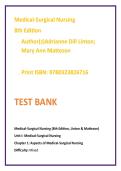
Davis Advantage for Medical-
Surgical Nursing
Making Connections to Practice
3rd Edition
• Author(s)Janice Hoffman; Nancy
Sullivan
• PublisherPublished by F.A.
Davis Copyright© 2024
• Print ISBN: 9781719647366
TEST BANK
,1. MCQ
Clinical Scenario:
A postoperative patient on a medical-surgical unit becomes
pale, restless, and lightheaded. The patient’s blood pressure
drops from 124/78 to 88/50 mm Hg, and the heart rate
increases to 118 beats/min.
Question Stem:
What is the nurse’s first action?
Answer Options:
A. Document the findings and continue with the next patient
B. Activate the rapid response team and perform a focused
assessment
C. Offer the patient oral fluids and recheck in 30 minutes
D. Ask the nursing assistant to obtain repeat vital signs in 1
hour
Correct Answer:
B. Activate the rapid response team and perform a focused
assessment
Detailed Rationale:
The patient shows acute instability with signs of possible shock
or hemorrhage. The nurse must act immediately by recognizing
the cue cluster and escalating care while performing a focused
assessment of airway, breathing, circulation, and perfusion.
,Early intervention improves outcomes and supports patient
safety.
Incorrect Option Analysis:
• A: Incorrect because documenting without intervening
delays care. Misconception: “Chart first, act later.” Risk:
missed deterioration.
• C: Incorrect because oral fluids are not an appropriate first
response for possible hemodynamic instability. Risk:
worsened delay in treatment.
• D: Incorrect because delayed reassessment is unsafe in an
unstable patient. Risk: rapid decompensation.
Nursing Process Linkage: Assessment
NCJMM Competencies: Recognize Cues, Take Action
Difficulty: Moderate
Bloom’s Level: Apply
NCLEX Client Needs: Physiological Adaptation
Key Learning Objective: Identify and respond to acute
deterioration using prioritization and rapid escalation.
2. MCQ
Clinical Scenario:
A nurse is revising a unit protocol to reduce pressure injuries on
a medical-surgical floor.
, Question Stem:
Which source should the nurse use first to guide the revision?
Answer Options:
A. Advice from a senior nurse who has worked on the unit for
20 years
B. A current evidence-based clinical practice guideline
C. A patient’s personal story about a pressure injury
D. A social media post about turning schedules
Correct Answer:
B. A current evidence-based clinical practice guideline
Detailed Rationale:
Evidence-based practice begins with the best available research
and clinical guidelines. Guidelines integrate high-quality
evidence and are most appropriate for revising protocols to
improve outcomes and consistency of care.
Incorrect Option Analysis:
• A: Experience is valuable, but not sufficient as the primary
source for protocol revision. Risk: continuation of
outdated practice.
• C: Patient experience matters, but one case is not
generalizable evidence. Risk: weak clinical decisions.
• D: Social media is not a reliable evidence source. Risk:
unsafe or inaccurate practice changes.
Surgical Nursing
Making Connections to Practice
3rd Edition
• Author(s)Janice Hoffman; Nancy
Sullivan
• PublisherPublished by F.A.
Davis Copyright© 2024
• Print ISBN: 9781719647366
TEST BANK
,1. MCQ
Clinical Scenario:
A postoperative patient on a medical-surgical unit becomes
pale, restless, and lightheaded. The patient’s blood pressure
drops from 124/78 to 88/50 mm Hg, and the heart rate
increases to 118 beats/min.
Question Stem:
What is the nurse’s first action?
Answer Options:
A. Document the findings and continue with the next patient
B. Activate the rapid response team and perform a focused
assessment
C. Offer the patient oral fluids and recheck in 30 minutes
D. Ask the nursing assistant to obtain repeat vital signs in 1
hour
Correct Answer:
B. Activate the rapid response team and perform a focused
assessment
Detailed Rationale:
The patient shows acute instability with signs of possible shock
or hemorrhage. The nurse must act immediately by recognizing
the cue cluster and escalating care while performing a focused
assessment of airway, breathing, circulation, and perfusion.
,Early intervention improves outcomes and supports patient
safety.
Incorrect Option Analysis:
• A: Incorrect because documenting without intervening
delays care. Misconception: “Chart first, act later.” Risk:
missed deterioration.
• C: Incorrect because oral fluids are not an appropriate first
response for possible hemodynamic instability. Risk:
worsened delay in treatment.
• D: Incorrect because delayed reassessment is unsafe in an
unstable patient. Risk: rapid decompensation.
Nursing Process Linkage: Assessment
NCJMM Competencies: Recognize Cues, Take Action
Difficulty: Moderate
Bloom’s Level: Apply
NCLEX Client Needs: Physiological Adaptation
Key Learning Objective: Identify and respond to acute
deterioration using prioritization and rapid escalation.
2. MCQ
Clinical Scenario:
A nurse is revising a unit protocol to reduce pressure injuries on
a medical-surgical floor.
, Question Stem:
Which source should the nurse use first to guide the revision?
Answer Options:
A. Advice from a senior nurse who has worked on the unit for
20 years
B. A current evidence-based clinical practice guideline
C. A patient’s personal story about a pressure injury
D. A social media post about turning schedules
Correct Answer:
B. A current evidence-based clinical practice guideline
Detailed Rationale:
Evidence-based practice begins with the best available research
and clinical guidelines. Guidelines integrate high-quality
evidence and are most appropriate for revising protocols to
improve outcomes and consistency of care.
Incorrect Option Analysis:
• A: Experience is valuable, but not sufficient as the primary
source for protocol revision. Risk: continuation of
outdated practice.
• C: Patient experience matters, but one case is not
generalizable evidence. Risk: weak clinical decisions.
• D: Social media is not a reliable evidence source. Risk:
unsafe or inaccurate practice changes.