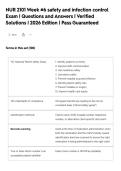
NUR 2101 Week #6 safety and infection control
Exam | Questions and Answers | Verified
Solutions | 2026 Edition | Pass Guaranteed
Save
Terms in this set (100)
TJC National Patient Safety Goals 1. Identify patients correctly
2. Improve staff communication
3. Use medicines safely
4. Use alarms safely
5. Prevent hospital-acquired infection
6. Identify patient safety risks
7. Prevent mistakes in surgery
15. Improve health care equity
TJC's Standards of compliance Old goals that still are needing to be met on
consistent basis ("retired safety goals")
identification methods Clients name, DOB, hospital number, telephone
number, or alternative client-specific document
Barcode scanning Used at the time of medication administration when
both the medication and the client's facility-issued
identification band are scanned to ensure the right
medication is being administered to the right client
True or false: Room number is an False (room number is NEVER acceptable)
acceptable patient identifier
, True or false: Critical results should True
never be given via voicemail but
always given directly to provider in
person or by telephone
ISBARR introduction, situation, background, assessment,
recommendation, read back
3 prolonged goals of goal 3: Use 1) label all medicaitons
medication safely 2) Decrease posibility of medication errors with
anticoagulant medications
3) Establish an accurate and current medications
list for the cliet and have provider reconcile the list
with new drugs ordered
Medication label should include date/time it was mixed and medication name and
dose
Alarm fatigue Sensory overlord from noise pollution created in
part by the numerous distress alerts
4 main type of HAI (hospital- 1) CAUTI
acquired infections) 2) CLABSI
3) SSI
4) VAP
Multidrug-resistant organisms 1) MRSA
(MDROs) 2) VRA
3) C. Diff
CAUTI Occurs when pathogens enter the urinary system
via a catheter inserted through the urethra into the
bladder