
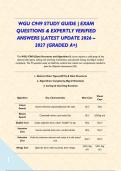
QUESTIONS & EXPERTLY VERIFIED
This WGU C949 (Data Structures and Algorithms I) course requires a solid grasp of key
abstract data types, sorting and searching mechanisms, pseudocode tracing, and Big-O runtime
complexity. This 95-question study set distill the material into critical core competencies needed to
pass the Objective Assessment (OA).
1. Abstract Data Types (ADTs) & Data Structures
2. Algorithmic Complexity (Big-O Notation)
3. Sorting & Searching Runtimes
Worst
Algorithm Key Characteristic Best Case
Case
Linear
Checks elements sequentially from the start. O(1) O(n)
Search
Binary
Continually halves a pre-sorted list. O(1) \(O(\log n)\)
Search
Bubble Sort Swaps adjacent items; values "bubble" to top. O(n) O(n²)
Insertion
Inserts unsorted items into a sorted sub-list. O(n) O(n²)
Sort
Selection Finds the minimum element and moves it to the sorted
O(n²) O(n²)
Sort end.
\(O(n \log \(O(n \log
Merge Sort Splits the list in half recursively, then merges.
n)\) n)\)
1
, \(O(n \log
Quick Sort Selects a pivot to partition data. O(n²)
n)\)
4. Trees & Graphs
5. Python Concepts & Types
Quiz_________________?
A binary tree is complete if: -
ANSWER✅
all levels except possibly the last are completely full, and the last level has all its nodes to the
left side
Quiz_________________?
A binary tree is full if: -
ANSWER✅
every node contains 0 or 2 children.
Quiz_________________?
A binary tree is perfect if: -
ANSWER✅
if all internal nodes have 2 children and all leaf nodes are at the same level.
Quiz_________________?
Abstract Data Type (ADT) -
ANSWER✅
2
, A data type described by predefined user operations, such as "insert data at rear," without
indicating how each operation is implemented.
Quiz_________________?
Array -
ANSWER✅
A data structure that stores an ordered list of items, with each item is directly accessible by
a positional index.
Quiz_________________?
Array based list -
ANSWER✅
A list ADT implemented using an array. An array-based list supports the common list ADT
operations, such as append, prepend, insert after, remove, and search.
Quiz_________________?
Array in Java -
ANSWER✅
generic class that supports different data types. declared as follows, where T is the data
type.
Quiz_________________?
Assignment vs comparison -
ANSWER✅
= vs ==
3
, Quiz_________________?
Bag -
ANSWER✅
An ADT for storing items in which the order does not matter and duplicate items are
allowed.
Underlying data structures: Linked list, Array
Quiz_________________?
Bianary Search Tree -
ANSWER✅
A data structure in which each node stores data and has up to two children, known as a left
child and a right child.
Quiz_________________?
Big-O Average runtime complexity -
ANSWER✅
Selection sort O(N2) Not fast
Insertion sort O(N2) Not fast
Shell sort O(N1.5) No fast
Quicksort O(NlogN) fast
Merge sort O(NlogN) fast
Heap sort O(NlogN) fast
Radix sort O(N) fast (integer only)
4
This WGU C949 (Data Structures and Algorithms I) course requires a solid grasp of key
abstract data types, sorting and searching mechanisms, pseudocode tracing, and Big-O runtime
complexity. This 95-question study set distill the material into critical core competencies needed to
pass the Objective Assessment (OA).
1. Abstract Data Types (ADTs) & Data Structures
2. Algorithmic Complexity (Big-O Notation)
3. Sorting & Searching Runtimes
Worst
Algorithm Key Characteristic Best Case
Case
Linear
Checks elements sequentially from the start. O(1) O(n)
Search
Binary
Continually halves a pre-sorted list. O(1) \(O(\log n)\)
Search
Bubble Sort Swaps adjacent items; values "bubble" to top. O(n) O(n²)
Insertion
Inserts unsorted items into a sorted sub-list. O(n) O(n²)
Sort
Selection Finds the minimum element and moves it to the sorted
O(n²) O(n²)
Sort end.
\(O(n \log \(O(n \log
Merge Sort Splits the list in half recursively, then merges.
n)\) n)\)
1
, \(O(n \log
Quick Sort Selects a pivot to partition data. O(n²)
n)\)
4. Trees & Graphs
5. Python Concepts & Types
Quiz_________________?
A binary tree is complete if: -
ANSWER✅
all levels except possibly the last are completely full, and the last level has all its nodes to the
left side
Quiz_________________?
A binary tree is full if: -
ANSWER✅
every node contains 0 or 2 children.
Quiz_________________?
A binary tree is perfect if: -
ANSWER✅
if all internal nodes have 2 children and all leaf nodes are at the same level.
Quiz_________________?
Abstract Data Type (ADT) -
ANSWER✅
2
, A data type described by predefined user operations, such as "insert data at rear," without
indicating how each operation is implemented.
Quiz_________________?
Array -
ANSWER✅
A data structure that stores an ordered list of items, with each item is directly accessible by
a positional index.
Quiz_________________?
Array based list -
ANSWER✅
A list ADT implemented using an array. An array-based list supports the common list ADT
operations, such as append, prepend, insert after, remove, and search.
Quiz_________________?
Array in Java -
ANSWER✅
generic class that supports different data types. declared as follows, where T is the data
type.
Quiz_________________?
Assignment vs comparison -
ANSWER✅
= vs ==
3
, Quiz_________________?
Bag -
ANSWER✅
An ADT for storing items in which the order does not matter and duplicate items are
allowed.
Underlying data structures: Linked list, Array
Quiz_________________?
Bianary Search Tree -
ANSWER✅
A data structure in which each node stores data and has up to two children, known as a left
child and a right child.
Quiz_________________?
Big-O Average runtime complexity -
ANSWER✅
Selection sort O(N2) Not fast
Insertion sort O(N2) Not fast
Shell sort O(N1.5) No fast
Quicksort O(NlogN) fast
Merge sort O(NlogN) fast
Heap sort O(NlogN) fast
Radix sort O(N) fast (integer only)
4


