

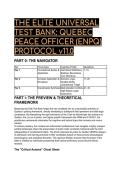
THE ELITE UNIVERSAL
TEST BANK: QUEBEC
PEACE OFFICER (ENPQ)
PROTOCOL v11.0
PART 0: THE NAVIGATOR
Tier Focus Area Cognitive Profile Questions
Tier 1 Foundational Syntax & Hard-Deck Definitions, 1–10
Application Statutory Boundaries,
Core Directives
Tier 2 Complex Application & Scenario Logic, 11–20
Simulation Variable Shifts,
Jurisdictional Triage
Tier 3 Grandmaster Synthesis Multi-Variable Conflicts, 21–30
High-Stakes Legal
Deductions
PART I: THE PREVIEW & THEORETICAL
FRAMEWORK
Mastering this Elite Test Bank forges the raw candidate into an untouchable authority on
Quebec’s policing framework, directly translating to bulletproof field operations and elite legal
compliance. By internalizing the rigid mechanics of the Code de déontologie des policiers du
Québec, the Loi sur la police, and highly specific frameworks like IPAM and P-38.001, the
practitioner permanently eliminates the cognitive and tactical traps that routinely end novice
careers.
To achieve mastery, the modern law enforcement professional must navigate a highly complex
juridical landscape where the preservation of public order constantly intersects with the strict
safeguarding of constitutional rights. The École nationale de police du Québec (ENPQ) designs
its admission and training protocols to filter candidates based on these precise physiological,
psychological, and analytical demands. This rigorous filtration ensures that the power of the
state is wielded by individuals possessing both tactical proficiency and profound ethical
restraint.
The "Critical Axioms" Cheat Sheet
, ● The P-38.001 Absolute Threshold: Under the Loi sur la protection des personnes dont
l'état mental présente un danger pour elles-mêmes ou pour autrui, a garde préventive
(maximum 72 hours) strictly requires the presence of a danger grave et immédiat. Police
transport the subject; however, only a physician or specialized nurse practitioner can
legally authorize the clinical hold.
● The Luamba Precedent (Art. 636 CSR): The judicial nullification of random, motiveless
traffic stops under Article 636 of the Code de la sécurité routière. Interceptions now
require objective, articulable suspicion to prevent profilage racial, completely rewriting the
tactical baseline for road safety operations and protecting Charter rights under Sections 7,
9, and 15(1).
● The Article 6 Proportionality Doctrine: Article 6 of the Code de déontologie forbids
abuse of authority. Any use of force must be strictly calibrated to the force nécessaire
required to accomplish a permitted or enjoined duty. Escalation beyond this parameter is
an absolute ethical and legal nullity.
● The IPAM Integration Mandate: The Modèle d'intervention policière auprès des aînés
maltraités (IPAM) inherently rejects the reliance on specialized units. It mandates that all
frontline patrol officers execute concerted, intersectoral collaboration to resolve both
criminal and non-criminal elder abuse.
● The Article 48 Dual-Mission Paradox: The Loi sur la police (Art. 48) mandates officers
to maintain peace, order, and public security, while simultaneously binding them to
sauvegarder les droits et les libertés (safeguard rights and freedoms). Elite policing exists
entirely within the friction between enforcing order and protecting constitutional rights.
PART II: THE ELITE TEST BANK
Tier 1: Foundational Syntax & Application
Q1: A candidate holding a Diplôme d'études collégiales (DEC) in police technology is
completing the ENPQ admission sequence. The candidate is subjected to a 455-question
assessment. According to the ENPQ entry protocols, what is the EXACT operational purpose of
the M-Pulse measuring tool? A) To evaluate the candidate’s physical endurance and
cardiovascular recovery rate during simulated high-stress interventions. B) To test the
candidate’s capacity to apply the Code de déontologie to complex, multi-variable field scenarios
via ranked multiple-choice options. C) To assess the candidate's risk level of exhibiting
behaviors inconsistent with the policing profession and measure their sense of responsibility. D)
To verify the candidate’s linguistic proficiency and ability to draft legally binding incident reports
under extreme time constraints.
● The Answer: C (To assess the candidate's risk level of exhibiting behaviors inconsistent
with the policing profession and measure their sense of responsibility.)
● Distractor Analysis:
○ A is incorrect: This describes the ESAP-ENPQ (Épreuve standardisée d'aptitudes
physiques), which handles the physiological and biomechanical benchmarking
required for police work.
○ B is incorrect: This is the exact definition of the Test de jugement situationnel (TJS),
which measures field judgment and strategy through scenario ranking, not baseline
psychological risk.
○ D is incorrect: Language proficiency is verified at the DEC level via uniform
, examinations prescribed by the Minister of Education, not via the M-Pulse
psychometric test.
The Mentor's Analysis: The M-Pulse is a psychometric firewall designed to filter out future
liability. While the TJS measures "how" a candidate solves a problem, the M-Pulse identifies the
latent psychological traits that predict counter-productive or rule-breaking behaviors before the
candidate ever wears a uniform. Professional/Academic Intuition: Elite institutions evaluate
character risk as rigorously as tactical competence; operational skills can be taught, but
baseline probity is an inherent prerequisite.
Q2: Under Article 5 of the Code de déontologie des policiers du Québec, an officer must behave
in a manner that preserves the trust and consideration required by their function. Which of the
following actions constitutes a DIRECT violation of this specific article? A) Refusing to answer
questions from a civilian ethics investigator during an official inquiry. B) Omitting to wear a
prescribed identification mark during direct relations with a member of the public. C) Utilizing a
degree of physical force slightly greater than necessary to subdue a resisting suspect. D)
Recommending the services of a specific criminal defense attorney to an arrested individual.
● The Answer: B (Omitting to wear a prescribed identification mark during direct relations
with a member of the public.)
● Distractor Analysis:
○ A is incorrect: Refusing to answer an ethics investigator is a protected statutory
right under Article 192 of the Loi sur la police, not an ethics violation.
○ C is incorrect: The use of excessive force is a severe violation, but it is explicitly
categorized under Article 6 (Abuse of authority), not Article 5.
○ D is incorrect: Recommending a specific attorney is a conflict of interest, which is
strictly prosecuted under Article 9 (Impartiality and Disinterest).
The Mentor's Analysis: Article 5 governs the optics, respect, and foundational trust between
the state and the citizen. Refusing to identify oneself or hiding a badge directly severs the
accountability loop, creating an immediate breach of the public trust doctrine.
Professional/Academic Intuition: Know your statutory categories flawlessly. A bad action
is not a universal violation; it must be mapped to its exact regulatory jurisdiction to
survive a tribunal.
Q3: Officers are responding to an individual exhibiting highly erratic behavior in a public park.
The individual is shouting at trees and claims to be an extraterrestrial envoy. The individual is
unarmed and not aggressive toward anyone. Based strictly on the parameters of the Loi
P-38.001, what is the MOST APPROPRIATE legal justification for initiating a garde préventive?
A) The individual is exhibiting clear signs of psychosis and requires immediate psychiatric
evaluation for their own well-being. B) The police cannot transport the individual under Loi
P-38.001 because there is no articulable danger grave et immédiat. C) The officers can initiate a
72-hour hold because the erratic behavior in a public space constitutes a breach of the peace.
D) The officers must secure a court order prior to transporting the individual, as non-violent
psychosis does not bypass constitutional liberties.
● The Answer: B (The police cannot transport the individual under Loi P-38.001 because
there is no articulable danger grave et immédiat.)
● Distractor Analysis:
○ A is incorrect: Psychosis or bizarre behavior alone does not trigger the law. The law
is a strict exception to civil liberty and requires an explicit, severe danger
component.
○ C is incorrect: A breach of the peace might warrant a municipal or criminal
intervention, but it absolutely does not authorize a medical garde préventive under
TEST BANK: QUEBEC
PEACE OFFICER (ENPQ)
PROTOCOL v11.0
PART 0: THE NAVIGATOR
Tier Focus Area Cognitive Profile Questions
Tier 1 Foundational Syntax & Hard-Deck Definitions, 1–10
Application Statutory Boundaries,
Core Directives
Tier 2 Complex Application & Scenario Logic, 11–20
Simulation Variable Shifts,
Jurisdictional Triage
Tier 3 Grandmaster Synthesis Multi-Variable Conflicts, 21–30
High-Stakes Legal
Deductions
PART I: THE PREVIEW & THEORETICAL
FRAMEWORK
Mastering this Elite Test Bank forges the raw candidate into an untouchable authority on
Quebec’s policing framework, directly translating to bulletproof field operations and elite legal
compliance. By internalizing the rigid mechanics of the Code de déontologie des policiers du
Québec, the Loi sur la police, and highly specific frameworks like IPAM and P-38.001, the
practitioner permanently eliminates the cognitive and tactical traps that routinely end novice
careers.
To achieve mastery, the modern law enforcement professional must navigate a highly complex
juridical landscape where the preservation of public order constantly intersects with the strict
safeguarding of constitutional rights. The École nationale de police du Québec (ENPQ) designs
its admission and training protocols to filter candidates based on these precise physiological,
psychological, and analytical demands. This rigorous filtration ensures that the power of the
state is wielded by individuals possessing both tactical proficiency and profound ethical
restraint.
The "Critical Axioms" Cheat Sheet
, ● The P-38.001 Absolute Threshold: Under the Loi sur la protection des personnes dont
l'état mental présente un danger pour elles-mêmes ou pour autrui, a garde préventive
(maximum 72 hours) strictly requires the presence of a danger grave et immédiat. Police
transport the subject; however, only a physician or specialized nurse practitioner can
legally authorize the clinical hold.
● The Luamba Precedent (Art. 636 CSR): The judicial nullification of random, motiveless
traffic stops under Article 636 of the Code de la sécurité routière. Interceptions now
require objective, articulable suspicion to prevent profilage racial, completely rewriting the
tactical baseline for road safety operations and protecting Charter rights under Sections 7,
9, and 15(1).
● The Article 6 Proportionality Doctrine: Article 6 of the Code de déontologie forbids
abuse of authority. Any use of force must be strictly calibrated to the force nécessaire
required to accomplish a permitted or enjoined duty. Escalation beyond this parameter is
an absolute ethical and legal nullity.
● The IPAM Integration Mandate: The Modèle d'intervention policière auprès des aînés
maltraités (IPAM) inherently rejects the reliance on specialized units. It mandates that all
frontline patrol officers execute concerted, intersectoral collaboration to resolve both
criminal and non-criminal elder abuse.
● The Article 48 Dual-Mission Paradox: The Loi sur la police (Art. 48) mandates officers
to maintain peace, order, and public security, while simultaneously binding them to
sauvegarder les droits et les libertés (safeguard rights and freedoms). Elite policing exists
entirely within the friction between enforcing order and protecting constitutional rights.
PART II: THE ELITE TEST BANK
Tier 1: Foundational Syntax & Application
Q1: A candidate holding a Diplôme d'études collégiales (DEC) in police technology is
completing the ENPQ admission sequence. The candidate is subjected to a 455-question
assessment. According to the ENPQ entry protocols, what is the EXACT operational purpose of
the M-Pulse measuring tool? A) To evaluate the candidate’s physical endurance and
cardiovascular recovery rate during simulated high-stress interventions. B) To test the
candidate’s capacity to apply the Code de déontologie to complex, multi-variable field scenarios
via ranked multiple-choice options. C) To assess the candidate's risk level of exhibiting
behaviors inconsistent with the policing profession and measure their sense of responsibility. D)
To verify the candidate’s linguistic proficiency and ability to draft legally binding incident reports
under extreme time constraints.
● The Answer: C (To assess the candidate's risk level of exhibiting behaviors inconsistent
with the policing profession and measure their sense of responsibility.)
● Distractor Analysis:
○ A is incorrect: This describes the ESAP-ENPQ (Épreuve standardisée d'aptitudes
physiques), which handles the physiological and biomechanical benchmarking
required for police work.
○ B is incorrect: This is the exact definition of the Test de jugement situationnel (TJS),
which measures field judgment and strategy through scenario ranking, not baseline
psychological risk.
○ D is incorrect: Language proficiency is verified at the DEC level via uniform
, examinations prescribed by the Minister of Education, not via the M-Pulse
psychometric test.
The Mentor's Analysis: The M-Pulse is a psychometric firewall designed to filter out future
liability. While the TJS measures "how" a candidate solves a problem, the M-Pulse identifies the
latent psychological traits that predict counter-productive or rule-breaking behaviors before the
candidate ever wears a uniform. Professional/Academic Intuition: Elite institutions evaluate
character risk as rigorously as tactical competence; operational skills can be taught, but
baseline probity is an inherent prerequisite.
Q2: Under Article 5 of the Code de déontologie des policiers du Québec, an officer must behave
in a manner that preserves the trust and consideration required by their function. Which of the
following actions constitutes a DIRECT violation of this specific article? A) Refusing to answer
questions from a civilian ethics investigator during an official inquiry. B) Omitting to wear a
prescribed identification mark during direct relations with a member of the public. C) Utilizing a
degree of physical force slightly greater than necessary to subdue a resisting suspect. D)
Recommending the services of a specific criminal defense attorney to an arrested individual.
● The Answer: B (Omitting to wear a prescribed identification mark during direct relations
with a member of the public.)
● Distractor Analysis:
○ A is incorrect: Refusing to answer an ethics investigator is a protected statutory
right under Article 192 of the Loi sur la police, not an ethics violation.
○ C is incorrect: The use of excessive force is a severe violation, but it is explicitly
categorized under Article 6 (Abuse of authority), not Article 5.
○ D is incorrect: Recommending a specific attorney is a conflict of interest, which is
strictly prosecuted under Article 9 (Impartiality and Disinterest).
The Mentor's Analysis: Article 5 governs the optics, respect, and foundational trust between
the state and the citizen. Refusing to identify oneself or hiding a badge directly severs the
accountability loop, creating an immediate breach of the public trust doctrine.
Professional/Academic Intuition: Know your statutory categories flawlessly. A bad action
is not a universal violation; it must be mapped to its exact regulatory jurisdiction to
survive a tribunal.
Q3: Officers are responding to an individual exhibiting highly erratic behavior in a public park.
The individual is shouting at trees and claims to be an extraterrestrial envoy. The individual is
unarmed and not aggressive toward anyone. Based strictly on the parameters of the Loi
P-38.001, what is the MOST APPROPRIATE legal justification for initiating a garde préventive?
A) The individual is exhibiting clear signs of psychosis and requires immediate psychiatric
evaluation for their own well-being. B) The police cannot transport the individual under Loi
P-38.001 because there is no articulable danger grave et immédiat. C) The officers can initiate a
72-hour hold because the erratic behavior in a public space constitutes a breach of the peace.
D) The officers must secure a court order prior to transporting the individual, as non-violent
psychosis does not bypass constitutional liberties.
● The Answer: B (The police cannot transport the individual under Loi P-38.001 because
there is no articulable danger grave et immédiat.)
● Distractor Analysis:
○ A is incorrect: Psychosis or bizarre behavior alone does not trigger the law. The law
is a strict exception to civil liberty and requires an explicit, severe danger
component.
○ C is incorrect: A breach of the peace might warrant a municipal or criminal
intervention, but it absolutely does not authorize a medical garde préventive under


