

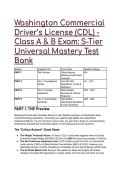
Washington Commercial
Driver’s License (CDL) -
Class A & B Exam: S-Tier
Universal Mastery Test
Bank
Section Cognitive Tier Focus Area Question Range
PART I The Preview Critical Axioms, N/A
Matrices & Hard Deck
Formulas
PART II Tier 1: Foundational Core WA CDL Q1 – Q15
Syntax Regulations, Limits &
Definitions
PART II Tier 2: Complex Multi-Variable Q16 – Q35
Application Scenarios & Tactical
Response
PART II Tier 3: Grandmaster High-Stakes Q36 – Q60
Synthesis Operational Simulation
& Crisis Synthesis
PART I: THE Preview
Mastering this test bank translates directly to elite, flawless execution of Washington State
commercial driving operations, immunizing you against legal liability and catastrophic
mechanical failures. You are not here to pass a test; you are here to forge an uncompromising
professional standard that commands respect on the highway and in the courtroom.
The "Critical Axioms" Cheat Sheet
● The Weight Threshold Axiom: A Class A CDL is universally triggered when the Gross
Combined Weight Rating (GCWR) is 26,001+ lbs AND the towed unit exceeds 10,000 lbs.
● The Zero-Tolerance Impairment Law: A CDL holder is guilty of a DUI in a commercial
motor vehicle (CMV) at a Blood Alcohol Concentration (BAC) of 0.04%. However, any
detectable alcohol (<0.04%) mandates an immediate 24-hour Out-of-Service (OOS) order.
● The Air Brake Bleed Limit: During a fully applied air brake test (engine off, brakes
released, foot pedal fully depressed), a single vehicle must not lose more than 3 psi per
, minute; a combination vehicle must not lose more than 4 psi per minute.
● The Washington Speed & Lane Mandate: Any vehicle exceeding 10,000 lbs GVWR, or
any combination vehicle, is strictly restricted to a maximum of 60 mph on state highways,
regardless of higher posted limits. These vehicles are strictly prohibited from utilizing the
far-left lane on any roadway with three or more lanes traveling in the same direction.
● The "Three-Lane" School Bus Exception: Under RCW 46.61.370, opposing traffic is
not required to stop for a school bus displaying red lights if the roadway has three or more
marked traffic lanes (e.g., a two-lane road with a center turn lane).
Washington CDL Restriction Matrix
Restriction Code Operational Limitation Technical Definition Source
E No Manual Skills test taken in an
Transmission automatic transmission
vehicle.
L No Air Brake Equipped Complete failure to
CMV pass air brake
knowledge/skills
testing.
Z No Full Air Brake CMV Skills test taken in
air-over-hydraulic
vehicle.
O No Tractor-Trailer CMV Skills test taken with a
pintle
hook/non-fifth-wheel
connection.
V Medical Variance Driver operates under a
federal or state medical
waiver.
K Intrastate Only Driver is under 21 or
certified as
Non-excepted
Intrastate.
PART II: THE ELITE TEST BANK
Tier 1: Foundational Syntax & Application
Q1: A driver operates a single-unit box truck with a Gross Vehicle Weight Rating (GVWR) of
27,500 lbs and occasionally tows a utility trailer with a GVWR of 9,500 lbs. Based on the
principles of Washington commercial vehicle classification, which CDL class is the ABSOLUTE
MINIMUM required? A) Class A CDL, because the combined GCWR exceeds 26,000 lbs. B)
Class C CDL with a heavy-towing endorsement. C) Class B CDL, because the single vehicle
exceeds 26,000 lbs GVWR but the towed unit is under 10,001 lbs. D) No CDL is required
because the trailer is under 10,000 lbs.
● The Answer: C (Class B CDL, because the single vehicle exceeds 26,000 lbs GVWR but
the towed unit is under 10,001 lbs.)
, ● Distractor Analysis:
○ A is incorrect: A Class A CDL is only triggered when the towed unit has a GVWR
strictly over 10,000 lbs, regardless of the combined weight.
○ B is incorrect: Washington State does not issue a heavy-towing endorsement for
Class C; Class C is reserved for vehicles under 26,001 lbs carrying 16+ passengers
or hazmat.
○ D is incorrect: The power unit itself exceeds 26,000 lbs GVWR, which automatically
legally mandates a Class B CDL.
The Mentor's Analysis: The fundamental dividing line between Class A and Class B
classification is entirely dependent on the weight of the towed unit. When analyzing vehicle
classifications, the immediate priority is verifying if the trailer breaches the 10,000 lb threshold.
By utilizing the 10,001 lb Trailer GVWR rule, you bypass the common trap of merely adding
weights together blindly. Professional/Academic Intuition: The trailer's weight dictates the
Class A upgrade; if the trailer is 10,000 lbs or less, you remain in Class B territory.
Q2: During a pre-trip inspection of a tractor-trailer combination, you perform a final applied air
brake test. With the air pressure at 125 psi, you shut off the engine, chock the wheels, release
the parking brake, and fully apply the foot brake. Over one minute, the air gauge drops from 120
psi to 115 psi. Based on federal and state air brake testing protocols, what is the IMMEDIATE
required action? A) Proceed with the route, as a 5 psi drop is within the acceptable 10%
operating variance for combination vehicles. B) Place the vehicle out of service immediately and
repair the air leaks, as the loss rate exceeds the maximum allowable limit. C) Bleed the tanks
manually to clear moisture, then retest to ensure the governor cut-in pressure stabilizes the
system. D) Proceed cautiously, but document the 5 psi loss in the Driver Vehicle Inspection
Report (DVIR).
● The Answer: B (Place the vehicle out of service immediately and repair the air leaks, as
the loss rate exceeds the maximum allowable limit.)
● Distractor Analysis:
○ A is incorrect: There is no "10% operating variance." A 5 psi drop in one minute for
a combination vehicle is a critical failure.
○ C is incorrect: While draining moisture is routine maintenance, it does not seal
closed-loop air leaks causing a static pressure drop.
○ D is incorrect: Driving a vehicle that fails the applied leakage test is illegal and
lethal. The loss rate is too high, and brakes could be lost during operation.
The Mentor's Analysis: Pneumatic integrity is the absolute foundation of heavy vehicle
stopping power. When facing a pressure drop during an applied brake test, the immediate
priority is measuring the loss against the hard-deck legal limits: 3 psi for single units, 4 psi for
combinations. By utilizing the 4-psi Combination Limit, you bypass the common trap of
accepting marginal air leaks as normal wear. Professional/Academic Intuition: 3 for single, 4
for combo; any leakage beyond these digits grounds the asset immediately.
Q3: A Washington State commercial driver holding a Class A CDL is pulled over while driving
their personal, non-commercial sedan on a Saturday night. The driver submits to a breathalyzer
and registers a Blood Alcohol Concentration (BAC) of 0.08%. Under Washington law, how will
this affect their commercial driving privileges? A) Their CDL will be unaffected because the
violation occurred in a personal vehicle, though their personal license will be suspended. B)
Their CDL will be suspended for 60 days as a standard "serious traffic violation." C) Their CDL
will be disqualified for at least one year because the 0.08% BAC constitutes a DUI, which strips
commercial privileges regardless of the vehicle driven. D) Their CDL will be revoked for life
immediately, as Washington maintains a zero-tolerance policy for off-duty CDL holders.
Driver’s License (CDL) -
Class A & B Exam: S-Tier
Universal Mastery Test
Bank
Section Cognitive Tier Focus Area Question Range
PART I The Preview Critical Axioms, N/A
Matrices & Hard Deck
Formulas
PART II Tier 1: Foundational Core WA CDL Q1 – Q15
Syntax Regulations, Limits &
Definitions
PART II Tier 2: Complex Multi-Variable Q16 – Q35
Application Scenarios & Tactical
Response
PART II Tier 3: Grandmaster High-Stakes Q36 – Q60
Synthesis Operational Simulation
& Crisis Synthesis
PART I: THE Preview
Mastering this test bank translates directly to elite, flawless execution of Washington State
commercial driving operations, immunizing you against legal liability and catastrophic
mechanical failures. You are not here to pass a test; you are here to forge an uncompromising
professional standard that commands respect on the highway and in the courtroom.
The "Critical Axioms" Cheat Sheet
● The Weight Threshold Axiom: A Class A CDL is universally triggered when the Gross
Combined Weight Rating (GCWR) is 26,001+ lbs AND the towed unit exceeds 10,000 lbs.
● The Zero-Tolerance Impairment Law: A CDL holder is guilty of a DUI in a commercial
motor vehicle (CMV) at a Blood Alcohol Concentration (BAC) of 0.04%. However, any
detectable alcohol (<0.04%) mandates an immediate 24-hour Out-of-Service (OOS) order.
● The Air Brake Bleed Limit: During a fully applied air brake test (engine off, brakes
released, foot pedal fully depressed), a single vehicle must not lose more than 3 psi per
, minute; a combination vehicle must not lose more than 4 psi per minute.
● The Washington Speed & Lane Mandate: Any vehicle exceeding 10,000 lbs GVWR, or
any combination vehicle, is strictly restricted to a maximum of 60 mph on state highways,
regardless of higher posted limits. These vehicles are strictly prohibited from utilizing the
far-left lane on any roadway with three or more lanes traveling in the same direction.
● The "Three-Lane" School Bus Exception: Under RCW 46.61.370, opposing traffic is
not required to stop for a school bus displaying red lights if the roadway has three or more
marked traffic lanes (e.g., a two-lane road with a center turn lane).
Washington CDL Restriction Matrix
Restriction Code Operational Limitation Technical Definition Source
E No Manual Skills test taken in an
Transmission automatic transmission
vehicle.
L No Air Brake Equipped Complete failure to
CMV pass air brake
knowledge/skills
testing.
Z No Full Air Brake CMV Skills test taken in
air-over-hydraulic
vehicle.
O No Tractor-Trailer CMV Skills test taken with a
pintle
hook/non-fifth-wheel
connection.
V Medical Variance Driver operates under a
federal or state medical
waiver.
K Intrastate Only Driver is under 21 or
certified as
Non-excepted
Intrastate.
PART II: THE ELITE TEST BANK
Tier 1: Foundational Syntax & Application
Q1: A driver operates a single-unit box truck with a Gross Vehicle Weight Rating (GVWR) of
27,500 lbs and occasionally tows a utility trailer with a GVWR of 9,500 lbs. Based on the
principles of Washington commercial vehicle classification, which CDL class is the ABSOLUTE
MINIMUM required? A) Class A CDL, because the combined GCWR exceeds 26,000 lbs. B)
Class C CDL with a heavy-towing endorsement. C) Class B CDL, because the single vehicle
exceeds 26,000 lbs GVWR but the towed unit is under 10,001 lbs. D) No CDL is required
because the trailer is under 10,000 lbs.
● The Answer: C (Class B CDL, because the single vehicle exceeds 26,000 lbs GVWR but
the towed unit is under 10,001 lbs.)
, ● Distractor Analysis:
○ A is incorrect: A Class A CDL is only triggered when the towed unit has a GVWR
strictly over 10,000 lbs, regardless of the combined weight.
○ B is incorrect: Washington State does not issue a heavy-towing endorsement for
Class C; Class C is reserved for vehicles under 26,001 lbs carrying 16+ passengers
or hazmat.
○ D is incorrect: The power unit itself exceeds 26,000 lbs GVWR, which automatically
legally mandates a Class B CDL.
The Mentor's Analysis: The fundamental dividing line between Class A and Class B
classification is entirely dependent on the weight of the towed unit. When analyzing vehicle
classifications, the immediate priority is verifying if the trailer breaches the 10,000 lb threshold.
By utilizing the 10,001 lb Trailer GVWR rule, you bypass the common trap of merely adding
weights together blindly. Professional/Academic Intuition: The trailer's weight dictates the
Class A upgrade; if the trailer is 10,000 lbs or less, you remain in Class B territory.
Q2: During a pre-trip inspection of a tractor-trailer combination, you perform a final applied air
brake test. With the air pressure at 125 psi, you shut off the engine, chock the wheels, release
the parking brake, and fully apply the foot brake. Over one minute, the air gauge drops from 120
psi to 115 psi. Based on federal and state air brake testing protocols, what is the IMMEDIATE
required action? A) Proceed with the route, as a 5 psi drop is within the acceptable 10%
operating variance for combination vehicles. B) Place the vehicle out of service immediately and
repair the air leaks, as the loss rate exceeds the maximum allowable limit. C) Bleed the tanks
manually to clear moisture, then retest to ensure the governor cut-in pressure stabilizes the
system. D) Proceed cautiously, but document the 5 psi loss in the Driver Vehicle Inspection
Report (DVIR).
● The Answer: B (Place the vehicle out of service immediately and repair the air leaks, as
the loss rate exceeds the maximum allowable limit.)
● Distractor Analysis:
○ A is incorrect: There is no "10% operating variance." A 5 psi drop in one minute for
a combination vehicle is a critical failure.
○ C is incorrect: While draining moisture is routine maintenance, it does not seal
closed-loop air leaks causing a static pressure drop.
○ D is incorrect: Driving a vehicle that fails the applied leakage test is illegal and
lethal. The loss rate is too high, and brakes could be lost during operation.
The Mentor's Analysis: Pneumatic integrity is the absolute foundation of heavy vehicle
stopping power. When facing a pressure drop during an applied brake test, the immediate
priority is measuring the loss against the hard-deck legal limits: 3 psi for single units, 4 psi for
combinations. By utilizing the 4-psi Combination Limit, you bypass the common trap of
accepting marginal air leaks as normal wear. Professional/Academic Intuition: 3 for single, 4
for combo; any leakage beyond these digits grounds the asset immediately.
Q3: A Washington State commercial driver holding a Class A CDL is pulled over while driving
their personal, non-commercial sedan on a Saturday night. The driver submits to a breathalyzer
and registers a Blood Alcohol Concentration (BAC) of 0.08%. Under Washington law, how will
this affect their commercial driving privileges? A) Their CDL will be unaffected because the
violation occurred in a personal vehicle, though their personal license will be suspended. B)
Their CDL will be suspended for 60 days as a standard "serious traffic violation." C) Their CDL
will be disqualified for at least one year because the 0.08% BAC constitutes a DUI, which strips
commercial privileges regardless of the vehicle driven. D) Their CDL will be revoked for life
immediately, as Washington maintains a zero-tolerance policy for off-duty CDL holders.


