
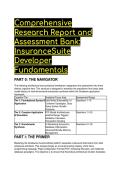
Comprehensive
Research Report and
Assessment Bank:
InsuranceSuite
Developer
Fundamentals
PART 0: THE NAVIGATOR
The following architectural and syntactical breakdown categorizes the assessment into three
distinct cognitive tiers. This structure is designed to transition the practitioner from basic data
model literacy to multi-dimensional transaction synthesis within the Guidewire application
framework.
Cognitive Tier Analytical Focus Area Assessment Range
Tier 1: Foundational Syntax & Data Model Extensibility, UI Questions 1–10
Application Container Topologies, Gosu
Query Syntax, Bundle
Primitives
Tier 2: Complex Application PCF Modal Architectures, Questions 11–20
& Simulation postOnChange Triggers,
Validation Cascades,
Transaction Scoping
Tier 3: Grandmaster UI Rendering Economics, Questions 21–30
Synthesis Database Optimization,
Advanced Bundle Memory
Management
PART I: THE PRIMER
Mastering the Guidewire InsuranceSuite platform separates code-level technicians from elite
enterprise architects. This analysis forges an uncompromising mastery of the Gosu
programming language, Page Configuration Format (PCF) rendering lifecycles, and relational
database paradigms. The objective is to ensure that theoretical architectural intuition translates
,directly into scalable, defect-free production deployments across complex financial systems.
The core architecture of InsuranceSuite relies on a highly abstracted Object-Relational Mapping
(ORM) layer, a proprietary MVC-style UI framework, and a strict transactional bundle memory
system. A failure to understand the interplay between these three domains results in severe
performance degradation, corrupted database states, and catastrophic memory leaks during
high-volume batch processing.
Architectural Axioms and Frameworks
To navigate the application safely, practitioners must internalize several non-negotiable system
paradigms. The following table delineates the foundational laws governing data structure,
memory management, and user interface rendering within the ecosystem.
Axiom Category Core Principle Technical Execution
The Bundle Mandate All database interactions Entities in a read-only bundle
mandate an explicit or implicit cannot be modified without
transaction bundle. invoking bundle.add().
gw.transaction.Transaction.run
WithNewBundle() is absolute
for custom batch processes
and web services.
Data Model Immutability Core platform entities cannot Use .eti files for entirely new
be directly altered; they must custom entities. Use .etx files
be extended. strictly to extend base
application entities.
Inheritance Economics Sharing functionality across Implement Delegation over
entities must avoid database Subtyping when sharing
table bloat. behaviors across discrete entity
types to prevent massive
single-table inheritance
fragmentation.
Validation Cascades The validation engine does not Explicitly configure
assume child modifications triggersValidation="true" on
invalidate the parent. foreign keys or arrays to force
the application to validate the
parent entity upon a child
commit.
Query Optimization Application heap memory must Utilize FirstResult on Gosu
be protected from massive queries. This executes a
database pulls. DBMS-level TOP 1
optimization, whereas .first()
retrieves the entire collection
into memory before filtering.
UI Rendering Efficiency Server round-trips must be Client Reflection executes
minimized during user entirely within the browser for
interaction. instantaneous updates.
postOnChange mandates a
server request and should be
, Axiom Category Core Principle Technical Execution
reserved for structural UI
changes.
The interaction between the user interface and the underlying data model is mediated by the
Gosu rule engine. The application utilizes a distinct lifecycle sequence during any data
persistence event. When a transaction is initiated, the system first executes PreUpdate rules,
allowing domain logic to finalize calculations or auto-populate fields before the object is
committed. Following the PreUpdate phase, the Validation rules run to ensure data integrity
against the configured schema and business logic. Finally, the bundle is committed to the
database. Understanding this exact sequence is the primary barrier preventing the introduction
of phantom writes, infinite loops, and asynchronous data corruption.
PART II: THE ELITE TEST BANK
Tier 1: Foundational Syntax & Application
Q1: An implementation architect is tasked with adding three new fields to the baseline Policy
entity to support a specialized line of business. Based on the InsuranceSuite Data Model
architecture, which file type configuration is the MOST APPROPRIATE choice? A) A new
custom .eti file containing the three new fields. B) A new .eix internal file to override the
Guidewire application core. C) A new .etx file named Policy_Ext.etx containing the extension
elements. D) A custom .tti file configured with the required new fields.
● The Answer: C (A new .etx file named Policy_Ext.etx containing the extension elements.)
● Distractor Analysis:
○ A is incorrect: The .eti extension is strictly reserved for creating entirely new base or
custom entities, not for extending existing base application entities.
○ B is incorrect: The .eix format denotes internal, read-only entities provided by the
software vendor that cannot be extended or modified by implementation
developers.
○ D is incorrect: The .tti extension is utilized exclusively for defining new Typelists,
which are enumerations, not data entities.
The Mentor's Analysis: The fundamental architecture of the platform demands strict
separation between base code and customer configurations. When augmenting an
out-of-the-box entity, the immediate priority is preserving upgradeability and data model integrity.
By utilizing an .etx file, the architecture bypasses the common trap of corrupting the base data
model, ensuring that future software updates do not overwrite custom business logic.
Professional/Academic Intuition: Base entities are extended exclusively via .etx files; entirely
new customer entities are instantiated via .eti files.
Q2: When structuring a new Page Configuration Format (PCF) element, a developer requires a
reusable configuration that organizes atomic widgets in a tabular format to display a collection of
records. Which container type represents the MOST ACCURATE selection? A) DetailView
configured within a Card View. B) InputSet attached directly to a Top-Level Screen. C) ListView
referenced within a PanelRef. D) A Location Group containing multiple array objects.
● The Answer: C (ListView referenced within a PanelRef.)
● Distractor Analysis:
○ A is incorrect: A DetailView organizes data fields into static columns, and cannot
natively render a tabular array format for multiple records.
Research Report and
Assessment Bank:
InsuranceSuite
Developer
Fundamentals
PART 0: THE NAVIGATOR
The following architectural and syntactical breakdown categorizes the assessment into three
distinct cognitive tiers. This structure is designed to transition the practitioner from basic data
model literacy to multi-dimensional transaction synthesis within the Guidewire application
framework.
Cognitive Tier Analytical Focus Area Assessment Range
Tier 1: Foundational Syntax & Data Model Extensibility, UI Questions 1–10
Application Container Topologies, Gosu
Query Syntax, Bundle
Primitives
Tier 2: Complex Application PCF Modal Architectures, Questions 11–20
& Simulation postOnChange Triggers,
Validation Cascades,
Transaction Scoping
Tier 3: Grandmaster UI Rendering Economics, Questions 21–30
Synthesis Database Optimization,
Advanced Bundle Memory
Management
PART I: THE PRIMER
Mastering the Guidewire InsuranceSuite platform separates code-level technicians from elite
enterprise architects. This analysis forges an uncompromising mastery of the Gosu
programming language, Page Configuration Format (PCF) rendering lifecycles, and relational
database paradigms. The objective is to ensure that theoretical architectural intuition translates
,directly into scalable, defect-free production deployments across complex financial systems.
The core architecture of InsuranceSuite relies on a highly abstracted Object-Relational Mapping
(ORM) layer, a proprietary MVC-style UI framework, and a strict transactional bundle memory
system. A failure to understand the interplay between these three domains results in severe
performance degradation, corrupted database states, and catastrophic memory leaks during
high-volume batch processing.
Architectural Axioms and Frameworks
To navigate the application safely, practitioners must internalize several non-negotiable system
paradigms. The following table delineates the foundational laws governing data structure,
memory management, and user interface rendering within the ecosystem.
Axiom Category Core Principle Technical Execution
The Bundle Mandate All database interactions Entities in a read-only bundle
mandate an explicit or implicit cannot be modified without
transaction bundle. invoking bundle.add().
gw.transaction.Transaction.run
WithNewBundle() is absolute
for custom batch processes
and web services.
Data Model Immutability Core platform entities cannot Use .eti files for entirely new
be directly altered; they must custom entities. Use .etx files
be extended. strictly to extend base
application entities.
Inheritance Economics Sharing functionality across Implement Delegation over
entities must avoid database Subtyping when sharing
table bloat. behaviors across discrete entity
types to prevent massive
single-table inheritance
fragmentation.
Validation Cascades The validation engine does not Explicitly configure
assume child modifications triggersValidation="true" on
invalidate the parent. foreign keys or arrays to force
the application to validate the
parent entity upon a child
commit.
Query Optimization Application heap memory must Utilize FirstResult on Gosu
be protected from massive queries. This executes a
database pulls. DBMS-level TOP 1
optimization, whereas .first()
retrieves the entire collection
into memory before filtering.
UI Rendering Efficiency Server round-trips must be Client Reflection executes
minimized during user entirely within the browser for
interaction. instantaneous updates.
postOnChange mandates a
server request and should be
, Axiom Category Core Principle Technical Execution
reserved for structural UI
changes.
The interaction between the user interface and the underlying data model is mediated by the
Gosu rule engine. The application utilizes a distinct lifecycle sequence during any data
persistence event. When a transaction is initiated, the system first executes PreUpdate rules,
allowing domain logic to finalize calculations or auto-populate fields before the object is
committed. Following the PreUpdate phase, the Validation rules run to ensure data integrity
against the configured schema and business logic. Finally, the bundle is committed to the
database. Understanding this exact sequence is the primary barrier preventing the introduction
of phantom writes, infinite loops, and asynchronous data corruption.
PART II: THE ELITE TEST BANK
Tier 1: Foundational Syntax & Application
Q1: An implementation architect is tasked with adding three new fields to the baseline Policy
entity to support a specialized line of business. Based on the InsuranceSuite Data Model
architecture, which file type configuration is the MOST APPROPRIATE choice? A) A new
custom .eti file containing the three new fields. B) A new .eix internal file to override the
Guidewire application core. C) A new .etx file named Policy_Ext.etx containing the extension
elements. D) A custom .tti file configured with the required new fields.
● The Answer: C (A new .etx file named Policy_Ext.etx containing the extension elements.)
● Distractor Analysis:
○ A is incorrect: The .eti extension is strictly reserved for creating entirely new base or
custom entities, not for extending existing base application entities.
○ B is incorrect: The .eix format denotes internal, read-only entities provided by the
software vendor that cannot be extended or modified by implementation
developers.
○ D is incorrect: The .tti extension is utilized exclusively for defining new Typelists,
which are enumerations, not data entities.
The Mentor's Analysis: The fundamental architecture of the platform demands strict
separation between base code and customer configurations. When augmenting an
out-of-the-box entity, the immediate priority is preserving upgradeability and data model integrity.
By utilizing an .etx file, the architecture bypasses the common trap of corrupting the base data
model, ensuring that future software updates do not overwrite custom business logic.
Professional/Academic Intuition: Base entities are extended exclusively via .etx files; entirely
new customer entities are instantiated via .eti files.
Q2: When structuring a new Page Configuration Format (PCF) element, a developer requires a
reusable configuration that organizes atomic widgets in a tabular format to display a collection of
records. Which container type represents the MOST ACCURATE selection? A) DetailView
configured within a Card View. B) InputSet attached directly to a Top-Level Screen. C) ListView
referenced within a PanelRef. D) A Location Group containing multiple array objects.
● The Answer: C (ListView referenced within a PanelRef.)
● Distractor Analysis:
○ A is incorrect: A DetailView organizes data fields into static columns, and cannot
natively render a tabular array format for multiple records.


