

CSET Subtest 3 Exam Actual 2026 Newest
Updated Questions and Correct Answers (Latest
Update) (Verified Answers by
Expert)
Save
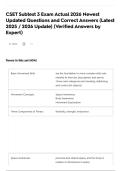
Terms in this set (454)
Basic Movement Skills are the foundation to more complex skills sets
needed to exercise, play games, and sports.
-three main categories are traveling, stabilizing,
and control (of objects)
Movement Concepts Space Awareness
Body Awareness
Movement Exploration
Three Components of Fitness flexibility, strength, endurance
Space Awareness personal and shared space, and the body in
relation to dimensions in space
,Body Awareness teaches children about body shapes, body parts,
and relationships
-proprioception
Body Awareness Lessons Shape- have students form different shapes with
their body (stand like a pole)
Balance- balance on one foot
Quality - "how fast or how slow can you move?"
Space - "run in a zigzag fashion without hitting
others"
Exploration - "lead with your head while you're
walking"
Movement Exploration Allows students to experiment with time, space,
force, and flow as the elements of movement
PE Standards I: competency in motor skills and movement
patterns (locomotor, non-locomotor,
manipulative)
II: understanding of movement principals,
strategies, tactics, and apply it to performance
(directions, identifying locomotor skills)
III: regular participation in physical activity
(aerobic exercise)
IV: achieve and maintain health enhancing level
of physical fitness (learning about the body)
V: responsible personal and social behavior in
physical activity
Throwing Basics Underarm - step and swing, point to target
Overarm - step and over head, point to target
, Locomotor Skills skills used to move around, such as walking,
running, and climbing
-indicates the movement of the body
-basis of gross motor skills
-K-2: still mastering locomotor skills
-3-9: more complex locomotor skills
Locomotor Skill Activities Jumping - bend knees, have your feet leave the
ground, land with knees bent to act as shock
absorbers
-- in 3-9 this is combined with sports
Skipping - series of step hops completed with
alternate feet
Galloping - can be taught by going in a circle
Sliding
Nonlocomotor Skills indicates body control and balance, with little
emphasis on movement
-used to balance, bend, stretch, and pull
Nonlocomotor Skill Activities Stretching - carries body parts away from the
body's center core
--should begin all warm up activities
Twisting - rotation of a body part around its own
long axis
Pushing - controlled forceful action
Updated Questions and Correct Answers (Latest
Update) (Verified Answers by
Expert)
Save
Terms in this set (454)
Basic Movement Skills are the foundation to more complex skills sets
needed to exercise, play games, and sports.
-three main categories are traveling, stabilizing,
and control (of objects)
Movement Concepts Space Awareness
Body Awareness
Movement Exploration
Three Components of Fitness flexibility, strength, endurance
Space Awareness personal and shared space, and the body in
relation to dimensions in space
,Body Awareness teaches children about body shapes, body parts,
and relationships
-proprioception
Body Awareness Lessons Shape- have students form different shapes with
their body (stand like a pole)
Balance- balance on one foot
Quality - "how fast or how slow can you move?"
Space - "run in a zigzag fashion without hitting
others"
Exploration - "lead with your head while you're
walking"
Movement Exploration Allows students to experiment with time, space,
force, and flow as the elements of movement
PE Standards I: competency in motor skills and movement
patterns (locomotor, non-locomotor,
manipulative)
II: understanding of movement principals,
strategies, tactics, and apply it to performance
(directions, identifying locomotor skills)
III: regular participation in physical activity
(aerobic exercise)
IV: achieve and maintain health enhancing level
of physical fitness (learning about the body)
V: responsible personal and social behavior in
physical activity
Throwing Basics Underarm - step and swing, point to target
Overarm - step and over head, point to target
, Locomotor Skills skills used to move around, such as walking,
running, and climbing
-indicates the movement of the body
-basis of gross motor skills
-K-2: still mastering locomotor skills
-3-9: more complex locomotor skills
Locomotor Skill Activities Jumping - bend knees, have your feet leave the
ground, land with knees bent to act as shock
absorbers
-- in 3-9 this is combined with sports
Skipping - series of step hops completed with
alternate feet
Galloping - can be taught by going in a circle
Sliding
Nonlocomotor Skills indicates body control and balance, with little
emphasis on movement
-used to balance, bend, stretch, and pull
Nonlocomotor Skill Activities Stretching - carries body parts away from the
body's center core
--should begin all warm up activities
Twisting - rotation of a body part around its own
long axis
Pushing - controlled forceful action


