
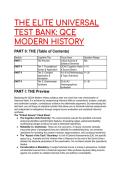
THE ELITE UNIVERSAL
TEST BANK: QCE
MODERN HISTORY
PART 0: THE (Table of Contents)
Section Cognitive Tier Focus Area Question Range
PART I The Preview Critical Axioms & N/A
Syllabus Directives
PART II Tier 1: Foundational QCAA Cognitive Verbs 1–10
Syntax & Application & Source Basics
PART II Tier 2: Complex IA1 & IA2 Methodology 11–20
Application & & Topic Scenarios
Simulation
PART II Tier 3: Grandmaster EA & IA3 21–30
Synthesis Historiographical
Evaluation
PART I: THE Preview
Mastering the QCAA Modern History syllabus does not come from rote memorization of
historical dates; it is achieved by weaponizing historical skills to comprehend, analyse, evaluate,
and synthesise complex, contradictory evidence into defensible arguments. By internalizing this
test bank, you will forge an analytical intuition that allows you to dominate external assessments
and independent investigations through surgical source evaluation and sustained historical
synthesis.
The "Critical Axioms" Cheat Sheet:
● The Cognitive Verb Hierarchy: You must precisely execute the specified command.
Analysing identifies explicit/implicit features; Evaluating judges usefulness/reliability;
Synthesising merges evidence to build a defensible hypothesis.
● Reliability vs. Usefulness: These are not synonyms. A heavily censored, factually
inaccurate piece of propaganda has zero reliability for establishing facts, but immense
usefulness for revealing the creator's motives, target audience, and contextual worldview.
● The "Aspect of the Topic" Boundary: In Unit 4 External Assessments (EA), the specific
aspect (e.g., Australia and the Vietnam War or Reasons for the end of the Soviet Union)
dictates the absolute parameters of the examination. Do not bleed outside this operational
theatre.
● Corroboration is Mandatory: A single historical source is merely a perspective; multiple
corroborated sources form a historical argument. Elite synthesis requires pitting sources
against one another to validate historical truths and address contestability.
,PART II: THE ELITE TEST BANK
Tier 1 - Foundational Syntax & Application
Q1: During the Summative Internal Assessment 1 (IA1), a student is presented with an unseen
essay question and 12 historical sources concerning Germany, 1914–1945. Based on the
QCAA principles of Synthesising, which action is the FIRST and MOST APPROPRIATE
cognitive step before drafting the response? A) Immediately writing an introduction that quotes
the three most reliable primary sources to establish academic authority. B) Evaluating the origin
and motive of every single source in isolation to prove their individual historical usefulness. C)
Corroborating evidence across multiple sources to develop a unique, sustained historical
hypothesis that directly answers the unseen question. D) Categorizing the sources
chronologically to form a basic narrative timeline of the historical event.
● The Answer: C (Corroborating evidence across multiple sources to develop a unique,
sustained historical hypothesis that directly answers the unseen question.)
● Distractor Analysis:
○ A is incorrect: Quoting sources before forming a hypothesis bypasses the synthesis
requirement entirely, leading to a descriptive, rather than analytical, essay structure.
○ B is incorrect: While evaluating origin and motive is vital for the Evaluating criterion,
doing it for all 12 sources indiscriminately wastes limited examination time and
ignores the requirement to synthesize evidence toward a specific argument.
○ D is incorrect: Organizing a chronological narrative demonstrates Comprehending,
not Synthesising. It fails to address the analytical demands of an essay in response
to historical sources.
The Mentor's Analysis: The IA1 examination requires students to generate a sustained
historical argument under highly restrictive timed conditions. You cannot simply list or describe
sources; you must forge them into a cohesive weapon. By focusing on Synthesising early, you
bypass the novice trap of treating sources as isolated islands of data.
QCAA Cognitive Verb Operational Definition in Modern History
Comprehending Identifying and using relevant terms in historical
context.
Analysing Examining explicit and implicit features of
evidence.
Evaluating Making judgments about usefulness and
reliability based on evidence.
Synthesising Combining disparate evidence to develop a
sustained historical argument.
Professional/Academic Intuition: Synthesis is not summarizing; it is the strategic combination
of disparate evidence to construct a defensible historical truth.
Q2: When analyzing a highly biased piece of government propaganda from the Australian
Frontier Wars (Unit 1, Topic 1) , a student dismisses the source entirely because its assertions
regarding indigenous populations are factually inaccurate. Based on QCE assessment
standards for Evaluating, why is this conclusion TECHNICALLY FLAWED? A) Propaganda is
always considered a secondary source, meaning factual accuracy is irrelevant in the QCAA
syllabus. B) The student confused reliability with usefulness; a highly unreliable source can still
be exceptionally useful for revealing the motives, prejudices, and perspectives of the colonial
, creators. C) Government documents are inherently reliable due to their official provenance,
making the student's premise incorrect from the start. D) The student failed to apply the
cognitive verb Comprehend, which requires accepting historical primary sources at face value
regardless of colonial bias.
● The Answer: B (The student confused reliability with usefulness; a highly unreliable
source can still be exceptionally useful for revealing the motives, prejudices, and
perspectives of the colonial creators.)
● Distractor Analysis:
○ A is incorrect: Propaganda from the era being studied is a primary source, not a
secondary source. Furthermore, factual accuracy is never "irrelevant," but it is not
the only metric of value.
○ C is incorrect: Official provenance does not guarantee factual reliability, especially
in the context of frontier conflict and colonial government reporting where motives to
suppress violence were high.
○ D is incorrect: Comprehending does not mean accepting things blindly; it means
understanding terms and contexts. Evaluating demands critical judgment of bias,
not blind acceptance.
The Mentor's Analysis: Novices discard biased sources because they are looking exclusively
for objective facts. Experts mine biased sources because they are looking for historical context
and motive. A lie published in a colonial newspaper tells you exactly what the publisher wanted
the public to believe, revealing the structural mechanics of historical racism and frontier policy.
Professional/Academic Intuition: Never discard a source solely for bias. Bias is a
fundamental feature of historical evidence, not a bug.
Q3: The QCAA cognitive verbs dictate specific student actions during assessments. If a short
response question asks a student to ANALYSE the features of evidence in a historical source
regarding the May Fourth Movement in China (Unit 3, Topic 5) , which response aligns BEST
with this exact command? A) Making a final, definitive judgment about whether the source is
trustworthy enough to be used in a larger research essay. B) Examining the source to explicitly
identify its implicit meanings, context, audience, and the relationship between its visual or
textual parts. C) Creating a chronological timeline of Chinese political events that led up to the
creation of the source. D) Combining the source with three other provided documents to build a
new historical narrative about the student movement.
● The Answer: B (Examining the source to explicitly identify its implicit meanings, context,
audience, and the relationship between its visual or textual parts.)
● Distractor Analysis:
○ A is incorrect: Making a judgment about trustworthiness is the strict definition of
Evaluating, not Analysing.
○ C is incorrect: Organizing a timeline is an act of Comprehending and basic recall,
failing to meet the rigorous analytical threshold required by the syllabus.
○ D is incorrect: Combining multiple sources to build a narrative is the definition of
Synthesising, which is a separate cognitive step that must occur after analysis.
The Mentor's Analysis: To "Analyse" in Modern History is to dissect the source. You are taking
it apart to see how the gears work—looking at tone, audience, motive, and historical context.
You do not judge it (Evaluate) or combine it (Synthesise) until the rigorous analysis is complete.
The failure to separate these cognitive verbs results in a convoluted, mid-tier response.
Professional/Academic Intuition: Analysis is the dissection of evidence; Evaluation is the
judgment of its worth.
Q4: In designing their course of study for Unit 4, a school selects Topic 1: Australian
TEST BANK: QCE
MODERN HISTORY
PART 0: THE (Table of Contents)
Section Cognitive Tier Focus Area Question Range
PART I The Preview Critical Axioms & N/A
Syllabus Directives
PART II Tier 1: Foundational QCAA Cognitive Verbs 1–10
Syntax & Application & Source Basics
PART II Tier 2: Complex IA1 & IA2 Methodology 11–20
Application & & Topic Scenarios
Simulation
PART II Tier 3: Grandmaster EA & IA3 21–30
Synthesis Historiographical
Evaluation
PART I: THE Preview
Mastering the QCAA Modern History syllabus does not come from rote memorization of
historical dates; it is achieved by weaponizing historical skills to comprehend, analyse, evaluate,
and synthesise complex, contradictory evidence into defensible arguments. By internalizing this
test bank, you will forge an analytical intuition that allows you to dominate external assessments
and independent investigations through surgical source evaluation and sustained historical
synthesis.
The "Critical Axioms" Cheat Sheet:
● The Cognitive Verb Hierarchy: You must precisely execute the specified command.
Analysing identifies explicit/implicit features; Evaluating judges usefulness/reliability;
Synthesising merges evidence to build a defensible hypothesis.
● Reliability vs. Usefulness: These are not synonyms. A heavily censored, factually
inaccurate piece of propaganda has zero reliability for establishing facts, but immense
usefulness for revealing the creator's motives, target audience, and contextual worldview.
● The "Aspect of the Topic" Boundary: In Unit 4 External Assessments (EA), the specific
aspect (e.g., Australia and the Vietnam War or Reasons for the end of the Soviet Union)
dictates the absolute parameters of the examination. Do not bleed outside this operational
theatre.
● Corroboration is Mandatory: A single historical source is merely a perspective; multiple
corroborated sources form a historical argument. Elite synthesis requires pitting sources
against one another to validate historical truths and address contestability.
,PART II: THE ELITE TEST BANK
Tier 1 - Foundational Syntax & Application
Q1: During the Summative Internal Assessment 1 (IA1), a student is presented with an unseen
essay question and 12 historical sources concerning Germany, 1914–1945. Based on the
QCAA principles of Synthesising, which action is the FIRST and MOST APPROPRIATE
cognitive step before drafting the response? A) Immediately writing an introduction that quotes
the three most reliable primary sources to establish academic authority. B) Evaluating the origin
and motive of every single source in isolation to prove their individual historical usefulness. C)
Corroborating evidence across multiple sources to develop a unique, sustained historical
hypothesis that directly answers the unseen question. D) Categorizing the sources
chronologically to form a basic narrative timeline of the historical event.
● The Answer: C (Corroborating evidence across multiple sources to develop a unique,
sustained historical hypothesis that directly answers the unseen question.)
● Distractor Analysis:
○ A is incorrect: Quoting sources before forming a hypothesis bypasses the synthesis
requirement entirely, leading to a descriptive, rather than analytical, essay structure.
○ B is incorrect: While evaluating origin and motive is vital for the Evaluating criterion,
doing it for all 12 sources indiscriminately wastes limited examination time and
ignores the requirement to synthesize evidence toward a specific argument.
○ D is incorrect: Organizing a chronological narrative demonstrates Comprehending,
not Synthesising. It fails to address the analytical demands of an essay in response
to historical sources.
The Mentor's Analysis: The IA1 examination requires students to generate a sustained
historical argument under highly restrictive timed conditions. You cannot simply list or describe
sources; you must forge them into a cohesive weapon. By focusing on Synthesising early, you
bypass the novice trap of treating sources as isolated islands of data.
QCAA Cognitive Verb Operational Definition in Modern History
Comprehending Identifying and using relevant terms in historical
context.
Analysing Examining explicit and implicit features of
evidence.
Evaluating Making judgments about usefulness and
reliability based on evidence.
Synthesising Combining disparate evidence to develop a
sustained historical argument.
Professional/Academic Intuition: Synthesis is not summarizing; it is the strategic combination
of disparate evidence to construct a defensible historical truth.
Q2: When analyzing a highly biased piece of government propaganda from the Australian
Frontier Wars (Unit 1, Topic 1) , a student dismisses the source entirely because its assertions
regarding indigenous populations are factually inaccurate. Based on QCE assessment
standards for Evaluating, why is this conclusion TECHNICALLY FLAWED? A) Propaganda is
always considered a secondary source, meaning factual accuracy is irrelevant in the QCAA
syllabus. B) The student confused reliability with usefulness; a highly unreliable source can still
be exceptionally useful for revealing the motives, prejudices, and perspectives of the colonial
, creators. C) Government documents are inherently reliable due to their official provenance,
making the student's premise incorrect from the start. D) The student failed to apply the
cognitive verb Comprehend, which requires accepting historical primary sources at face value
regardless of colonial bias.
● The Answer: B (The student confused reliability with usefulness; a highly unreliable
source can still be exceptionally useful for revealing the motives, prejudices, and
perspectives of the colonial creators.)
● Distractor Analysis:
○ A is incorrect: Propaganda from the era being studied is a primary source, not a
secondary source. Furthermore, factual accuracy is never "irrelevant," but it is not
the only metric of value.
○ C is incorrect: Official provenance does not guarantee factual reliability, especially
in the context of frontier conflict and colonial government reporting where motives to
suppress violence were high.
○ D is incorrect: Comprehending does not mean accepting things blindly; it means
understanding terms and contexts. Evaluating demands critical judgment of bias,
not blind acceptance.
The Mentor's Analysis: Novices discard biased sources because they are looking exclusively
for objective facts. Experts mine biased sources because they are looking for historical context
and motive. A lie published in a colonial newspaper tells you exactly what the publisher wanted
the public to believe, revealing the structural mechanics of historical racism and frontier policy.
Professional/Academic Intuition: Never discard a source solely for bias. Bias is a
fundamental feature of historical evidence, not a bug.
Q3: The QCAA cognitive verbs dictate specific student actions during assessments. If a short
response question asks a student to ANALYSE the features of evidence in a historical source
regarding the May Fourth Movement in China (Unit 3, Topic 5) , which response aligns BEST
with this exact command? A) Making a final, definitive judgment about whether the source is
trustworthy enough to be used in a larger research essay. B) Examining the source to explicitly
identify its implicit meanings, context, audience, and the relationship between its visual or
textual parts. C) Creating a chronological timeline of Chinese political events that led up to the
creation of the source. D) Combining the source with three other provided documents to build a
new historical narrative about the student movement.
● The Answer: B (Examining the source to explicitly identify its implicit meanings, context,
audience, and the relationship between its visual or textual parts.)
● Distractor Analysis:
○ A is incorrect: Making a judgment about trustworthiness is the strict definition of
Evaluating, not Analysing.
○ C is incorrect: Organizing a timeline is an act of Comprehending and basic recall,
failing to meet the rigorous analytical threshold required by the syllabus.
○ D is incorrect: Combining multiple sources to build a narrative is the definition of
Synthesising, which is a separate cognitive step that must occur after analysis.
The Mentor's Analysis: To "Analyse" in Modern History is to dissect the source. You are taking
it apart to see how the gears work—looking at tone, audience, motive, and historical context.
You do not judge it (Evaluate) or combine it (Synthesise) until the rigorous analysis is complete.
The failure to separate these cognitive verbs results in a convoluted, mid-tier response.
Professional/Academic Intuition: Analysis is the dissection of evidence; Evaluation is the
judgment of its worth.
Q4: In designing their course of study for Unit 4, a school selects Topic 1: Australian


