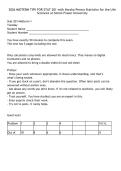
2026 MIDTERM TIPS FOR STAT 201 with Harsha Perera Statistics for the Life
Sciences at Simon Fraser University
Stat 201 Midterm 1
Tuesday
Student Name
Student Number
You have exactly 50 minutes to complete this exam.
This test has 5 pages including this one.
Only calculators (any kind) are allowed for electronics. That means no digital
translators and no phones.
You are allowed to bring a double-sided A4 size aid-sheet
Protips:
- Show your work whenever appropriate. It shows understanding, and that’s
what’s being tested.
- If you get stuck on a part, don't abandon the question. Often later parts can be
answered without earlier ones.
- Ask about any words you don't know. If it's not related to statistics, you will likely
get an answer.
- Trust yourself. You have studied; you are an expert in this.
- Even experts check their work.
- Try not to panic, it rarely helps.
Good luck!
Problem 1 2 3 4 TOTAL
Out of 10 8 6 6 30
, Problem 1: 10 pts total, 2 for each part
A baby can be born either pre-term, at the normal time, or late term. Every baby fits exactly one of
these categories (no overlap, no missing values). Without knowing anything else about a given baby,
the following probabilities apply:
Pr(pre-term) = 0.20 Pr(normal) = 0.70 Pr(late) = 0.10
a) Find Pr(pre-term OR normal)
0.20 + 0.70 = 0.90
b) Find Pr(pre-term AND normal)
0, by property of mutual exclusivity
c) Find Pr(late | not pre-term)
Pr(not pre-term) = 1 – 0.20 = 0.80 ( Or 0.10 + 0.70 = 0.80)
Pr(late AND not pre-term) = Pr(late) X Pr(not pre-term | late) = 0.10 x 1 = 0.10
Therfore
Pr(late | not pre-term) = Pr( late AND not pre-term) / Pr(not pre-term)
= 0..80 = 1/8 or 0.125
d) Assume each baby is independent. Find the probability that three particular babies are all born at the
normal time?
0.7 x 0.7 x 0.7 = 0.343
e) If these three babies are all from the same mother and father, is the independence assumption
reasonable? Why or why not?
No. There may be genetic or other medical factors that affect a given set of parents' chances at a
pre-term or late birth.
Sciences at Simon Fraser University
Stat 201 Midterm 1
Tuesday
Student Name
Student Number
You have exactly 50 minutes to complete this exam.
This test has 5 pages including this one.
Only calculators (any kind) are allowed for electronics. That means no digital
translators and no phones.
You are allowed to bring a double-sided A4 size aid-sheet
Protips:
- Show your work whenever appropriate. It shows understanding, and that’s
what’s being tested.
- If you get stuck on a part, don't abandon the question. Often later parts can be
answered without earlier ones.
- Ask about any words you don't know. If it's not related to statistics, you will likely
get an answer.
- Trust yourself. You have studied; you are an expert in this.
- Even experts check their work.
- Try not to panic, it rarely helps.
Good luck!
Problem 1 2 3 4 TOTAL
Out of 10 8 6 6 30
, Problem 1: 10 pts total, 2 for each part
A baby can be born either pre-term, at the normal time, or late term. Every baby fits exactly one of
these categories (no overlap, no missing values). Without knowing anything else about a given baby,
the following probabilities apply:
Pr(pre-term) = 0.20 Pr(normal) = 0.70 Pr(late) = 0.10
a) Find Pr(pre-term OR normal)
0.20 + 0.70 = 0.90
b) Find Pr(pre-term AND normal)
0, by property of mutual exclusivity
c) Find Pr(late | not pre-term)
Pr(not pre-term) = 1 – 0.20 = 0.80 ( Or 0.10 + 0.70 = 0.80)
Pr(late AND not pre-term) = Pr(late) X Pr(not pre-term | late) = 0.10 x 1 = 0.10
Therfore
Pr(late | not pre-term) = Pr( late AND not pre-term) / Pr(not pre-term)
= 0..80 = 1/8 or 0.125
d) Assume each baby is independent. Find the probability that three particular babies are all born at the
normal time?
0.7 x 0.7 x 0.7 = 0.343
e) If these three babies are all from the same mother and father, is the independence assumption
reasonable? Why or why not?
No. There may be genetic or other medical factors that affect a given set of parents' chances at a
pre-term or late birth.