
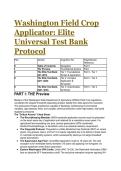
Washington Field Crop
Applicator: Elite
Universal Test Bank
Protocol
Part Section Cognitive Tier Page/Section
Reference
0 Table of Contents Navigation Part 0
I The Preview Foundational Axioms Part I
II The Elite Test Bank Tier 1: Foundational Part II - Tier 1
(Q1–Q10) Syntax & Application
II The Elite Test Bank Tier 2: Complex Part II - Tier 2
(Q11–Q20) Application &
Simulation
II The Elite Test Bank Tier 3: Grandmaster Part II - Tier 3
(Q21–Q30) Synthesis
PART I: THE Preview
Mastery of the Washington State Department of Agriculture (WSDA) Field Crop regulations
constitutes the singular threshold separating amateur liability from elite agronomic execution.
This assessment forges practitioners capable of flawlessly synthesizing environmental
variables, rigid statutory limits, and complex chemical behaviors under high-stakes, real-world
regulatory pressures.
The "Critical Axioms" Cheat Sheet:
● The Recordkeeping Mandate: WSDA pesticide application records must be generated
on the exact same day of application and retained for a mandatory seven years. For
agricultural land exceeding one acre, precise geolocation (GPS coordinates,
Section/Township/Range, or block/farm unit) is an absolute statutory requirement.
● The Clopyralid Protocol: Clopyralid is a State Restricted Use Pesticide (RUP) on cereal
grains, hay grasses, lawns, and turf. It is heavily regulated due to its failure to break down
in municipal composting systems, which subsequently destroys non-target broadleaf
plants downstream.
● The Supervision Age Floor: Uncertified applicators must be 18 years old. The sole
exception is for immediate family members (16 years old) applying non-fumigants via
ground equipment under direct supervision.
● Eastern Washington URH Limits: Under WAC 16-230, Use Restricted Herbicides (URH)
face an absolute 85°F temperature cutoff. The exclusive exemption requires applying 50+
, gallons per acre (GPA) utilizing a "Very Coarse" or larger droplet spectrum.
● The 1/128th Calibration Law: When calibrating based on a 1/128th acre course (340
square feet), the fluid ounces of output collected from a single nozzle directly equates to
the total Gallons Per Acre (GPA) applied.
PART II: THE ELITE TEST BANK
Tier 1: Foundational Syntax & Application
Q1: A certified commercial applicator completes a broadcast application of a General Use
herbicide across a 5-acre agricultural field. According to WAC 16-228-1320, which combination
of recordkeeping actions is STRICTLY REQUIRED by the WSDA? A) The record must be
completed within 30 days and retained for five years, detailing the total product used. B) The
record must be completed the same day, retained for seven years, and specify the exact
location using a GPS coordinate, Section/Township/Range, or irrigation block number. C) The
record must be completed the same day and retained for three years, identifying the site simply
as "agricultural field." D) The applicator is exempt from recordkeeping because the chemical
used was a General Use pesticide, not a Restricted Use Pesticide (RUP).
● The Answer: B (The record must be completed the same day, retained for seven years,
and specify the exact location using a GPS coordinate, Section/Township/Range, or
irrigation block number.)
● Distractor Analysis:
○ A is incorrect: Thirty days and five years are standard Federal Worker Protection
Standard (WPS) or legacy EPA limits, but Washington state strictly demands
same-day completion and a seven-year retention period.
○ C is incorrect: Because the application exceeds one acre of agricultural land, a
generic description is invalid; precise geographic plotting is mandated by law.
○ D is incorrect: WAC 16-228-1320 requires detailed records for all persons applying
any pesticide to more than one acre of agricultural land in a calendar year,
regardless of the RUP classification.
The Mentor's Analysis: Washington State enforces one of the most aggressive agricultural
tracking frameworks in the nation. When an application crosses the one-acre agricultural
threshold, the state requires absolute geographic certainty to trace potential drift, groundwater
contamination, or worker exposure events spanning nearly a decade. The statutory architecture
treats the physical mapping of the application as the foundation of environmental accountability.
By maintaining records for seven years with pinpoint GPS or TRS data, the operation bypasses
the fatal audit trap of untraceable, generic field applications. Professional/Academic Intuition:
Record retention is seven years; over one acre demands absolute geographic
coordinates.
Q2: Under WAC 16-228-1548, a certified private applicator intends to utilize their 16-year-old
child to assist with field applications. Which scenario is the ONLY LEGALLY PERMISSIBLE
utilization of this minor as a noncertified applicator? A) The minor applies an unrestricted aerial
spray from a fixed-wing aircraft over a family-owned wheat field. B) The minor applies a
federally restricted use fumigant to the soil using tractor-mounted injection equipment. C) The
minor applies a restricted use herbicide via ground equipment to an agricultural crop, under the
direct supervision of the certified parent. D) The minor applies a General Use herbicide to a
neighboring farm as a commercial hire, provided the parent holds the commercial contract.
, ● The Answer: C (The minor applies a restricted use herbicide via ground equipment to an
agricultural crop, under the direct supervision of the certified parent.)
● Distractor Analysis:
○ A is incorrect: Aerial application by any noncertified minor, regardless of family
status, is strictly prohibited by WAC 16-228-1548.
○ B is incorrect: The application of federal restricted use fumigants is categorically
banned for all noncertified applicators under 18 years of age due to extreme acute
inhalation hazards.
○ D is incorrect: The 16-year-old exception applies strictly to immediate family
members operating on their own establishment, not commercial applications for hire
on neighboring properties.
The Mentor's Analysis: The WSDA sets the hard deck for pesticide application at 18 years of
age. The family farm exception drops this to 16, but rigidly strips away high-hazard vectors to
prevent catastrophic acute exposure. The regulatory logic asserts that while family members
may work on the family operation, they cannot be subjected to enclosed atmospheric hazards
(fumigants) or highly complex aerodynamic operations (aerial applications). When utilizing
minors on the farm, the immediate priority is shielding them from acute risk profiles. By limiting
minors to ground-based, non-fumigant applications, the practitioner bypasses the legal trap of
child endangerment under the Worker Protection Standard. Professional/Academic Intuition:
The 16-year-old family exception is grounded; no planes, no fumigants, no exceptions.
Q3: A candidate fails the WSDA commercial applicator insect and disease control exam for the
second time. According to WAC 16-228-1540, what is the MANDATORY MINIMUM action
required before the candidate can test again? A) They must wait 60 calendar days before
scheduling a retest. B) They must complete a 40-hour remedial training course approved by
Washington State University. C) They must wait at least 14 days before retaking the exact same
examination. D) They are barred from obtaining a pesticide license for the remainder of the
calendar year.
● The Answer: C (They must wait at least 14 days before retaking the exact same
examination.)
● Distractor Analysis:
○ A is incorrect: The 60-day penalty is the statutory maximum waiting period reserved
specifically for a candidate's fifth (or subsequent) failure, acting as a terminal pause
on chronic testing.
○ B is incorrect: While WSU provides study materials and pre-license training ,
remedial coursework is not a statutory prerequisite for a retest under WAC
16-228-1540.
○ D is incorrect: This reflects a legacy punitive structure not present in current
Washington administrative code.
The Mentor's Analysis: Regulatory bodies utilize forced delays to guarantee that candidates
engage in deep study rather than attempting to memorize the test bank through brute-force
repetition. The Washington administrative code institutes an escalating temporal penalty
structure designed to break the cycle of rapid-fire guessing.
Failure Iteration Mandatory Waiting Period
Second, Third, or Fourth Failure 14 Days
Fifth or Subsequent Failure 60 Days
> By recognizing this 14-day statutory pause, the candidate bypasses the trap of attempting an
immediate, invalid retest that the WSDA will formally void.
Applicator: Elite
Universal Test Bank
Protocol
Part Section Cognitive Tier Page/Section
Reference
0 Table of Contents Navigation Part 0
I The Preview Foundational Axioms Part I
II The Elite Test Bank Tier 1: Foundational Part II - Tier 1
(Q1–Q10) Syntax & Application
II The Elite Test Bank Tier 2: Complex Part II - Tier 2
(Q11–Q20) Application &
Simulation
II The Elite Test Bank Tier 3: Grandmaster Part II - Tier 3
(Q21–Q30) Synthesis
PART I: THE Preview
Mastery of the Washington State Department of Agriculture (WSDA) Field Crop regulations
constitutes the singular threshold separating amateur liability from elite agronomic execution.
This assessment forges practitioners capable of flawlessly synthesizing environmental
variables, rigid statutory limits, and complex chemical behaviors under high-stakes, real-world
regulatory pressures.
The "Critical Axioms" Cheat Sheet:
● The Recordkeeping Mandate: WSDA pesticide application records must be generated
on the exact same day of application and retained for a mandatory seven years. For
agricultural land exceeding one acre, precise geolocation (GPS coordinates,
Section/Township/Range, or block/farm unit) is an absolute statutory requirement.
● The Clopyralid Protocol: Clopyralid is a State Restricted Use Pesticide (RUP) on cereal
grains, hay grasses, lawns, and turf. It is heavily regulated due to its failure to break down
in municipal composting systems, which subsequently destroys non-target broadleaf
plants downstream.
● The Supervision Age Floor: Uncertified applicators must be 18 years old. The sole
exception is for immediate family members (16 years old) applying non-fumigants via
ground equipment under direct supervision.
● Eastern Washington URH Limits: Under WAC 16-230, Use Restricted Herbicides (URH)
face an absolute 85°F temperature cutoff. The exclusive exemption requires applying 50+
, gallons per acre (GPA) utilizing a "Very Coarse" or larger droplet spectrum.
● The 1/128th Calibration Law: When calibrating based on a 1/128th acre course (340
square feet), the fluid ounces of output collected from a single nozzle directly equates to
the total Gallons Per Acre (GPA) applied.
PART II: THE ELITE TEST BANK
Tier 1: Foundational Syntax & Application
Q1: A certified commercial applicator completes a broadcast application of a General Use
herbicide across a 5-acre agricultural field. According to WAC 16-228-1320, which combination
of recordkeeping actions is STRICTLY REQUIRED by the WSDA? A) The record must be
completed within 30 days and retained for five years, detailing the total product used. B) The
record must be completed the same day, retained for seven years, and specify the exact
location using a GPS coordinate, Section/Township/Range, or irrigation block number. C) The
record must be completed the same day and retained for three years, identifying the site simply
as "agricultural field." D) The applicator is exempt from recordkeeping because the chemical
used was a General Use pesticide, not a Restricted Use Pesticide (RUP).
● The Answer: B (The record must be completed the same day, retained for seven years,
and specify the exact location using a GPS coordinate, Section/Township/Range, or
irrigation block number.)
● Distractor Analysis:
○ A is incorrect: Thirty days and five years are standard Federal Worker Protection
Standard (WPS) or legacy EPA limits, but Washington state strictly demands
same-day completion and a seven-year retention period.
○ C is incorrect: Because the application exceeds one acre of agricultural land, a
generic description is invalid; precise geographic plotting is mandated by law.
○ D is incorrect: WAC 16-228-1320 requires detailed records for all persons applying
any pesticide to more than one acre of agricultural land in a calendar year,
regardless of the RUP classification.
The Mentor's Analysis: Washington State enforces one of the most aggressive agricultural
tracking frameworks in the nation. When an application crosses the one-acre agricultural
threshold, the state requires absolute geographic certainty to trace potential drift, groundwater
contamination, or worker exposure events spanning nearly a decade. The statutory architecture
treats the physical mapping of the application as the foundation of environmental accountability.
By maintaining records for seven years with pinpoint GPS or TRS data, the operation bypasses
the fatal audit trap of untraceable, generic field applications. Professional/Academic Intuition:
Record retention is seven years; over one acre demands absolute geographic
coordinates.
Q2: Under WAC 16-228-1548, a certified private applicator intends to utilize their 16-year-old
child to assist with field applications. Which scenario is the ONLY LEGALLY PERMISSIBLE
utilization of this minor as a noncertified applicator? A) The minor applies an unrestricted aerial
spray from a fixed-wing aircraft over a family-owned wheat field. B) The minor applies a
federally restricted use fumigant to the soil using tractor-mounted injection equipment. C) The
minor applies a restricted use herbicide via ground equipment to an agricultural crop, under the
direct supervision of the certified parent. D) The minor applies a General Use herbicide to a
neighboring farm as a commercial hire, provided the parent holds the commercial contract.
, ● The Answer: C (The minor applies a restricted use herbicide via ground equipment to an
agricultural crop, under the direct supervision of the certified parent.)
● Distractor Analysis:
○ A is incorrect: Aerial application by any noncertified minor, regardless of family
status, is strictly prohibited by WAC 16-228-1548.
○ B is incorrect: The application of federal restricted use fumigants is categorically
banned for all noncertified applicators under 18 years of age due to extreme acute
inhalation hazards.
○ D is incorrect: The 16-year-old exception applies strictly to immediate family
members operating on their own establishment, not commercial applications for hire
on neighboring properties.
The Mentor's Analysis: The WSDA sets the hard deck for pesticide application at 18 years of
age. The family farm exception drops this to 16, but rigidly strips away high-hazard vectors to
prevent catastrophic acute exposure. The regulatory logic asserts that while family members
may work on the family operation, they cannot be subjected to enclosed atmospheric hazards
(fumigants) or highly complex aerodynamic operations (aerial applications). When utilizing
minors on the farm, the immediate priority is shielding them from acute risk profiles. By limiting
minors to ground-based, non-fumigant applications, the practitioner bypasses the legal trap of
child endangerment under the Worker Protection Standard. Professional/Academic Intuition:
The 16-year-old family exception is grounded; no planes, no fumigants, no exceptions.
Q3: A candidate fails the WSDA commercial applicator insect and disease control exam for the
second time. According to WAC 16-228-1540, what is the MANDATORY MINIMUM action
required before the candidate can test again? A) They must wait 60 calendar days before
scheduling a retest. B) They must complete a 40-hour remedial training course approved by
Washington State University. C) They must wait at least 14 days before retaking the exact same
examination. D) They are barred from obtaining a pesticide license for the remainder of the
calendar year.
● The Answer: C (They must wait at least 14 days before retaking the exact same
examination.)
● Distractor Analysis:
○ A is incorrect: The 60-day penalty is the statutory maximum waiting period reserved
specifically for a candidate's fifth (or subsequent) failure, acting as a terminal pause
on chronic testing.
○ B is incorrect: While WSU provides study materials and pre-license training ,
remedial coursework is not a statutory prerequisite for a retest under WAC
16-228-1540.
○ D is incorrect: This reflects a legacy punitive structure not present in current
Washington administrative code.
The Mentor's Analysis: Regulatory bodies utilize forced delays to guarantee that candidates
engage in deep study rather than attempting to memorize the test bank through brute-force
repetition. The Washington administrative code institutes an escalating temporal penalty
structure designed to break the cycle of rapid-fire guessing.
Failure Iteration Mandatory Waiting Period
Second, Third, or Fourth Failure 14 Days
Fifth or Subsequent Failure 60 Days
> By recognizing this 14-day statutory pause, the candidate bypasses the trap of attempting an
immediate, invalid retest that the WSDA will formally void.


