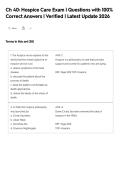
Ch 40: Hospice Care Exam | Questions with 100%
Correct Answers | Verified | Latest Update 2026
Save
Terms in this set (38)
1. The hospice nurse explains to the ANS: C
family that the overall objective of Hospice is a philosophy of care that provides
hospice service is to: support and comfort to patients who are dying.
a. relieve symptoms of terminal
disease. REF: Page 1222 TOP: Hospice
b. educate the patient about the
process of death.
c. keep the patient comfortable as
death approaches.
d. relieve the family of the stress of
death.
2. In 1960, the hospice philosophy ANS: A
was launched by: Dame Cicely Saunders renewed the idea of
a. Cicely Saunders. hospice in the 1960s.
b. Lillian Wald.
c. Dorothea Dix. REF: Page 1223
d. Florence Nightingale. TOP: Hospice
, 3. The hospice nurse clarifies that ANS: D
hospice service is initiated when Hospice care is appropriate when curative
what type of treatment is no longer treatment is no longer effective. Hospice service is
effective? palliative, proactive, and an alternative to curative
a. Proactive treatment.
b. Palliative
c. Alternative
d. Curative REF: Page 1224 TOP: Hospice
4. The nurse differentiates for the ANS: B
family active and palliative care, in Active treatment is aggressive care that aims to
that active care is: cure disease and prolong life.
a. centered on symptom control.
b. focused on treatment for a cure. REF: Page 1224 TOP: Hospice
c. not concerned with dying.
d. covered by health insurance.
5. Because the family is confused ANS: D
about the meaning of palliative care, Palliative care is not curative but is an integrated
the hospice nurse explains it as plan designed to relieve pain and control
treatment that is centered on a(n): symptoms.
a. aggressive approach to prolong
life. REF: Page 1223 TOP: Hospice
b. protocol of pain relief.
c. form of organized care which
relieves the family of responsibility.
d. integrated service of support for
alleviation of symptoms.
Correct Answers | Verified | Latest Update 2026
Save
Terms in this set (38)
1. The hospice nurse explains to the ANS: C
family that the overall objective of Hospice is a philosophy of care that provides
hospice service is to: support and comfort to patients who are dying.
a. relieve symptoms of terminal
disease. REF: Page 1222 TOP: Hospice
b. educate the patient about the
process of death.
c. keep the patient comfortable as
death approaches.
d. relieve the family of the stress of
death.
2. In 1960, the hospice philosophy ANS: A
was launched by: Dame Cicely Saunders renewed the idea of
a. Cicely Saunders. hospice in the 1960s.
b. Lillian Wald.
c. Dorothea Dix. REF: Page 1223
d. Florence Nightingale. TOP: Hospice
, 3. The hospice nurse clarifies that ANS: D
hospice service is initiated when Hospice care is appropriate when curative
what type of treatment is no longer treatment is no longer effective. Hospice service is
effective? palliative, proactive, and an alternative to curative
a. Proactive treatment.
b. Palliative
c. Alternative
d. Curative REF: Page 1224 TOP: Hospice
4. The nurse differentiates for the ANS: B
family active and palliative care, in Active treatment is aggressive care that aims to
that active care is: cure disease and prolong life.
a. centered on symptom control.
b. focused on treatment for a cure. REF: Page 1224 TOP: Hospice
c. not concerned with dying.
d. covered by health insurance.
5. Because the family is confused ANS: D
about the meaning of palliative care, Palliative care is not curative but is an integrated
the hospice nurse explains it as plan designed to relieve pain and control
treatment that is centered on a(n): symptoms.
a. aggressive approach to prolong
life. REF: Page 1223 TOP: Hospice
b. protocol of pain relief.
c. form of organized care which
relieves the family of responsibility.
d. integrated service of support for
alleviation of symptoms.