
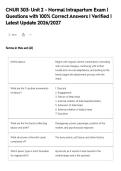
CNUR 303: Unit 2 - Normal Intrapartum Exam |
Questions with 100% Correct Answers | Verified |
Latest Update 2026/2027
Save
Terms in this set (41)
Define labour Begins with regular uterine contractions coinciding
with cervical changes, continuing with further
fundal and cervical adaptations, and ending as the
family begins the attachment process with the
infant.
What are the 7 cardinal movements 1. Descent
of labour? 2. Engagement
3. Flexion of fetal head
4. Internal rotation of fetal head/shoulders
5. Extension of fetal head
6. External rotation of baby's head
7. Expulsion
What are the five factors affecting Passageway, power, passenger, position of the
labour and birth? mother, and psychosocial response.
What structures is the birth canal The bony pelvis, soft tissue, and other factors.
composed of?
Which pelvic type is most favorable Gynecoid, as it results in less trauma to the
for vaginal birth? mother/baby and is the quickest.
, How do soft tissue factors change There is lower thinning and the overall shape
during dilation? changes.
What are some other factors which A full bladder, tumours, and fibroids.
may block the passageway?
What is the primary power? Is it Uterine contractions; involuntary
voluntary or involuntary?
What are the effects of uterine Dilation/effacement of the cervix, decreased blood
contractions? flow to the placenta/uterus, increased maternal BD,
and Ferguson reflux.
Define Ferguson reflux The body naturally expels the fetus without
pushing.
Define cervical effacement Thinning and shortening of the cervix.
Define involution The uterus shrinks back to normal size
What are the secondary powers? Are Bearing down; voluntary
they voluntary or involuntary?
When should a pregnant women When the cervix is 100% effaced and dilated AND
begin to push? the woman feels an urge to push.
How does breathing change during - Breath holding OR hyperventilation
labour? - Increased tension/anxiety
- Controlled breathing releases endorphins,
relaxes the pelvic floor, and prevents
adrenaline/cortisol from blocking oxytocin
Define placenta previa Partial or complete blockage of the vaginal canal.
Questions with 100% Correct Answers | Verified |
Latest Update 2026/2027
Save
Terms in this set (41)
Define labour Begins with regular uterine contractions coinciding
with cervical changes, continuing with further
fundal and cervical adaptations, and ending as the
family begins the attachment process with the
infant.
What are the 7 cardinal movements 1. Descent
of labour? 2. Engagement
3. Flexion of fetal head
4. Internal rotation of fetal head/shoulders
5. Extension of fetal head
6. External rotation of baby's head
7. Expulsion
What are the five factors affecting Passageway, power, passenger, position of the
labour and birth? mother, and psychosocial response.
What structures is the birth canal The bony pelvis, soft tissue, and other factors.
composed of?
Which pelvic type is most favorable Gynecoid, as it results in less trauma to the
for vaginal birth? mother/baby and is the quickest.
, How do soft tissue factors change There is lower thinning and the overall shape
during dilation? changes.
What are some other factors which A full bladder, tumours, and fibroids.
may block the passageway?
What is the primary power? Is it Uterine contractions; involuntary
voluntary or involuntary?
What are the effects of uterine Dilation/effacement of the cervix, decreased blood
contractions? flow to the placenta/uterus, increased maternal BD,
and Ferguson reflux.
Define Ferguson reflux The body naturally expels the fetus without
pushing.
Define cervical effacement Thinning and shortening of the cervix.
Define involution The uterus shrinks back to normal size
What are the secondary powers? Are Bearing down; voluntary
they voluntary or involuntary?
When should a pregnant women When the cervix is 100% effaced and dilated AND
begin to push? the woman feels an urge to push.
How does breathing change during - Breath holding OR hyperventilation
labour? - Increased tension/anxiety
- Controlled breathing releases endorphins,
relaxes the pelvic floor, and prevents
adrenaline/cortisol from blocking oxytocin
Define placenta previa Partial or complete blockage of the vaginal canal.


