

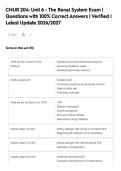
CNUR 204: Unit 6 - The Renal System Exam |
Questions with 100% Correct Answers | Verified |
Latest Update 2026/2027
Save
Terms in this set (35)
What are the functions of the - Maintaining fluid and electrolyte balances
kidneys? - Removing metabolic waste
- Maintaining acid-base balance
Briefly explain AKI - Sudden onset
- Commonly caused by acute tubular necrosis
- High mortality rate
- Potentially reversible
What are the risk factors for CKD? - HTN
- Diabetic neuropathy
- Glomerulonephritis
- Polycystic kidney disease
- Nephrotoxic drugs (NSAIDs)
Explain stage 1 of CKD - Kidney damage with normal or increased GFR
- Diagnosis and treatment of co-morbidities
Explain stage 2 of CKD - Kidney damage with mild decreased GFR
- Estimation of progression
Explain stage 3 of CKD - Moderate decreased GFR
- Evaluation and treatment of complications
, Explain stage 4 of CKD - Severe decreased GFR
- Preparation for RRT
Explain stage 5 of CKD - Kidney failure
- ESRD
- RRT if uremia present
What is the onset of ESRD? Constellation of signs and symptoms (uremia).
What are the urinary clinical - Nocturia
manifestations of CKD? - Anuria
- Oliguria
What are the metabolic - Altered carbohydrate metabolism
disturbances/clinical manifestations - Elevated triglycerides
of CKD? - Waste product accumulation
What are the electrolyte/acid-base - High potassium
clinical manifestations of CKD? - Normal to low sodium
- Low calcium
- High phosphate
- Metabolic acidosis
What are the hematologic clinical - Anemia
manifestations of CKD? - Bleeding
- Infection
What are the cardiovascular clinical - HTN
manifestations of CKD? - Atherosclerosis and CAD
- HF
- Peripheral edema
Questions with 100% Correct Answers | Verified |
Latest Update 2026/2027
Save
Terms in this set (35)
What are the functions of the - Maintaining fluid and electrolyte balances
kidneys? - Removing metabolic waste
- Maintaining acid-base balance
Briefly explain AKI - Sudden onset
- Commonly caused by acute tubular necrosis
- High mortality rate
- Potentially reversible
What are the risk factors for CKD? - HTN
- Diabetic neuropathy
- Glomerulonephritis
- Polycystic kidney disease
- Nephrotoxic drugs (NSAIDs)
Explain stage 1 of CKD - Kidney damage with normal or increased GFR
- Diagnosis and treatment of co-morbidities
Explain stage 2 of CKD - Kidney damage with mild decreased GFR
- Estimation of progression
Explain stage 3 of CKD - Moderate decreased GFR
- Evaluation and treatment of complications
, Explain stage 4 of CKD - Severe decreased GFR
- Preparation for RRT
Explain stage 5 of CKD - Kidney failure
- ESRD
- RRT if uremia present
What is the onset of ESRD? Constellation of signs and symptoms (uremia).
What are the urinary clinical - Nocturia
manifestations of CKD? - Anuria
- Oliguria
What are the metabolic - Altered carbohydrate metabolism
disturbances/clinical manifestations - Elevated triglycerides
of CKD? - Waste product accumulation
What are the electrolyte/acid-base - High potassium
clinical manifestations of CKD? - Normal to low sodium
- Low calcium
- High phosphate
- Metabolic acidosis
What are the hematologic clinical - Anemia
manifestations of CKD? - Bleeding
- Infection
What are the cardiovascular clinical - HTN
manifestations of CKD? - Atherosclerosis and CAD
- HF
- Peripheral edema


