
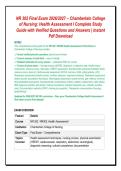
NR 302 Final Exam 2026/2027 – Chamberlain College
of Nursing: Health Assessment I Complete Study
Guide with Verified Questions and Answers | Instant
Pdf Download
INTRO
This comprehensive study guide for the NR 302 / NR302 Health Assessment I Final Exam at
Chamberlain College of Nursing includes:
✅ Actual verified practice questions (actual exam format)
✅ Correct answers in bold italic – easy to identify
✅ Detailed rationales for every answer – understand WHY it's correct
✅ Covers all exam topics – Nursing process (ADPIE), Subjective vs objective data, Health history
components, General survey, Vital signs, HEENT assessment, Skin/hair/nails assessment (Braden Scale,
pressure ulcers, lesions), Cardiovascular assessment (S1/S2, murmurs, thrills, pitting edema, JVD),
Respiratory assessment (breath sounds, crackles, wheezes, respiratory distress), Abdominal assessment
(bowel sounds, auscultation technique), Neurological assessment (cranial nerves, gait, reflexes, tremors),
Musculoskeletal assessment, Developmental considerations (infants, toddlers, adolescents, older adults),
BMI categories (children and adults), Cultural competence (medical interpreter use, culturally sensitive
care), Documentation methods (SOAP, charting by exception), Therapeutic communication (focusing,
paraphrasing)
Updated for 2026/2027 NR 302 curriculum – Pass your Chamberlain College Health Assessment I
final exam on your first attempt!
EXAM OVERVIEW
Feature Details
Course NR 302 / NR302: Health Assessment I
Institution Chamberlain College of Nursing
Exam Type Final Exam – Comprehensive
Topics Health assessment techniques, nursing process, physical examination
Covered (HEENT, cardiovascular, respiratory, abdominal, neurological),
diagnostic reasoning, cultural competence, documentation
,SECTION 1: FUNDAMENTALS OF HEALTH ASSESSMENT & NURSING PROCESS
Q1. After conducting the health interview, the nurse begins to measure the client's
vital signs. The nurse is collecting:
A. Subjective data
B. Objective data
C. Secondary data
D. Constant data
Rationale: Objective data is information that is measured by a professional nurse through
observation, physical examination, and diagnostic testing. It is used to validate subjective
data .
Q2. Which of the following demonstrates the documentation of subjective
information?
A. "It hurts when I put weight on my leg."
B. Abdomen soft and nontender to palpation
C. Blood pressure 110/68
D. "Pulses present in lower extremities"
Rationale: When documenting subjective data (information obtained from the client during
the interview), quotes should be used to directly capture the client's words. Objective data is
assessment data obtained by the nurse .
Q3. The nurse documents findings on a flow sheet with check marks and short
notations. This type of documentation is:
A. Narrative
B. SOAP
C. APIE
D. Charting by exception
Rationale: Charting by exception (CBE) is a system in which documentation is limited to
exceptions from preestablished norms or significant findings. Flow sheets with check marks
and short notations eliminate much of the repetition involved in narrative documentation .
, Q4. The nurse is looking at information collected during the health interview to
cluster or group data together. This demonstrates which phase of the nursing
process?
A. Assessment
B. Diagnosis
C. Planning
D. Evaluation
Rationale: After data is collected, the nurse uses critical thinking skills to cluster data in
order to create a nursing diagnosis. Assessment is the first step; planning involves setting
goals; evaluation compares outcomes to goals .
Q5. The nurse is implementing the critical thinking process with collected data and
choosing approaches to implement. In which step is this nurse engaged?
A. Analysis of the situation
B. Collection of information
C. Selecting alternatives
D. Evaluation
Rationale: Once data is analyzed and alternatives are generated, the nurse selects the
alternatives most appropriate for the client's care needs. Analysis involves distinguishing
normal vs abnormal data; evaluation determines whether outcomes were achieved .
Q6. The nurse tells the client, "Push with both arms against my hands so that I can
compare the strength of your right and left arms." This is an example of:
A. Formal teaching
B. Informal teaching
C. Learning needs
D. Goal identification
Rationale: Informal teaching occurs as a natural part of a client encounter—providing
instructions, explaining procedures, or reducing anxiety. Formal teaching occurs in
response to identified learning needs with developed teaching plans .
of Nursing: Health Assessment I Complete Study
Guide with Verified Questions and Answers | Instant
Pdf Download
INTRO
This comprehensive study guide for the NR 302 / NR302 Health Assessment I Final Exam at
Chamberlain College of Nursing includes:
✅ Actual verified practice questions (actual exam format)
✅ Correct answers in bold italic – easy to identify
✅ Detailed rationales for every answer – understand WHY it's correct
✅ Covers all exam topics – Nursing process (ADPIE), Subjective vs objective data, Health history
components, General survey, Vital signs, HEENT assessment, Skin/hair/nails assessment (Braden Scale,
pressure ulcers, lesions), Cardiovascular assessment (S1/S2, murmurs, thrills, pitting edema, JVD),
Respiratory assessment (breath sounds, crackles, wheezes, respiratory distress), Abdominal assessment
(bowel sounds, auscultation technique), Neurological assessment (cranial nerves, gait, reflexes, tremors),
Musculoskeletal assessment, Developmental considerations (infants, toddlers, adolescents, older adults),
BMI categories (children and adults), Cultural competence (medical interpreter use, culturally sensitive
care), Documentation methods (SOAP, charting by exception), Therapeutic communication (focusing,
paraphrasing)
Updated for 2026/2027 NR 302 curriculum – Pass your Chamberlain College Health Assessment I
final exam on your first attempt!
EXAM OVERVIEW
Feature Details
Course NR 302 / NR302: Health Assessment I
Institution Chamberlain College of Nursing
Exam Type Final Exam – Comprehensive
Topics Health assessment techniques, nursing process, physical examination
Covered (HEENT, cardiovascular, respiratory, abdominal, neurological),
diagnostic reasoning, cultural competence, documentation
,SECTION 1: FUNDAMENTALS OF HEALTH ASSESSMENT & NURSING PROCESS
Q1. After conducting the health interview, the nurse begins to measure the client's
vital signs. The nurse is collecting:
A. Subjective data
B. Objective data
C. Secondary data
D. Constant data
Rationale: Objective data is information that is measured by a professional nurse through
observation, physical examination, and diagnostic testing. It is used to validate subjective
data .
Q2. Which of the following demonstrates the documentation of subjective
information?
A. "It hurts when I put weight on my leg."
B. Abdomen soft and nontender to palpation
C. Blood pressure 110/68
D. "Pulses present in lower extremities"
Rationale: When documenting subjective data (information obtained from the client during
the interview), quotes should be used to directly capture the client's words. Objective data is
assessment data obtained by the nurse .
Q3. The nurse documents findings on a flow sheet with check marks and short
notations. This type of documentation is:
A. Narrative
B. SOAP
C. APIE
D. Charting by exception
Rationale: Charting by exception (CBE) is a system in which documentation is limited to
exceptions from preestablished norms or significant findings. Flow sheets with check marks
and short notations eliminate much of the repetition involved in narrative documentation .
, Q4. The nurse is looking at information collected during the health interview to
cluster or group data together. This demonstrates which phase of the nursing
process?
A. Assessment
B. Diagnosis
C. Planning
D. Evaluation
Rationale: After data is collected, the nurse uses critical thinking skills to cluster data in
order to create a nursing diagnosis. Assessment is the first step; planning involves setting
goals; evaluation compares outcomes to goals .
Q5. The nurse is implementing the critical thinking process with collected data and
choosing approaches to implement. In which step is this nurse engaged?
A. Analysis of the situation
B. Collection of information
C. Selecting alternatives
D. Evaluation
Rationale: Once data is analyzed and alternatives are generated, the nurse selects the
alternatives most appropriate for the client's care needs. Analysis involves distinguishing
normal vs abnormal data; evaluation determines whether outcomes were achieved .
Q6. The nurse tells the client, "Push with both arms against my hands so that I can
compare the strength of your right and left arms." This is an example of:
A. Formal teaching
B. Informal teaching
C. Learning needs
D. Goal identification
Rationale: Informal teaching occurs as a natural part of a client encounter—providing
instructions, explaining procedures, or reducing anxiety. Formal teaching occurs in
response to identified learning needs with developed teaching plans .


