

Page 1 of 163
COMSAE Phase 1 - Form 110 EXAM QUESTIONS AND CORRECT
VERIFIED SOLUTIONS LATEST UPDATE THIS YEAR – JUST
RELEASED
COMSAE Phase 1 - Form 110: Comprehensive Practice Exam
Below is a comprehensive exam coverage summary followed by 250 randomized, scenario-
based multiple-choice questions with answers and detailed rationales. Each question is exam-
relevant for the COMSAE Phase 1 Form 110, which assesses readiness for COMLEX-USA Level 1,
covering foundational biomedical sciences with an emphasis on osteopathic principles and
clinical problem-solving .
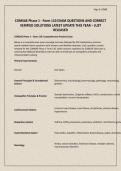
Primary Exam Domains
Domain Key Topics
General Principles & Foundational Biochemistry, microbiology, pharmacology, pathology, immunology,
Science genetics
Somatic dysfunction, Chapman reflexes, HVLA, counterstrain, cranial
Osteopathic Principles & Practice
manipulation, visceral manipulation
Ischemic heart disease, heart failure, arrhythmias, valvular disease,
Cardiovascular System
hypertension
Respiratory System Asthma, COPD, pneumonia, pulmonary embolism, restrictive lung dise
Gastrointestinal System Pancreatitis, hepatitis, inflammatory bowel disease, peptic ulcer disea
Stroke, seizure disorders, Parkinson disease, multiple sclerosis,
Neurology
neuromuscular disorders
, Page 2 of 163
Domain Key Topics
Acute kidney injury, chronic kidney disease, nephrotic syndrome,
Renal/Genitourinary
nephrolithiasis
Diabetes mellitus, thyroid disorders, adrenal disorders, menstrual
Endocrine/Reproductive
disorders
Infectious Disease Common pathogens, antibiotic therapy, prevention strategies
250 Randomized, Scenario-Based Practice Questions
Questions 1-50
1. A 24-year-old man presents with episodic wheezing, chest tightness, and shortness of breath
after exercise. Pulmonary function testing reveals reversible airflow obstruction. Which of the
following is the primary pathophysiologic mechanism?
A) Alveolar destruction
B) Bronchial smooth muscle hyperreactivity
C) Restrictive fibrosis
D) Pulmonary vascular remodeling
, Page 3 of 163
E) Pleural inflammation
Answer: B – Asthma is characterized by reversible airway obstruction due to bronchial smooth
muscle hyperreactivity, inflammation, and mucus production .
2. A patient with chronic alcoholism develops confusion, ophthalmoplegia, and ataxia. Which
vitamin deficiency is most likely responsible?
A) Vitamin B12
B) Vitamin C
C) Vitamin B1 (thiamine)
D) Vitamin D
E) Vitamin K
Answer: C – The triad of confusion, ophthalmoplegia, and ataxia suggests Wernicke
encephalopathy due to thiamine deficiency, commonly seen in chronic alcohol use disorder .
3. A 65-year-old woman develops crushing substernal chest pain radiating to her jaw. ECG
reveals ST-segment elevations in leads II, III, and aVF. Which coronary artery is most likely
occluded?
A) Left anterior descending artery
B) Circumflex artery
, Page 4 of 163
C) Right coronary artery
D) Left main coronary artery
E) Posterior descending artery
Answer: C – ST elevation in leads II, III, and aVF localizes an inferior wall myocardial infarction,
most commonly due to occlusion of the right coronary artery .
4. A child presents with a barking cough and inspiratory stridor. Which pathogen is the most
common cause?
A) Respiratory syncytial virus
B) Parainfluenza virus
C) Adenovirus
D) Influenza virus
E) Rhinovirus
Answer: B – Parainfluenza virus is the most common cause of croup (laryngotracheobronchitis),
presenting with barking cough and inspiratory stridor.
5. A 45-year-old woman presents with proximal muscle weakness and a heliotrope rash. Which
autoantibody is most specific for this condition?
A) Anti-Jo-1
COMSAE Phase 1 - Form 110 EXAM QUESTIONS AND CORRECT
VERIFIED SOLUTIONS LATEST UPDATE THIS YEAR – JUST
RELEASED
COMSAE Phase 1 - Form 110: Comprehensive Practice Exam
Below is a comprehensive exam coverage summary followed by 250 randomized, scenario-
based multiple-choice questions with answers and detailed rationales. Each question is exam-
relevant for the COMSAE Phase 1 Form 110, which assesses readiness for COMLEX-USA Level 1,
covering foundational biomedical sciences with an emphasis on osteopathic principles and
clinical problem-solving .
Primary Exam Domains
Domain Key Topics
General Principles & Foundational Biochemistry, microbiology, pharmacology, pathology, immunology,
Science genetics
Somatic dysfunction, Chapman reflexes, HVLA, counterstrain, cranial
Osteopathic Principles & Practice
manipulation, visceral manipulation
Ischemic heart disease, heart failure, arrhythmias, valvular disease,
Cardiovascular System
hypertension
Respiratory System Asthma, COPD, pneumonia, pulmonary embolism, restrictive lung dise
Gastrointestinal System Pancreatitis, hepatitis, inflammatory bowel disease, peptic ulcer disea
Stroke, seizure disorders, Parkinson disease, multiple sclerosis,
Neurology
neuromuscular disorders
, Page 2 of 163
Domain Key Topics
Acute kidney injury, chronic kidney disease, nephrotic syndrome,
Renal/Genitourinary
nephrolithiasis
Diabetes mellitus, thyroid disorders, adrenal disorders, menstrual
Endocrine/Reproductive
disorders
Infectious Disease Common pathogens, antibiotic therapy, prevention strategies
250 Randomized, Scenario-Based Practice Questions
Questions 1-50
1. A 24-year-old man presents with episodic wheezing, chest tightness, and shortness of breath
after exercise. Pulmonary function testing reveals reversible airflow obstruction. Which of the
following is the primary pathophysiologic mechanism?
A) Alveolar destruction
B) Bronchial smooth muscle hyperreactivity
C) Restrictive fibrosis
D) Pulmonary vascular remodeling
, Page 3 of 163
E) Pleural inflammation
Answer: B – Asthma is characterized by reversible airway obstruction due to bronchial smooth
muscle hyperreactivity, inflammation, and mucus production .
2. A patient with chronic alcoholism develops confusion, ophthalmoplegia, and ataxia. Which
vitamin deficiency is most likely responsible?
A) Vitamin B12
B) Vitamin C
C) Vitamin B1 (thiamine)
D) Vitamin D
E) Vitamin K
Answer: C – The triad of confusion, ophthalmoplegia, and ataxia suggests Wernicke
encephalopathy due to thiamine deficiency, commonly seen in chronic alcohol use disorder .
3. A 65-year-old woman develops crushing substernal chest pain radiating to her jaw. ECG
reveals ST-segment elevations in leads II, III, and aVF. Which coronary artery is most likely
occluded?
A) Left anterior descending artery
B) Circumflex artery
, Page 4 of 163
C) Right coronary artery
D) Left main coronary artery
E) Posterior descending artery
Answer: C – ST elevation in leads II, III, and aVF localizes an inferior wall myocardial infarction,
most commonly due to occlusion of the right coronary artery .
4. A child presents with a barking cough and inspiratory stridor. Which pathogen is the most
common cause?
A) Respiratory syncytial virus
B) Parainfluenza virus
C) Adenovirus
D) Influenza virus
E) Rhinovirus
Answer: B – Parainfluenza virus is the most common cause of croup (laryngotracheobronchitis),
presenting with barking cough and inspiratory stridor.
5. A 45-year-old woman presents with proximal muscle weakness and a heliotrope rash. Which
autoantibody is most specific for this condition?
A) Anti-Jo-1


