

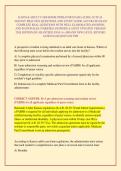
KANSAS ADULT CARE HOME OPERATOR EXAM (ACHO) ACTUAL
2026/2027 PRACTICE QUESTIONS AND STUDY GUIDE ACCURATE EXAM
COMPLETE REAL QUESTIONS WITH WELL ELABORATED ANSWERS
AND RATIONALES (VERIFIED ANSWERS) LATEST UPDATED VERSION
2026 EDITION |GUARANTEED PASS A+ (BRAND NEW!) |FULL REVISED
ACHO EXAM |INSTANT PDF
A prospective resident is being admitted to an adult care home in Kansas. Which of
the following must occur before the resident moves into the facility?
A) A complete physical examination performed by a licensed physician within 90
days prior to admission
B) A pre-admission screening and resident review (PASRR) for all applicants
regardless of payer source
C) Completion of a facility-specific admission agreement signed only by the
resident’s legal guardian
D) Submission of a complete Medicare Part D enrollment form to the facility
administrator
CORRECT ANSWER: B) A pre-admission screening and resident review
(PASRR) for all applicants regardless of payer source
Rationale: Under Kansas regulations (K.A.R. 28-39-70 and federal requirements),
a PASRR is required for all individuals applying for admission to a Medicaid-
certified nursing facility, regardless of payer source, to identify serious mental
illness or intellectual disability. A physical exam within 30 days (not 90) is
required per K.A.R. 28-39-71(a). The admission agreement must be signed by the
resident or responsible party, not solely a guardian unless applicable. Medicare
Part D enrollment is not an admission prerequisite.
According to Kansas adult care home regulations, the administrator must ensure
that each resident’s comprehensive care plan is reviewed and revised at least:
A) Monthly
,B) Quarterly
C) Semiannually
D) Annually
CORRECT ANSWER: B) Quarterly
Rationale: K.A.R. 28-39-74(b)(3) requires that each resident’s comprehensive care
plan be reviewed and revised at least once every three months (quarterly) or more
often if the resident’s condition changes. Monthly review is not mandated,
semiannual and annual are too infrequent.
An adult care home operator in Kansas discovers that a certified medication aide
(CMA) administered the wrong dose of a blood pressure medication to a resident.
What is the operator’s FIRST required action under Kansas law?
A) Terminate the CMA immediately
B) Notify the resident’s family within 24 hours
C) Complete an incident report and submit to the Kansas Department for Aging
and Disability Services (KDADS) within 72 hours if the error caused harm
D) Retrain all staff on medication administration within one week
CORRECT ANSWER: C) Complete an incident report and submit to the Kansas
Department for Aging and Disability Services (KDADS) within 72 hours if the
error caused harm
Rationale: K.A.R. 28-39-164(c) requires that medication errors resulting in adverse
drug reaction, injury, or potential harm be reported to KDADS within 72 hours.
Immediate termination is not mandated. Family notification is good practice but
not the first legal requirement unless specified. Retraining is a corrective action but
not the initial required step.
Which of the following is a violation of resident rights under Kansas
Administrative Regulations for adult care homes?
,A) Posting the resident rights statement in a common area accessible to residents
B) Allowing residents to manage their own finances if they choose and are capable
C) Restricting a resident’s access to their personal cell phone because the facility
has a “no electronics” policy
D) Permitting residents to refuse psychotropic medications after documented
education
CORRECT ANSWER: C) Restricting a resident’s access to their personal cell
phone because the facility has a “no electronics” policy
Rationale: Resident rights under K.A.R. 28-39-60 include the right to use personal
possessions, including communication devices, unless such use interferes with
others’ rights or safety. A blanket “no electronics” policy is impermissible. Posting
rights, financial self-management, and refusing medications are all protected.
Under Kansas law, an adult care home operator must ensure that all direct care
staff receive training on abuse, neglect, and exploitation prevention:
A) Upon hire only
B) Annually
C) Within the first 30 days of employment and then annually thereafter
D) Only if a substantiated complaint occurs
CORRECT ANSWER: C) Within the first 30 days of employment and then
annually thereafter
Rationale: K.A.R. 28-39-91(a)(6) requires abuse, neglect, and exploitation training
for all direct care employees within 30 days of hire and at least annually. Upon hire
only is insufficient; annual alone misses initial; only after a complaint violates
prevention standards.
, A resident with dementia repeatedly tries to leave the facility unsupervised and has
gotten lost before. The facility may use which of the following interventions
without obtaining informed consent?
A) A locked unit that is always staffed and monitored, with egress allowed upon
resident request
B) Physical restraints applied at night only
C) A bed alarm attached to the resident’s clothing without their knowledge
D) Chemical restraints administered as needed by a nurse
CORRECT ANSWER: A) A locked unit that is always staffed and monitored, with
egress allowed upon resident request
Rationale: K.A.R. 28-39-102(c) allows for secured dementia units only if the
facility has a special license, and egress is permitted upon request with supervision.
Physical restraints require consent and physician order per 28-39-101. Bed alarms
without consent may violate privacy; chemical restraints require specific
indications and consent.
The Kansas adult care home operator is responsible for ensuring that each
resident’s attending physician reviews the resident’s plan of care at least:
A) Every 30 days for all residents
B) Every 60 days for skilled nursing residents and every 90 days for custodial
residents
C) Every 90 days for all residents
D) Upon each admission and then as needed
CORRECT ANSWER: B) Every 60 days for skilled nursing residents and every 90
days for custodial residents
Rationale: K.A.R. 28-39-74(b)(1) specifies that the attending physician must
review the plan of care every 60 days for residents receiving skilled nursing care
and every 90 days for those receiving only custodial care.
2026/2027 PRACTICE QUESTIONS AND STUDY GUIDE ACCURATE EXAM
COMPLETE REAL QUESTIONS WITH WELL ELABORATED ANSWERS
AND RATIONALES (VERIFIED ANSWERS) LATEST UPDATED VERSION
2026 EDITION |GUARANTEED PASS A+ (BRAND NEW!) |FULL REVISED
ACHO EXAM |INSTANT PDF
A prospective resident is being admitted to an adult care home in Kansas. Which of
the following must occur before the resident moves into the facility?
A) A complete physical examination performed by a licensed physician within 90
days prior to admission
B) A pre-admission screening and resident review (PASRR) for all applicants
regardless of payer source
C) Completion of a facility-specific admission agreement signed only by the
resident’s legal guardian
D) Submission of a complete Medicare Part D enrollment form to the facility
administrator
CORRECT ANSWER: B) A pre-admission screening and resident review
(PASRR) for all applicants regardless of payer source
Rationale: Under Kansas regulations (K.A.R. 28-39-70 and federal requirements),
a PASRR is required for all individuals applying for admission to a Medicaid-
certified nursing facility, regardless of payer source, to identify serious mental
illness or intellectual disability. A physical exam within 30 days (not 90) is
required per K.A.R. 28-39-71(a). The admission agreement must be signed by the
resident or responsible party, not solely a guardian unless applicable. Medicare
Part D enrollment is not an admission prerequisite.
According to Kansas adult care home regulations, the administrator must ensure
that each resident’s comprehensive care plan is reviewed and revised at least:
A) Monthly
,B) Quarterly
C) Semiannually
D) Annually
CORRECT ANSWER: B) Quarterly
Rationale: K.A.R. 28-39-74(b)(3) requires that each resident’s comprehensive care
plan be reviewed and revised at least once every three months (quarterly) or more
often if the resident’s condition changes. Monthly review is not mandated,
semiannual and annual are too infrequent.
An adult care home operator in Kansas discovers that a certified medication aide
(CMA) administered the wrong dose of a blood pressure medication to a resident.
What is the operator’s FIRST required action under Kansas law?
A) Terminate the CMA immediately
B) Notify the resident’s family within 24 hours
C) Complete an incident report and submit to the Kansas Department for Aging
and Disability Services (KDADS) within 72 hours if the error caused harm
D) Retrain all staff on medication administration within one week
CORRECT ANSWER: C) Complete an incident report and submit to the Kansas
Department for Aging and Disability Services (KDADS) within 72 hours if the
error caused harm
Rationale: K.A.R. 28-39-164(c) requires that medication errors resulting in adverse
drug reaction, injury, or potential harm be reported to KDADS within 72 hours.
Immediate termination is not mandated. Family notification is good practice but
not the first legal requirement unless specified. Retraining is a corrective action but
not the initial required step.
Which of the following is a violation of resident rights under Kansas
Administrative Regulations for adult care homes?
,A) Posting the resident rights statement in a common area accessible to residents
B) Allowing residents to manage their own finances if they choose and are capable
C) Restricting a resident’s access to their personal cell phone because the facility
has a “no electronics” policy
D) Permitting residents to refuse psychotropic medications after documented
education
CORRECT ANSWER: C) Restricting a resident’s access to their personal cell
phone because the facility has a “no electronics” policy
Rationale: Resident rights under K.A.R. 28-39-60 include the right to use personal
possessions, including communication devices, unless such use interferes with
others’ rights or safety. A blanket “no electronics” policy is impermissible. Posting
rights, financial self-management, and refusing medications are all protected.
Under Kansas law, an adult care home operator must ensure that all direct care
staff receive training on abuse, neglect, and exploitation prevention:
A) Upon hire only
B) Annually
C) Within the first 30 days of employment and then annually thereafter
D) Only if a substantiated complaint occurs
CORRECT ANSWER: C) Within the first 30 days of employment and then
annually thereafter
Rationale: K.A.R. 28-39-91(a)(6) requires abuse, neglect, and exploitation training
for all direct care employees within 30 days of hire and at least annually. Upon hire
only is insufficient; annual alone misses initial; only after a complaint violates
prevention standards.
, A resident with dementia repeatedly tries to leave the facility unsupervised and has
gotten lost before. The facility may use which of the following interventions
without obtaining informed consent?
A) A locked unit that is always staffed and monitored, with egress allowed upon
resident request
B) Physical restraints applied at night only
C) A bed alarm attached to the resident’s clothing without their knowledge
D) Chemical restraints administered as needed by a nurse
CORRECT ANSWER: A) A locked unit that is always staffed and monitored, with
egress allowed upon resident request
Rationale: K.A.R. 28-39-102(c) allows for secured dementia units only if the
facility has a special license, and egress is permitted upon request with supervision.
Physical restraints require consent and physician order per 28-39-101. Bed alarms
without consent may violate privacy; chemical restraints require specific
indications and consent.
The Kansas adult care home operator is responsible for ensuring that each
resident’s attending physician reviews the resident’s plan of care at least:
A) Every 30 days for all residents
B) Every 60 days for skilled nursing residents and every 90 days for custodial
residents
C) Every 90 days for all residents
D) Upon each admission and then as needed
CORRECT ANSWER: B) Every 60 days for skilled nursing residents and every 90
days for custodial residents
Rationale: K.A.R. 28-39-74(b)(1) specifies that the attending physician must
review the plan of care every 60 days for residents receiving skilled nursing care
and every 90 days for those receiving only custodial care.


