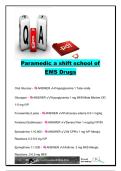
This comprehensive A Shift School of EMS Drugs 2026 Study Guide contains 30+ high-yield exam questions and correct answers covering the essential medications, emergency indications, and dosage principles frequently assessed in paramedic pharmacology examinations, National Registry of Emergency Medical Technicians (NREMT) testing, EMS academy assessments, and advanced life support competency evaluations. Designed as a rapid-review resource, this guide provides paramedic students and practicing providers with a structured overview of commonly administered prehospital medications used during medical emergencies, trauma responses, and resuscitation scenarios. The question-and-answer format reinforces medication recognition, strengthens recall under pressure, and promotes safe medication administration in the field.
The study guide begins with an extensive review of endocrine and metabolic emergency medications, focusing on the recognition and management of hypoglycemic events. Learners examine the indications, routes of administration, and dosing considerations for Oral Glucose, Dextrose 10% (D10), Glucagon, and Thiamine, while also reviewing glucagon's role in select beta-blocker overdose scenarios. These concepts reinforce evidence-based decision-making when treating altered mental status associated with glucose disturbances and nutritional deficiencies.
Significant emphasis is placed on cardiovascular pharmacology and Advanced Cardiac Life Support (ACLS) interventions. Candidates review medications used in cardiac arrest, symptomatic bradycardia, shock states, dysrhythmias, and acute coronary syndromes, including Epinephrine (1:10,000 and 1:1,000 formulations), Dopamine, Norepinephrine, Atropine, Adenosine, Amiodarone, Lidocaine, Aspirin, Nitroglycerin, and Sodium Bicarbonate. The material explores indications, common dosing strategies, routes of administration, and clinical applications in ventricular fibrillation, pulseless ventricular tachycardia, supraventricular tachycardia, cardiogenic shock, metabolic acidosis, and chest pain management.
Respiratory emergencies and allergy management represent another major focus of this resource. Learners strengthen their understanding of the pharmacologic treatment of asthma, bronchoconstriction, anaphylaxis, pulmonary edema, and allergic reactions through the review of medications such as Albuterol, Ipratropium Bromide (Atrovent), Terbutaline, Magnesium Sulfate, Methylprednisolone, Diphenhydramine (Benadryl), Epinephrine, and Furosemide (Lasix). These topics emphasize the importance of timely intervention and patient reassessment during respiratory compromise and hypersensitivity reactions.
The guide also provides detailed coverage of analgesia, sedation, seizure management, and toxicologic emergencies frequently encountered in prehospital practice. Students review medications including Fentanyl, Morphine Sulfate, Diazepam (Valium), Midazolam (Versed), Naloxone (Narcan), Activated Charcoal, and Calcium Chloride, examining their mechanisms of action, emergency indications, routes of administration, and safety considerations. Particular attention is given to opioid overdose reversal, seizure control, procedural sedation principles, ingested poison management, and overdose treatment protocols.
Additional content addresses the management of nausea and vomiting, with a review of antiemetic agents such as Ondansetron (Zofran) and Promethazine (Phenergan). Learners further reinforce pharmacology principles related to medication calculations, dosage accuracy, route selection, contraindication awareness, and the importance of ongoing patient monitoring following medication administration.
This study resource aligns closely with the National EMS Education Standards, common EMS academy pharmacology curricula, and the NREMT Paramedic Examination Content Outline. It serves as an effective revision companion for strengthening emergency pharmacology knowledge, improving examination performance, and enhancing clinical confidence in the delivery of safe, evidence-based prehospital care.
Referenced Sources:
National Registry of Emergency Medical Technicians (NREMT). Paramedic Examination Content Outline and Candidate Handbook.
American Heart Association (AHA). Advanced Cardiovascular Life Support (ACLS) Provider Manual, Latest Edition.
American Heart Association (AHA). Pediatric Advanced Life Support (PALS) Provider Manual, Latest Edition.
American Academy of Orthopaedic Surgeons (AAOS). Nancy Caroline's Emergency Care in the Streets, 9th Edition.
Bledsoe, Bryan E., Porter, Robert S., Cherry, Richard A. Paramedic Care: Principles & Practice, 5th Edition.
Tintinalli, Judith E., et al. Tintinalli's Emergency Medicine: A Comprehensive Study Guide, 9th Edition.
Lexicomp Drug Reference Database.
IBM Micromedex Drug Reference System.
National Association of EMS Physicians (NAEMSP). Clinical recommendations and position statements related to prehospital pharmacology.
Relevant Students:
This document is especially beneficial for NREMT paramedic candidates, EMS academy students, paramedic students enrolled in pharmacology courses, advanced EMTs transitioning into paramedic programs, emergency medical technician students preparing for medication examinations, flight paramedics, critical care transport providers, EMS educators, emergency department nurses reviewing prehospital medications, emergency medicine residents, and healthcare professionals seeking a concise review of emergency pharmacology and advanced life support medications.
Keywords:
A Shift School of EMS Drugs, EMS pharmacology, paramedic drug study guide, NREMT pharmacology, paramedic exam questions, ACLS medications, emergency medications, Oral Glucose, Glucagon, D10, Furosemide, Lasix, Fentanyl, Epinephrine 1:10,000, Epinephrine 1:1,000, Dopamine, Diphenhydramine, Benadryl, Diazepam, Atropine, Aspirin, Amiodarone, Activated Charcoal, Albuterol, Adenosine, Ipratropium, Lidocaine, Magnesium Sulfate, Methylprednisolone, Midazolam, Morphine, Naloxone, Nitroglycerin, Norepinephrine, Ondansetron, Promethazine, Sodium Bicarbonate, Terbutaline, Thiamine, EMS medication review, NREMT paramedic preparation
Content preview
Paramedic a shift school of
EMS Drugs
Oral Glucose - ANSWER ✔✔Hypoglycemia 1 Tube orally
Glucagon - ANSWER ✔✔Hypoglycemia 1 mg IM/IN Beta Blocker OD
1-5 mg IVP
Furosemide (Lasix) - ANSWER ✔✔Pulmonary edema 0.5-1 mg/kg
Fentanyl (Sublimaze) - ANSWER ✔✔Severe Pain 1 mcg/kg IVP/IN
Epinephrine 1:10,000 - ANSWER ✔✔All CPR's 1 mg IVP Allergic
Reactions 0.3-9.5 mg IVP
Epinephrine 1:1,000 - ANSWER ✔✔Asthma .3 mg IM/S Allergic
Reactions .3-0.5 mg IM/S