@LECTSOLUTIONSSTUVIA
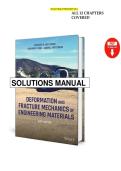
ALL 12 CHAPTERS
COVERED
SOLUTIONS MANUAL
,Table of Contents
Chapter 1. Elastic Response of Solids
Chapter 2. Yielding and Plastic Flow
Chapter 3. Controlling Strength
Chapter 4. Time-Dependent
Deformation Chapter 5. Fracture: An
Overview
Chapter 6. Elements of Fracture
Mechanics Chapter 7. Fracture
Toughness
Chapter 8. Environment-Assisted
Cracking Chapter 9. Cyclic Stress and
Strain Fatigue Chapter 10. Fatigue Crack
Propagation Chapter 11. Analyses of
Engineering Failures Chapter 12.
Consequences of Product Failure
,Deformation and Fracture Mechanics of Engineering Materials, 5th ed. Problem Solutions p. 1/162
Draft document, Copyright R. Hertzberg, R. Vinci, J. Hertzberg 2009
CHAPTER 1
Review
1.1 In your own words, what are two differences between product testing and
material testing?
Possible answers include: (a) The goal of the two procedures is different. Whereas product
testing is design to determine the lifetime of a component under conditions that mimic real-
world use, material testing is intended to extract fundamental material properties that are
independent of the material’s use. (b) The specimen shape is different. Product testing must
use the material in the shape in which it will be used in the real product. Material testing uses
idealized specimen shapes designed to unambiguously determine one or more properties of the
material with the simplest analysis possible.
1.2 What are the distinguishing differences between elasticity, plasticity, and fracture?
Elasticity involves only deformation that is fully reversible when the applied load is removed
(even if it takes time to occur). Plasticity is permanent shape change without cracking, even
when no load exists. Fracture inherently involves breaking of bonds and the creation of new
surfaces. Often two or more of these processes take place simultaneously, but the contribution
of each can be separated from the others.
1.3 Write the definitions for engineering stress, true stress, engineering strain,
and true strain for loading along a single axis.
load P
eng engineering stress (1-1a)
initial cross-sectional area A0
load P
true stress
tru (1-2a)
instantaneous cross-sectional areaAi
e
change in length lf l0
engineering strain
(1-1b)
eng
initial length l0
final lf
true true strain ln ln (1-2b)
length l0
initial
length
Excerpts from this work may be reproduced by instructors for distribution on a not-for-profit basis for testing or instructional
purposes only to students enrolled in courses for which the textbook has been adopted. Any other reproduction or translation of
this work beyond that permitted by Sections 107 or 108 of the 1976 United States Copyright Act without the permission of the
copyright owner is unlawful.
, 1.4 Under what conditions is Eq. 1-4 valid? What makes it no longer useful if
those conditions are not met?
ALL 12 CHAPTERS
COVERED
SOLUTIONS MANUAL
,Table of Contents
Chapter 1. Elastic Response of Solids
Chapter 2. Yielding and Plastic Flow
Chapter 3. Controlling Strength
Chapter 4. Time-Dependent
Deformation Chapter 5. Fracture: An
Overview
Chapter 6. Elements of Fracture
Mechanics Chapter 7. Fracture
Toughness
Chapter 8. Environment-Assisted
Cracking Chapter 9. Cyclic Stress and
Strain Fatigue Chapter 10. Fatigue Crack
Propagation Chapter 11. Analyses of
Engineering Failures Chapter 12.
Consequences of Product Failure
,Deformation and Fracture Mechanics of Engineering Materials, 5th ed. Problem Solutions p. 1/162
Draft document, Copyright R. Hertzberg, R. Vinci, J. Hertzberg 2009
CHAPTER 1
Review
1.1 In your own words, what are two differences between product testing and
material testing?
Possible answers include: (a) The goal of the two procedures is different. Whereas product
testing is design to determine the lifetime of a component under conditions that mimic real-
world use, material testing is intended to extract fundamental material properties that are
independent of the material’s use. (b) The specimen shape is different. Product testing must
use the material in the shape in which it will be used in the real product. Material testing uses
idealized specimen shapes designed to unambiguously determine one or more properties of the
material with the simplest analysis possible.
1.2 What are the distinguishing differences between elasticity, plasticity, and fracture?
Elasticity involves only deformation that is fully reversible when the applied load is removed
(even if it takes time to occur). Plasticity is permanent shape change without cracking, even
when no load exists. Fracture inherently involves breaking of bonds and the creation of new
surfaces. Often two or more of these processes take place simultaneously, but the contribution
of each can be separated from the others.
1.3 Write the definitions for engineering stress, true stress, engineering strain,
and true strain for loading along a single axis.
load P
eng engineering stress (1-1a)
initial cross-sectional area A0
load P
true stress
tru (1-2a)
instantaneous cross-sectional areaAi
e
change in length lf l0
engineering strain
(1-1b)
eng
initial length l0
final lf
true true strain ln ln (1-2b)
length l0
initial
length
Excerpts from this work may be reproduced by instructors for distribution on a not-for-profit basis for testing or instructional
purposes only to students enrolled in courses for which the textbook has been adopted. Any other reproduction or translation of
this work beyond that permitted by Sections 107 or 108 of the 1976 United States Copyright Act without the permission of the
copyright owner is unlawful.
, 1.4 Under what conditions is Eq. 1-4 valid? What makes it no longer useful if
those conditions are not met?