Critical Care Nursing
10th Edition
Author(s)Linda D. Urden;
Kathleen M. Stacy; Mary E.
Lough; Kimberly Sanchez
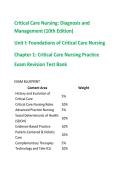
Weighted Exam Blueprint — Unit I: Foundations of Critical
Care Nursing
,Domain / Topic Cluster Weight Items
Critical care practice, history, contemporary
15% 3
roles, expanded/APN roles
Social determinants of health, disparities,
10% 2
inequities
Professional accountability, SCCM/AACN,
15% 3
evidence-based practice
Holistic care, patient-centered care, cultural
10% 2
care, complementary therapies
Technology, tele-ICU, interprofessional
collaboration, rapid response, care management 20% 4
tools
Quality, safety, regulations, resources 10% 2
Compassion fatigue, alarm fatigue, incivility,
bullying, workplace violence, healthy work 20% 4
environment
Bloom’s Taxonomy Distribution
Recall: 3 items
Comprehension: 3 items
Application: 7 items
Analysis: 5 items
, Evaluation/Judgment: 2 items
1) MCQ — Recall
Question: Which historical development most directly marked
the beginning of modern critical care nursing practice?
A. Introduction of patient satisfaction surveys
B. Establishment of specialized areas for continuous monitoring
of unstable patients
C. Replacement of all invasive monitoring with noninvasive
monitoring
D. Elimination of multidisciplinary team care
Correct Answer: B
Rationale: Modern critical care developed from the need to
concentrate severely ill patients in specialized units where
continuous monitoring, rapid intervention, and advanced
support could be provided.
Distractor Analysis:
A: Patient satisfaction is important but not a historical
foundation of critical care.
C: Invasive monitoring was not eliminated; both invasive
and noninvasive methods remain important.
D: Critical care depends on multidisciplinary team care.
Difficulty Rating: Easy
, Learning Objective: Identify the historical foundation of critical
care nursing.
Chapter Reference: Unit I, Critical Care Nursing Practice
Clinical Significance: Understanding the origin of ICU care
supports appreciation of monitoring intensity, staffing needs,
and rapid response priorities.
2) MCQ — Recall
Question: Which role is most characteristic of an expanded-role
critical care nursing position?
A. Routine linen distribution
B. Bedside vital sign documentation only
C. Clinical nurse specialist or nurse practitioner practice
D. Nonclinical scheduling without patient contact
Correct Answer: C
Rationale: Expanded-role positions in critical care include
advanced practice and expert clinical roles such as nurse
practitioner and clinical nurse specialist functions.
Distractor Analysis:
A: Not a critical care nursing role.
B: Too limited to describe expanded practice.
D: This is an administrative function, not expanded critical
care nursing practice.
10th Edition
Author(s)Linda D. Urden;
Kathleen M. Stacy; Mary E.
Lough; Kimberly Sanchez
Weighted Exam Blueprint — Unit I: Foundations of Critical
Care Nursing
,Domain / Topic Cluster Weight Items
Critical care practice, history, contemporary
15% 3
roles, expanded/APN roles
Social determinants of health, disparities,
10% 2
inequities
Professional accountability, SCCM/AACN,
15% 3
evidence-based practice
Holistic care, patient-centered care, cultural
10% 2
care, complementary therapies
Technology, tele-ICU, interprofessional
collaboration, rapid response, care management 20% 4
tools
Quality, safety, regulations, resources 10% 2
Compassion fatigue, alarm fatigue, incivility,
bullying, workplace violence, healthy work 20% 4
environment
Bloom’s Taxonomy Distribution
Recall: 3 items
Comprehension: 3 items
Application: 7 items
Analysis: 5 items
, Evaluation/Judgment: 2 items
1) MCQ — Recall
Question: Which historical development most directly marked
the beginning of modern critical care nursing practice?
A. Introduction of patient satisfaction surveys
B. Establishment of specialized areas for continuous monitoring
of unstable patients
C. Replacement of all invasive monitoring with noninvasive
monitoring
D. Elimination of multidisciplinary team care
Correct Answer: B
Rationale: Modern critical care developed from the need to
concentrate severely ill patients in specialized units where
continuous monitoring, rapid intervention, and advanced
support could be provided.
Distractor Analysis:
A: Patient satisfaction is important but not a historical
foundation of critical care.
C: Invasive monitoring was not eliminated; both invasive
and noninvasive methods remain important.
D: Critical care depends on multidisciplinary team care.
Difficulty Rating: Easy
, Learning Objective: Identify the historical foundation of critical
care nursing.
Chapter Reference: Unit I, Critical Care Nursing Practice
Clinical Significance: Understanding the origin of ICU care
supports appreciation of monitoring intensity, staffing needs,
and rapid response priorities.
2) MCQ — Recall
Question: Which role is most characteristic of an expanded-role
critical care nursing position?
A. Routine linen distribution
B. Bedside vital sign documentation only
C. Clinical nurse specialist or nurse practitioner practice
D. Nonclinical scheduling without patient contact
Correct Answer: C
Rationale: Expanded-role positions in critical care include
advanced practice and expert clinical roles such as nurse
practitioner and clinical nurse specialist functions.
Distractor Analysis:
A: Not a critical care nursing role.
B: Too limited to describe expanded practice.
D: This is an administrative function, not expanded critical
care nursing practice.