
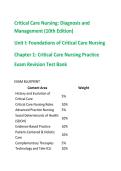
Critical Care Nursing: Diagnosis and
Management (10th Edition)
Unit I: Foundations of Critical Care Nursing
Chapter 1: Critical Care Nursing Practice
Exam Revision Test Bank
EXAM BLUEPRINT
Content Area Weight
History and Evolution of
5%
Critical Care
Critical Care Nursing Roles 10%
Advanced Practice Nursing 5%
Social Determinants of Health
10%
(SDOH)
Evidence-Based Practice 10%
Patient-Centered & Holistic
10%
Care
Complementary Therapies 5%
Technology and Tele-ICU 10%
,Interprofessional
10%
Collaboration
Rapid Response Teams 10%
Quality & Safety 10%
Healthy Work Environment 5%
1. (MCQ | Recall)
A nurse educator is teaching new staff about the historical
development of critical care. Which event most directly led to
the modern ICU concept?
A. Development of community health nursing
B. Concentration of unstable postoperative patients in one
specialized area
C. Introduction of home hospice services
D. Expansion of outpatient surgery centers
Correct Answer: B
Rationale: Critical care emerged when patients requiring close
physiologic monitoring and intensive intervention were
grouped in specialized units to improve outcomes.
Distractor Analysis:
• A: Community health nursing is important but did not
drive ICU development.
• C: Hospice reflects end-of-life care, not ICU evolution.
, • D: Outpatient surgery expanded later and is unrelated to
ICU origins.
Difficulty: Easy
Learning Objective: Describe the historical basis for the
development of critical care nursing.
Chapter Reference: Unit I, Chapter 1 — Critical Care
Nursing Practice: History of Critical Care
Clinical Significance: Understanding ICU origins supports
appreciation of why continuous surveillance and rapid
intervention are central to critical care practice.
2. (MCQ | Comprehension)
Which statement best reflects contemporary critical care
nursing?
A. Care is limited to ventilated patients in large academic
hospitals
B. Critical care is focused only on disease-specific treatment
C. Critical care involves advanced monitoring, rapid decision-
making, and interdisciplinary collaboration
D. Critical care nurses work independently without input from
other disciplines
Correct Answer: C
Rationale: Contemporary critical care is characterized by
complex surveillance, advanced technology, patient advocacy,
, and teamwork across disciplines.
Distractor Analysis:
• A: Critical care occurs in many settings, not only academic
hospitals.
• B: Care extends beyond disease treatment to holistic,
patient-centered management.
• D: Interdisciplinary collaboration is essential in ICU care.
Difficulty: Easy
Learning Objective: Explain the defining features of
contemporary critical care practice.
Chapter Reference: Unit I, Chapter 1 — Contemporary
Critical Care
Clinical Significance: Recognizing modern ICU practice
supports safe, coordinated care delivery.
3. (SATA | Recall/Application)
Which roles are recognized as critical care nursing roles? Select
all that apply.
A. Bedside ICU nurse
B. Charge nurse
C. Clinical nurse specialist
D. Nurse practitioner
Management (10th Edition)
Unit I: Foundations of Critical Care Nursing
Chapter 1: Critical Care Nursing Practice
Exam Revision Test Bank
EXAM BLUEPRINT
Content Area Weight
History and Evolution of
5%
Critical Care
Critical Care Nursing Roles 10%
Advanced Practice Nursing 5%
Social Determinants of Health
10%
(SDOH)
Evidence-Based Practice 10%
Patient-Centered & Holistic
10%
Care
Complementary Therapies 5%
Technology and Tele-ICU 10%
,Interprofessional
10%
Collaboration
Rapid Response Teams 10%
Quality & Safety 10%
Healthy Work Environment 5%
1. (MCQ | Recall)
A nurse educator is teaching new staff about the historical
development of critical care. Which event most directly led to
the modern ICU concept?
A. Development of community health nursing
B. Concentration of unstable postoperative patients in one
specialized area
C. Introduction of home hospice services
D. Expansion of outpatient surgery centers
Correct Answer: B
Rationale: Critical care emerged when patients requiring close
physiologic monitoring and intensive intervention were
grouped in specialized units to improve outcomes.
Distractor Analysis:
• A: Community health nursing is important but did not
drive ICU development.
• C: Hospice reflects end-of-life care, not ICU evolution.
, • D: Outpatient surgery expanded later and is unrelated to
ICU origins.
Difficulty: Easy
Learning Objective: Describe the historical basis for the
development of critical care nursing.
Chapter Reference: Unit I, Chapter 1 — Critical Care
Nursing Practice: History of Critical Care
Clinical Significance: Understanding ICU origins supports
appreciation of why continuous surveillance and rapid
intervention are central to critical care practice.
2. (MCQ | Comprehension)
Which statement best reflects contemporary critical care
nursing?
A. Care is limited to ventilated patients in large academic
hospitals
B. Critical care is focused only on disease-specific treatment
C. Critical care involves advanced monitoring, rapid decision-
making, and interdisciplinary collaboration
D. Critical care nurses work independently without input from
other disciplines
Correct Answer: C
Rationale: Contemporary critical care is characterized by
complex surveillance, advanced technology, patient advocacy,
, and teamwork across disciplines.
Distractor Analysis:
• A: Critical care occurs in many settings, not only academic
hospitals.
• B: Care extends beyond disease treatment to holistic,
patient-centered management.
• D: Interdisciplinary collaboration is essential in ICU care.
Difficulty: Easy
Learning Objective: Explain the defining features of
contemporary critical care practice.
Chapter Reference: Unit I, Chapter 1 — Contemporary
Critical Care
Clinical Significance: Recognizing modern ICU practice
supports safe, coordinated care delivery.
3. (SATA | Recall/Application)
Which roles are recognized as critical care nursing roles? Select
all that apply.
A. Bedside ICU nurse
B. Charge nurse
C. Clinical nurse specialist
D. Nurse practitioner


