
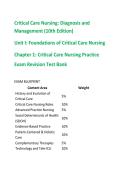
Critical Care Nursing: Diagnosis and
Management (10th Edition)
Unit I: Foundations of Critical Care Nursing
Chapter 1: Critical Care Nursing Practice
Exam Revision Test Bank
EXAM BLUEPRINT
Content Area Weight
History and Evolution of
5%
Critical Care
Critical Care Nursing Roles 10%
Advanced Practice Nursing 5%
Social Determinants of Health
10%
(SDOH)
Evidence-Based Practice 10%
Patient-Centered & Holistic
10%
Care
Complementary Therapies 5%
Technology and Tele-ICU 10%
,Interprofessional
10%
Collaboration
Rapid Response Teams 10%
Quality & Safety 10%
Healthy Work Environment 5%
Question 1
Cognitive level: Recall
Question type: MCQ
Chapter reference: Unit I, Chapter 1 — Critical Care Nursing
Practice
Learning objective: Identify the historical development of
critical care nursing.
Which event most directly contributed to the development of
modern critical care units?
A. The creation of outpatient specialty clinics
B. The need to closely monitor unstable postoperative and
respiratory patients
C. The replacement of nurses with telehealth technology
D. The elimination of invasive monitoring in hospitals
Correct answer: B
Rationale: Critical care units evolved from the need to provide
continuous surveillance and rapid intervention for patients with
,severe physiologic instability, especially after surgery, trauma,
and respiratory failure. This need drove the development of
specialized staffing, monitoring, and equipment.
Distractor analysis:
A. Outpatient clinics did not drive the origin of critical care
units.
C. Telehealth is a contemporary tool, not the origin of ICU
development.
D. Invasive monitoring expanded rather than disappeared in
critical care.
Difficulty rating: Easy
Clinical significance: Understanding ICU origins helps nurses
appreciate why continuous assessment and rapid response
remain central to critical care practice.
Question 2
Cognitive level: Recall
Question type: MCQ
Chapter reference: Unit I, Chapter 1 — Critical Care Nursing
Practice
Learning objective: Recognize the role of professional critical
care organizations.
Which organization is most directly associated with setting
standards and resources for critical care nursing practice?
A. Society of Critical Care Medicine (SCCM)
, B. National League for Nursing (NLN)
C. American Heart Association (AHA)
D. Centers for Disease Control and Prevention (CDC)
Correct answer: A
Rationale: The Society of Critical Care Medicine provides
education, guidelines, and professional resources specifically
focused on critical care. The AACN is also a major critical care
nursing organization, but SCCM is the best answer among the
options because it is directly focused on critical care medicine
and interdisciplinary ICU practice.
Distractor analysis:
B. NLN focuses on nursing education broadly, not critical care
practice standards.
C. AHA focuses primarily on cardiovascular health and
resuscitation guidelines.
D. CDC addresses public health and infection prevention rather
than ICU professional standards.
Difficulty rating: Easy
Clinical significance: Nurses use professional organizations to
support evidence-based practice, continuing education, and
quality improvement.
Question 3
Cognitive level: Recall
Management (10th Edition)
Unit I: Foundations of Critical Care Nursing
Chapter 1: Critical Care Nursing Practice
Exam Revision Test Bank
EXAM BLUEPRINT
Content Area Weight
History and Evolution of
5%
Critical Care
Critical Care Nursing Roles 10%
Advanced Practice Nursing 5%
Social Determinants of Health
10%
(SDOH)
Evidence-Based Practice 10%
Patient-Centered & Holistic
10%
Care
Complementary Therapies 5%
Technology and Tele-ICU 10%
,Interprofessional
10%
Collaboration
Rapid Response Teams 10%
Quality & Safety 10%
Healthy Work Environment 5%
Question 1
Cognitive level: Recall
Question type: MCQ
Chapter reference: Unit I, Chapter 1 — Critical Care Nursing
Practice
Learning objective: Identify the historical development of
critical care nursing.
Which event most directly contributed to the development of
modern critical care units?
A. The creation of outpatient specialty clinics
B. The need to closely monitor unstable postoperative and
respiratory patients
C. The replacement of nurses with telehealth technology
D. The elimination of invasive monitoring in hospitals
Correct answer: B
Rationale: Critical care units evolved from the need to provide
continuous surveillance and rapid intervention for patients with
,severe physiologic instability, especially after surgery, trauma,
and respiratory failure. This need drove the development of
specialized staffing, monitoring, and equipment.
Distractor analysis:
A. Outpatient clinics did not drive the origin of critical care
units.
C. Telehealth is a contemporary tool, not the origin of ICU
development.
D. Invasive monitoring expanded rather than disappeared in
critical care.
Difficulty rating: Easy
Clinical significance: Understanding ICU origins helps nurses
appreciate why continuous assessment and rapid response
remain central to critical care practice.
Question 2
Cognitive level: Recall
Question type: MCQ
Chapter reference: Unit I, Chapter 1 — Critical Care Nursing
Practice
Learning objective: Recognize the role of professional critical
care organizations.
Which organization is most directly associated with setting
standards and resources for critical care nursing practice?
A. Society of Critical Care Medicine (SCCM)
, B. National League for Nursing (NLN)
C. American Heart Association (AHA)
D. Centers for Disease Control and Prevention (CDC)
Correct answer: A
Rationale: The Society of Critical Care Medicine provides
education, guidelines, and professional resources specifically
focused on critical care. The AACN is also a major critical care
nursing organization, but SCCM is the best answer among the
options because it is directly focused on critical care medicine
and interdisciplinary ICU practice.
Distractor analysis:
B. NLN focuses on nursing education broadly, not critical care
practice standards.
C. AHA focuses primarily on cardiovascular health and
resuscitation guidelines.
D. CDC addresses public health and infection prevention rather
than ICU professional standards.
Difficulty rating: Easy
Clinical significance: Nurses use professional organizations to
support evidence-based practice, continuing education, and
quality improvement.
Question 3
Cognitive level: Recall


