

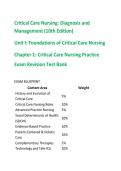
Critical Care Nursing: Diagnosis and
Management (10th Edition)
Unit I: Foundations of Critical Care Nursing
Chapter 1: Critical Care Nursing Practice
Exam Revision Test Bank
EXAM BLUEPRINT
Content Area Weight
History and Evolution of
5%
Critical Care
Critical Care Nursing Roles 10%
Advanced Practice Nursing 5%
Social Determinants of Health
10%
(SDOH)
Evidence-Based Practice 10%
Patient-Centered & Holistic
10%
Care
Complementary Therapies 5%
Technology and Tele-ICU 10%
,Interprofessional
10%
Collaboration
Rapid Response Teams 10%
Quality & Safety 10%
Healthy Work Environment 5%
1. MCQ
A critical care nurse is explaining the historical development of
the specialty to new staff. Which event best represents a major
driver in the growth of modern critical care nursing?
A. The widespread use of home health agencies for unstable
patients
B. The creation of intensive care units to support close
physiologic monitoring
C. The replacement of all bedside nursing with telehealth
systems
D. The elimination of invasive monitoring in high-acuity settings
Correct answer: B
Rationale: The development of intensive care units allowed
concentrated staffing, continuous monitoring, and rapid
intervention for unstable patients, which was central to the
growth of critical care nursing.
,Distractor analysis:
A. Home health is not a historical driver of ICU development.
C. Telehealth supports care but did not replace bedside nursing
in critical care.
D. Invasive monitoring was not eliminated; it became an
important ICU tool.
Difficulty rating: Easy
Learning objective: Identify a key historical development that
shaped critical care nursing practice.
Chapter reference: Unit I, Chapter 1: Critical Care Nursing
Practice
Clinical significance: Understanding the history of critical care
helps nurses appreciate the purpose of specialized monitoring
and rapid intervention in ICU care.
2. SATA
Which statements describe contemporary critical care practice?
Select all that apply.
A. It emphasizes complex physiologic monitoring and rapid
response to instability
B. It is limited to the management of ventilated patients only
C. It integrates interprofessional collaboration
D. It uses evidence-based protocols and technology
E. It excludes family involvement to reduce distractions
, Correct answers: A, C, D
Rationale: Contemporary critical care is characterized by rapid
assessment, advanced technology, interprofessional teamwork,
and evidence-based protocols. Family-centered care remains
important.
Distractor analysis:
B. Critical care includes many patient populations beyond
ventilated patients.
E. Family involvement is often incorporated, not excluded.
Difficulty rating: Moderate
Learning objective: Differentiate contemporary critical care
features from outdated assumptions.
Chapter reference: Unit I, Chapter 1: Critical Care Nursing
Practice
Clinical significance: Recognizing contemporary practice
supports safe, coordinated ICU care and adherence to current
standards.
3. MCQ
Which nursing role is most associated with autonomous
management of a patient population, including advanced
assessment and clinical decision-making?
Management (10th Edition)
Unit I: Foundations of Critical Care Nursing
Chapter 1: Critical Care Nursing Practice
Exam Revision Test Bank
EXAM BLUEPRINT
Content Area Weight
History and Evolution of
5%
Critical Care
Critical Care Nursing Roles 10%
Advanced Practice Nursing 5%
Social Determinants of Health
10%
(SDOH)
Evidence-Based Practice 10%
Patient-Centered & Holistic
10%
Care
Complementary Therapies 5%
Technology and Tele-ICU 10%
,Interprofessional
10%
Collaboration
Rapid Response Teams 10%
Quality & Safety 10%
Healthy Work Environment 5%
1. MCQ
A critical care nurse is explaining the historical development of
the specialty to new staff. Which event best represents a major
driver in the growth of modern critical care nursing?
A. The widespread use of home health agencies for unstable
patients
B. The creation of intensive care units to support close
physiologic monitoring
C. The replacement of all bedside nursing with telehealth
systems
D. The elimination of invasive monitoring in high-acuity settings
Correct answer: B
Rationale: The development of intensive care units allowed
concentrated staffing, continuous monitoring, and rapid
intervention for unstable patients, which was central to the
growth of critical care nursing.
,Distractor analysis:
A. Home health is not a historical driver of ICU development.
C. Telehealth supports care but did not replace bedside nursing
in critical care.
D. Invasive monitoring was not eliminated; it became an
important ICU tool.
Difficulty rating: Easy
Learning objective: Identify a key historical development that
shaped critical care nursing practice.
Chapter reference: Unit I, Chapter 1: Critical Care Nursing
Practice
Clinical significance: Understanding the history of critical care
helps nurses appreciate the purpose of specialized monitoring
and rapid intervention in ICU care.
2. SATA
Which statements describe contemporary critical care practice?
Select all that apply.
A. It emphasizes complex physiologic monitoring and rapid
response to instability
B. It is limited to the management of ventilated patients only
C. It integrates interprofessional collaboration
D. It uses evidence-based protocols and technology
E. It excludes family involvement to reduce distractions
, Correct answers: A, C, D
Rationale: Contemporary critical care is characterized by rapid
assessment, advanced technology, interprofessional teamwork,
and evidence-based protocols. Family-centered care remains
important.
Distractor analysis:
B. Critical care includes many patient populations beyond
ventilated patients.
E. Family involvement is often incorporated, not excluded.
Difficulty rating: Moderate
Learning objective: Differentiate contemporary critical care
features from outdated assumptions.
Chapter reference: Unit I, Chapter 1: Critical Care Nursing
Practice
Clinical significance: Recognizing contemporary practice
supports safe, coordinated ICU care and adherence to current
standards.
3. MCQ
Which nursing role is most associated with autonomous
management of a patient population, including advanced
assessment and clinical decision-making?


