

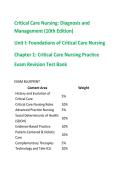
Critical Care Nursing: Diagnosis and
Management (10th Edition)
Unit I: Foundations of Critical Care Nursing
Chapter 1: Critical Care Nursing Practice
Exam Revision Test Bank
EXAM BLUEPRINT
Content Area Weight
History and Evolution of
5%
Critical Care
Critical Care Nursing Roles 10%
Advanced Practice Nursing 5%
Social Determinants of Health
10%
(SDOH)
Evidence-Based Practice 10%
Patient-Centered & Holistic
10%
Care
Complementary Therapies 5%
Technology and Tele-ICU 10%
,Interprofessional
10%
Collaboration
Rapid Response Teams 10%
Quality & Safety 10%
Healthy Work Environment 5%
1. (MCQ | Recall | Easy)
A nurse explains that modern critical care nursing originated
primarily from which historical development?
A. Expansion of home hospice services
B. Advances in monitoring and life-support technology
C. Replacement of physicians in acute care units
D. Elimination of infectious disease in hospitals
Correct Answer: B
Rationale: Critical care nursing developed alongside advances
in intensive monitoring, ventilatory support, hemodynamic
monitoring, and organ support technologies that made care of
unstable patients possible in specialized units.
Distractor Analysis:
• A: Hospice is a separate model of care and not the basis of
critical care nursing.
• C: Critical care nurses collaborate with physicians; they do
not replace them.
, • D: Infectious disease reduction improved care broadly, but
did not create critical care nursing.
Difficulty Rating: Easy
Learning Objective: Identify the historical drivers that shaped
critical care nursing practice.
Chapter Reference: Unit I, Chapter 1: Critical Care Nursing
Practice
Clinical Significance: Understanding the origins of critical care
supports appreciation of specialized monitoring and rapid
intervention in the ICU.
2. (MCQ | Comprehension | Easy)
Which statement best describes contemporary critical care
nursing?
A. It focuses only on ventilator management
B. It centers on one organ system at a time
C. It requires holistic management of unstable, complex
patients
D. It is limited to patients receiving end-of-life care
Correct Answer: C
Rationale: Contemporary critical care nursing is holistic and
integrates organ support, technology, family-centered care,
, ethical decision-making, and interdisciplinary collaboration for
complex, unstable patients.
Distractor Analysis:
• A: Ventilator management is important but not the whole
role.
• B: Critical illness often affects multiple systems
simultaneously.
• D: ICU care includes rescue, recovery, prevention, and
palliative care, not only end-of-life care.
Difficulty Rating: Easy
Learning Objective: Describe the scope of contemporary critical
care nursing.
Chapter Reference: Unit I, Chapter 1
Clinical Significance: ICU nurses must manage whole-patient
needs, not isolated abnormalities.
3. (MCQ | Application | Moderate)
A new ICU nurse asks why the unit uses evidence-based order
sets for sepsis care. What is the best response?
A. “They reduce nursing autonomy.”
B. “They standardize care based on the best available
evidence.”
Management (10th Edition)
Unit I: Foundations of Critical Care Nursing
Chapter 1: Critical Care Nursing Practice
Exam Revision Test Bank
EXAM BLUEPRINT
Content Area Weight
History and Evolution of
5%
Critical Care
Critical Care Nursing Roles 10%
Advanced Practice Nursing 5%
Social Determinants of Health
10%
(SDOH)
Evidence-Based Practice 10%
Patient-Centered & Holistic
10%
Care
Complementary Therapies 5%
Technology and Tele-ICU 10%
,Interprofessional
10%
Collaboration
Rapid Response Teams 10%
Quality & Safety 10%
Healthy Work Environment 5%
1. (MCQ | Recall | Easy)
A nurse explains that modern critical care nursing originated
primarily from which historical development?
A. Expansion of home hospice services
B. Advances in monitoring and life-support technology
C. Replacement of physicians in acute care units
D. Elimination of infectious disease in hospitals
Correct Answer: B
Rationale: Critical care nursing developed alongside advances
in intensive monitoring, ventilatory support, hemodynamic
monitoring, and organ support technologies that made care of
unstable patients possible in specialized units.
Distractor Analysis:
• A: Hospice is a separate model of care and not the basis of
critical care nursing.
• C: Critical care nurses collaborate with physicians; they do
not replace them.
, • D: Infectious disease reduction improved care broadly, but
did not create critical care nursing.
Difficulty Rating: Easy
Learning Objective: Identify the historical drivers that shaped
critical care nursing practice.
Chapter Reference: Unit I, Chapter 1: Critical Care Nursing
Practice
Clinical Significance: Understanding the origins of critical care
supports appreciation of specialized monitoring and rapid
intervention in the ICU.
2. (MCQ | Comprehension | Easy)
Which statement best describes contemporary critical care
nursing?
A. It focuses only on ventilator management
B. It centers on one organ system at a time
C. It requires holistic management of unstable, complex
patients
D. It is limited to patients receiving end-of-life care
Correct Answer: C
Rationale: Contemporary critical care nursing is holistic and
integrates organ support, technology, family-centered care,
, ethical decision-making, and interdisciplinary collaboration for
complex, unstable patients.
Distractor Analysis:
• A: Ventilator management is important but not the whole
role.
• B: Critical illness often affects multiple systems
simultaneously.
• D: ICU care includes rescue, recovery, prevention, and
palliative care, not only end-of-life care.
Difficulty Rating: Easy
Learning Objective: Describe the scope of contemporary critical
care nursing.
Chapter Reference: Unit I, Chapter 1
Clinical Significance: ICU nurses must manage whole-patient
needs, not isolated abnormalities.
3. (MCQ | Application | Moderate)
A new ICU nurse asks why the unit uses evidence-based order
sets for sepsis care. What is the best response?
A. “They reduce nursing autonomy.”
B. “They standardize care based on the best available
evidence.”


