

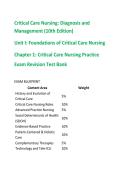
Critical Care Nursing: Diagnosis and
Management (10th Edition)
Unit I: Foundations of Critical Care Nursing
Chapter 1: Critical Care Nursing Practice
Exam Revision Test Bank
EXAM BLUEPRINT
Content Area Weight
History and Evolution of
5%
Critical Care
Critical Care Nursing Roles 10%
Advanced Practice Nursing 5%
Social Determinants of Health
10%
(SDOH)
Evidence-Based Practice 10%
Patient-Centered & Holistic
10%
Care
Complementary Therapies 5%
Technology and Tele-ICU 10%
,Interprofessional
10%
Collaboration
Rapid Response Teams 10%
Quality & Safety 10%
Healthy Work Environment 5%
1) Recall | MCQ
Stem: Which statement best describes the primary goal of
critical care nursing practice?
A. To provide only technologically advanced interventions for
unstable patients
B. To deliver continuous, evidence-based care to patients with
actual or potential life-threatening illness
C. To manage only postoperative patients in the intensive care
unit
D. To replace the role of the physician in urgent decision-
making
Correct Answer: B
Rationale: Critical care nursing focuses on continuous
assessment, surveillance, and evidence-based management of
patients with actual or potential life-threatening conditions. It is
,broader than technology alone and does not replace medical
decision-making.
Distractor Analysis:
A: Too narrow; critical care is not defined only by technology.
C: Too limited; critical care includes many diagnoses and
settings.
D: Incorrect scope; critical care nurses collaborate with, not
replace, physicians.
Difficulty: Easy
Learning Objective: Define the scope and purpose of critical
care nursing practice.
Chapter Reference: Unit I, Chapter 1 — Critical Care Nursing
Practice
Clinical Significance: Clarifies the role of critical care nursing in
safe management of high-acuity patients.
2) Recall | MCQ
Stem: Which organization is most directly associated with
setting standards and promoting excellence in critical care
nursing practice?
A. AACN
B. AMA
, C. AHA
D. CDC
Correct Answer: A
Rationale: The American Association of Critical-Care Nurses
(AACN) is the primary professional organization focused on
critical care nursing standards, education, and practice support.
Distractor Analysis:
B: Represents physicians broadly, not critical care nursing
specifically.
C: Focuses on cardiovascular health and resuscitation
guidelines.
D: Public health agency; not a nursing professional body.
Difficulty: Easy
Learning Objective: Identify a major professional organization
relevant to critical care nursing.
Chapter Reference: Unit I, Chapter 1 — Critical Care
Professional Organizations
Clinical Significance: Supports professional accountability and
standards-based practice.
3) Recall | SATA
Stem: Which of the following are recognized domains of social
determinants of health (SDOH)? Select all that apply.
Management (10th Edition)
Unit I: Foundations of Critical Care Nursing
Chapter 1: Critical Care Nursing Practice
Exam Revision Test Bank
EXAM BLUEPRINT
Content Area Weight
History and Evolution of
5%
Critical Care
Critical Care Nursing Roles 10%
Advanced Practice Nursing 5%
Social Determinants of Health
10%
(SDOH)
Evidence-Based Practice 10%
Patient-Centered & Holistic
10%
Care
Complementary Therapies 5%
Technology and Tele-ICU 10%
,Interprofessional
10%
Collaboration
Rapid Response Teams 10%
Quality & Safety 10%
Healthy Work Environment 5%
1) Recall | MCQ
Stem: Which statement best describes the primary goal of
critical care nursing practice?
A. To provide only technologically advanced interventions for
unstable patients
B. To deliver continuous, evidence-based care to patients with
actual or potential life-threatening illness
C. To manage only postoperative patients in the intensive care
unit
D. To replace the role of the physician in urgent decision-
making
Correct Answer: B
Rationale: Critical care nursing focuses on continuous
assessment, surveillance, and evidence-based management of
patients with actual or potential life-threatening conditions. It is
,broader than technology alone and does not replace medical
decision-making.
Distractor Analysis:
A: Too narrow; critical care is not defined only by technology.
C: Too limited; critical care includes many diagnoses and
settings.
D: Incorrect scope; critical care nurses collaborate with, not
replace, physicians.
Difficulty: Easy
Learning Objective: Define the scope and purpose of critical
care nursing practice.
Chapter Reference: Unit I, Chapter 1 — Critical Care Nursing
Practice
Clinical Significance: Clarifies the role of critical care nursing in
safe management of high-acuity patients.
2) Recall | MCQ
Stem: Which organization is most directly associated with
setting standards and promoting excellence in critical care
nursing practice?
A. AACN
B. AMA
, C. AHA
D. CDC
Correct Answer: A
Rationale: The American Association of Critical-Care Nurses
(AACN) is the primary professional organization focused on
critical care nursing standards, education, and practice support.
Distractor Analysis:
B: Represents physicians broadly, not critical care nursing
specifically.
C: Focuses on cardiovascular health and resuscitation
guidelines.
D: Public health agency; not a nursing professional body.
Difficulty: Easy
Learning Objective: Identify a major professional organization
relevant to critical care nursing.
Chapter Reference: Unit I, Chapter 1 — Critical Care
Professional Organizations
Clinical Significance: Supports professional accountability and
standards-based practice.
3) Recall | SATA
Stem: Which of the following are recognized domains of social
determinants of health (SDOH)? Select all that apply.


