Critical Care Nursing: Diagnosis and
Management (10th Edition)
Unit I: Foundations of Critical Care Nursing
Chapter 1: Critical Care Nursing Practice
Exam Revision Test Bank
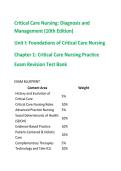
EXAM BLUEPRINT
Content Area Weight
History and Evolution of
5%
Critical Care
Critical Care Nursing Roles 10%
Advanced Practice Nursing 5%
Social Determinants of Health
10%
(SDOH)
Evidence-Based Practice 10%
Patient-Centered & Holistic
10%
Care
Complementary Therapies 5%
Technology and Tele-ICU 10%
,Interprofessional
10%
Collaboration
Rapid Response Teams 10%
Quality & Safety 10%
Healthy Work Environment 5%
Unit I, Chapter 1 — Critical Care Nursing Practice
1.
Type: MCQ
Bloom level: Recall
**Difficulify a defining historical milestone in the development
of critical care nursing.
Chapter reference: Unit I, Chapter 1
Clinical significance: Understanding ICU history supports
appreciation of why continuous monitoring and rapid
intervention are central to critical care.
Question: Which historical development most directly
contributed to the emergence of modern critical care units?
A. The shift from inpatient to outpatient nursing care
B. The need to provide continuous monitoring and life support
for unstable patients
C. The elimination of physician-directed care in hospitals
,D. The replacement of bedside assessment with laboratory
testing
Correct answer: B
Rationale: Modern critical care evolved to meet the need for
close surveillance, rapid intervention, and organ support for
patients with life-threatening instability.
Distractor analysis:
A. Incorrect; outpatient care did not drive ICU development.
C. Incorrect; critical care is interprofessional and physician-
directed care remains part of it.
D. Incorrect; bedside assessment remains essential and is not
replaced by lab testing.
2.
Type: MCQ
Bloom level: Recall
Difficulty: Easy
Learning objective: Distinguish the role of the advanced
practice nurse in critical care.
Chapter reference: Unit I, Chapter 1
Clinical significance: Role clarity improves escalation,
consultation, and safe delegation in ICU settings.
, Question: Which nurse role is most likely to diagnose
conditions, order selected tests, and prescribe treatments
within scope?
A. Staff nurse
B. Charge nurse
C. Nurse practitioner
D. Nursing assistant
Correct answer: C
Rationale: The nurse practitioner is an advanced practice nurse
role with expanded assessment and treatment authority within
licensure and state scope.
Distractor analysis:
A. Incorrect; staff nurses provide direct care but do not
independently diagnose/prescribe.
B. Incorrect; charge nurses coordinate care but do not function
as prescribers.
D. Incorrect; nursing assistants provide supportive care, not
advanced clinical decision-making.
3.
Type: SATA
Bloom level: Recall
Difficulty: Moderate
Management (10th Edition)
Unit I: Foundations of Critical Care Nursing
Chapter 1: Critical Care Nursing Practice
Exam Revision Test Bank
EXAM BLUEPRINT
Content Area Weight
History and Evolution of
5%
Critical Care
Critical Care Nursing Roles 10%
Advanced Practice Nursing 5%
Social Determinants of Health
10%
(SDOH)
Evidence-Based Practice 10%
Patient-Centered & Holistic
10%
Care
Complementary Therapies 5%
Technology and Tele-ICU 10%
,Interprofessional
10%
Collaboration
Rapid Response Teams 10%
Quality & Safety 10%
Healthy Work Environment 5%
Unit I, Chapter 1 — Critical Care Nursing Practice
1.
Type: MCQ
Bloom level: Recall
**Difficulify a defining historical milestone in the development
of critical care nursing.
Chapter reference: Unit I, Chapter 1
Clinical significance: Understanding ICU history supports
appreciation of why continuous monitoring and rapid
intervention are central to critical care.
Question: Which historical development most directly
contributed to the emergence of modern critical care units?
A. The shift from inpatient to outpatient nursing care
B. The need to provide continuous monitoring and life support
for unstable patients
C. The elimination of physician-directed care in hospitals
,D. The replacement of bedside assessment with laboratory
testing
Correct answer: B
Rationale: Modern critical care evolved to meet the need for
close surveillance, rapid intervention, and organ support for
patients with life-threatening instability.
Distractor analysis:
A. Incorrect; outpatient care did not drive ICU development.
C. Incorrect; critical care is interprofessional and physician-
directed care remains part of it.
D. Incorrect; bedside assessment remains essential and is not
replaced by lab testing.
2.
Type: MCQ
Bloom level: Recall
Difficulty: Easy
Learning objective: Distinguish the role of the advanced
practice nurse in critical care.
Chapter reference: Unit I, Chapter 1
Clinical significance: Role clarity improves escalation,
consultation, and safe delegation in ICU settings.
, Question: Which nurse role is most likely to diagnose
conditions, order selected tests, and prescribe treatments
within scope?
A. Staff nurse
B. Charge nurse
C. Nurse practitioner
D. Nursing assistant
Correct answer: C
Rationale: The nurse practitioner is an advanced practice nurse
role with expanded assessment and treatment authority within
licensure and state scope.
Distractor analysis:
A. Incorrect; staff nurses provide direct care but do not
independently diagnose/prescribe.
B. Incorrect; charge nurses coordinate care but do not function
as prescribers.
D. Incorrect; nursing assistants provide supportive care, not
advanced clinical decision-making.
3.
Type: SATA
Bloom level: Recall
Difficulty: Moderate