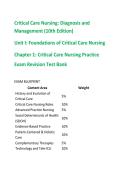
Critical Care Nursing: Diagnosis and
Management (10th Edition)
Unit I: Foundations of Critical Care Nursing
Chapter 1: Critical Care Nursing Practice
Exam Revision Test Bank
EXAM BLUEPRINT
Content Area Weight
History and Evolution of
5%
Critical Care
Critical Care Nursing Roles 10%
Advanced Practice Nursing 5%
Social Determinants of Health
10%
(SDOH)
Evidence-Based Practice 10%
Patient-Centered & Holistic
10%
Care
Complementary Therapies 5%
Technology and Tele-ICU 10%
,Interprofessional
10%
Collaboration
Rapid Response Teams 10%
Quality & Safety 10%
Healthy Work Environment 5%
Unit I — Foundations of Critical Care Nursing
Chapter Reference: Critical Care Nursing Practice
Exam Blueprint (20 items)
Topic Weighting
• Critical care nursing roles and practice: 20%
• SDOH, disparities, inequities, equity-focused care: 15%
• Evidence-based practice and clinical decision support: 15%
• Holistic, patient-centered, culturally responsive care: 10%
• Technology, tele-ICU, and interprofessional collaboration:
10%
• Quality, safety, regulatory issues: 15%
• Nurse well-being, fatigue, bullying, violence prevention,
HWE: 15%
Bloom’s Taxonomy Distribution
• Recall: 3 items
, • Comprehension: 3 items
• Application: 7 items
• Analysis: 5 items
• Evaluation/Judgment: 2 items
1. History of Critical Care
Type: MCQ
Bloom Level: Recall
Difficulty: Easy
Learning Objective: Identify the historical purpose of critical
care nursing.
Question:
Which factor most directly led to the development of modern
critical care units?
A. Increased availability of home health technology
B. Need for continuous monitoring and rapid intervention for
unstable patients
C. Reduction in all surgical procedures
D. Replacement of bedside nursing by automation
Correct Answer: B
Rationale: Critical care developed to support patients with life-
threatening instability who required close monitoring, frequent
, assessment, and immediate intervention.
Distractor Analysis:
• A: Home health technology did not drive ICU
development.
• C: Surgery increased the need for critical care, rather than
decreasing it.
• D: Automation supports care but does not replace bedside
critical care nursing.
Chapter Reference: Unit I, Critical Care Nursing Practice
Clinical Significance: Understanding ICU origins supports
appreciation of monitoring intensity and rapid response
priorities.
2. Contemporary Critical Care
Type: MCQ
Bloom Level: Comprehension
Difficulty: Easy
Learning Objective: Explain a defining feature of contemporary
critical care.
Question:
Which statement best describes contemporary critical care
nursing?
A. Care is delivered only after organ failure occurs
Management (10th Edition)
Unit I: Foundations of Critical Care Nursing
Chapter 1: Critical Care Nursing Practice
Exam Revision Test Bank
EXAM BLUEPRINT
Content Area Weight
History and Evolution of
5%
Critical Care
Critical Care Nursing Roles 10%
Advanced Practice Nursing 5%
Social Determinants of Health
10%
(SDOH)
Evidence-Based Practice 10%
Patient-Centered & Holistic
10%
Care
Complementary Therapies 5%
Technology and Tele-ICU 10%
,Interprofessional
10%
Collaboration
Rapid Response Teams 10%
Quality & Safety 10%
Healthy Work Environment 5%
Unit I — Foundations of Critical Care Nursing
Chapter Reference: Critical Care Nursing Practice
Exam Blueprint (20 items)
Topic Weighting
• Critical care nursing roles and practice: 20%
• SDOH, disparities, inequities, equity-focused care: 15%
• Evidence-based practice and clinical decision support: 15%
• Holistic, patient-centered, culturally responsive care: 10%
• Technology, tele-ICU, and interprofessional collaboration:
10%
• Quality, safety, regulatory issues: 15%
• Nurse well-being, fatigue, bullying, violence prevention,
HWE: 15%
Bloom’s Taxonomy Distribution
• Recall: 3 items
, • Comprehension: 3 items
• Application: 7 items
• Analysis: 5 items
• Evaluation/Judgment: 2 items
1. History of Critical Care
Type: MCQ
Bloom Level: Recall
Difficulty: Easy
Learning Objective: Identify the historical purpose of critical
care nursing.
Question:
Which factor most directly led to the development of modern
critical care units?
A. Increased availability of home health technology
B. Need for continuous monitoring and rapid intervention for
unstable patients
C. Reduction in all surgical procedures
D. Replacement of bedside nursing by automation
Correct Answer: B
Rationale: Critical care developed to support patients with life-
threatening instability who required close monitoring, frequent
, assessment, and immediate intervention.
Distractor Analysis:
• A: Home health technology did not drive ICU
development.
• C: Surgery increased the need for critical care, rather than
decreasing it.
• D: Automation supports care but does not replace bedside
critical care nursing.
Chapter Reference: Unit I, Critical Care Nursing Practice
Clinical Significance: Understanding ICU origins supports
appreciation of monitoring intensity and rapid response
priorities.
2. Contemporary Critical Care
Type: MCQ
Bloom Level: Comprehension
Difficulty: Easy
Learning Objective: Explain a defining feature of contemporary
critical care.
Question:
Which statement best describes contemporary critical care
nursing?
A. Care is delivered only after organ failure occurs