

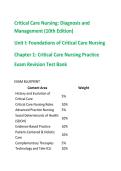
Critical Care Nursing: Diagnosis and
Management (10th Edition)
Unit I: Foundations of Critical Care Nursing
Chapter 1: Critical Care Nursing Practice
Exam Revision Test Bank
EXAM BLUEPRINT
Content Area Weight
History and Evolution of
5%
Critical Care
Critical Care Nursing Roles 10%
Advanced Practice Nursing 5%
Social Determinants of Health
10%
(SDOH)
Evidence-Based Practice 10%
Patient-Centered & Holistic
10%
Care
Complementary Therapies 5%
Technology and Tele-ICU 10%
,Interprofessional
10%
Collaboration
Rapid Response Teams 10%
Quality & Safety 10%
Healthy Work Environment 5%
Unit I — Foundations of Critical Care Nursing
Chapter Reference: Critical Care Nursing Practice
Exam Blueprint (20 items)
Topic Weighting
• Critical care nursing roles and practice: 20%
• SDOH, disparities, inequities, equity-focused care: 15%
• Evidence-based practice and clinical decision support: 15%
• Holistic, patient-centered, culturally responsive care: 10%
• Technology, tele-ICU, and interprofessional collaboration:
10%
• Quality, safety, regulatory issues: 15%
• Nurse well-being, fatigue, bullying, violence prevention,
HWE: 15%
Bloom’s Taxonomy Distribution
• Recall: 3 items
, • Comprehension: 3 items
• Application: 7 items
• Analysis: 5 items
• Evaluation/Judgment: 2 items
1. MCQ | Recall | Difficulty: Easy
Learning objective: Define the historical purpose of critical care
nursing.
Chapter reference: Unit I, Chapter 1: Critical Care Nursing
Practice
Clinical significance: Recognizing the roots of critical care helps
nurses understand why surveillance, rapid intervention, and
technology are central to ICU practice.
Question: Which development most directly contributed to the
early growth of modern critical care units?
A. Increased use of home health services
B. Need for close monitoring of unstable postoperative and
respiratory patients
C. Replacement of bedside nurses with remote providers
D. Elimination of invasive monitoring devices
Correct answer: B
, Rationale: Critical care developed to provide continuous
observation and advanced support for patients with rapidly
changing physiologic needs, especially postoperative,
respiratory, and hemodynamically unstable patients.
Distractor analysis:
A. Home health services are not the basis of ICU development.
C. Remote-only care does not reflect early critical care history.
D. Invasive monitoring expanded critical care capabilities rather
than being eliminated.
2. MCQ | Comprehension | Difficulty: Easy
Learning objective: Explain the role of critical care nursing in
contemporary practice.
Chapter reference: Unit I, Chapter 1: Critical Care Nursing
Practice
Clinical significance: ICU nurses coordinate surveillance,
stabilization, communication, and family-centered support.
Question: Which statement best describes contemporary
critical care nursing?
A. Focused primarily on task completion and device
management
B. Limited to patients receiving mechanical ventilation
C. Integrating advanced assessment, technology, teamwork,
Management (10th Edition)
Unit I: Foundations of Critical Care Nursing
Chapter 1: Critical Care Nursing Practice
Exam Revision Test Bank
EXAM BLUEPRINT
Content Area Weight
History and Evolution of
5%
Critical Care
Critical Care Nursing Roles 10%
Advanced Practice Nursing 5%
Social Determinants of Health
10%
(SDOH)
Evidence-Based Practice 10%
Patient-Centered & Holistic
10%
Care
Complementary Therapies 5%
Technology and Tele-ICU 10%
,Interprofessional
10%
Collaboration
Rapid Response Teams 10%
Quality & Safety 10%
Healthy Work Environment 5%
Unit I — Foundations of Critical Care Nursing
Chapter Reference: Critical Care Nursing Practice
Exam Blueprint (20 items)
Topic Weighting
• Critical care nursing roles and practice: 20%
• SDOH, disparities, inequities, equity-focused care: 15%
• Evidence-based practice and clinical decision support: 15%
• Holistic, patient-centered, culturally responsive care: 10%
• Technology, tele-ICU, and interprofessional collaboration:
10%
• Quality, safety, regulatory issues: 15%
• Nurse well-being, fatigue, bullying, violence prevention,
HWE: 15%
Bloom’s Taxonomy Distribution
• Recall: 3 items
, • Comprehension: 3 items
• Application: 7 items
• Analysis: 5 items
• Evaluation/Judgment: 2 items
1. MCQ | Recall | Difficulty: Easy
Learning objective: Define the historical purpose of critical care
nursing.
Chapter reference: Unit I, Chapter 1: Critical Care Nursing
Practice
Clinical significance: Recognizing the roots of critical care helps
nurses understand why surveillance, rapid intervention, and
technology are central to ICU practice.
Question: Which development most directly contributed to the
early growth of modern critical care units?
A. Increased use of home health services
B. Need for close monitoring of unstable postoperative and
respiratory patients
C. Replacement of bedside nurses with remote providers
D. Elimination of invasive monitoring devices
Correct answer: B
, Rationale: Critical care developed to provide continuous
observation and advanced support for patients with rapidly
changing physiologic needs, especially postoperative,
respiratory, and hemodynamically unstable patients.
Distractor analysis:
A. Home health services are not the basis of ICU development.
C. Remote-only care does not reflect early critical care history.
D. Invasive monitoring expanded critical care capabilities rather
than being eliminated.
2. MCQ | Comprehension | Difficulty: Easy
Learning objective: Explain the role of critical care nursing in
contemporary practice.
Chapter reference: Unit I, Chapter 1: Critical Care Nursing
Practice
Clinical significance: ICU nurses coordinate surveillance,
stabilization, communication, and family-centered support.
Question: Which statement best describes contemporary
critical care nursing?
A. Focused primarily on task completion and device
management
B. Limited to patients receiving mechanical ventilation
C. Integrating advanced assessment, technology, teamwork,


