

Digital Forensics EXAM 1 | Questions with 100%
Correct Answers | Verified | Latest Update 2026
Save
Practice questions for this set
Learn 1 /7 Study using Learn
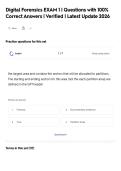
the largest area and contains the sectors that will be allocated to partitions.
The starting and ending sectors for this area (not the each partition area) are
defined in the GPT header
Choose an answer
1 Forensic 2 Documentary evidence
3 True 4 Partition Area
Don't know?
Terms in this set (117)
, Forensic relating to the use of scientific knowledge or
methods in solving crimes
Digital Forensics A discipline that combines elements of law and
computer science in order to collect and analyze
computer data from a variety of computer systems,
networks, storage devices, and other devices using
digital communications as the source and flow of
information in a way that is admissible as evidence
in a court of law.
Digital forensics includes computer True
forensics as well as forensics on all
other digital devices capable of
storing digital data
Forensic Tools *Network forensics
*Mobile device forensics
*Activity tracking device forensics, etc.
True DF investigation does not need to have deepest
understanding on theoretic knowledge on CS but
must have a familiarity with a wide range of subject
matter.
As a target of the crime e.g., computer network intrusion, DDOS attack
As an instrument of the crime Cyber Stalking and bullying
Identity theft
Pirated computer software
Forgery or falsification of documents
Corporate fraud
Terrorism and national security
Correct Answers | Verified | Latest Update 2026
Save
Practice questions for this set
Learn 1 /7 Study using Learn
the largest area and contains the sectors that will be allocated to partitions.
The starting and ending sectors for this area (not the each partition area) are
defined in the GPT header
Choose an answer
1 Forensic 2 Documentary evidence
3 True 4 Partition Area
Don't know?
Terms in this set (117)
, Forensic relating to the use of scientific knowledge or
methods in solving crimes
Digital Forensics A discipline that combines elements of law and
computer science in order to collect and analyze
computer data from a variety of computer systems,
networks, storage devices, and other devices using
digital communications as the source and flow of
information in a way that is admissible as evidence
in a court of law.
Digital forensics includes computer True
forensics as well as forensics on all
other digital devices capable of
storing digital data
Forensic Tools *Network forensics
*Mobile device forensics
*Activity tracking device forensics, etc.
True DF investigation does not need to have deepest
understanding on theoretic knowledge on CS but
must have a familiarity with a wide range of subject
matter.
As a target of the crime e.g., computer network intrusion, DDOS attack
As an instrument of the crime Cyber Stalking and bullying
Identity theft
Pirated computer software
Forgery or falsification of documents
Corporate fraud
Terrorism and national security


