

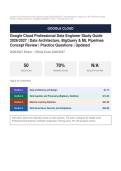
Google Cloud Professional Data Engineer Study Guide 2026/2027 | Data Architecture, BigQuery & ML Pipelines Concept
Review | Practice Questions | Updated 2026/2027 | Page 1 | Passing Score: 70%
GOOGLE CLOUD
Google Cloud Professional Data Engineer Study Guide
2026/2027 | Data Architecture, BigQuery & ML Pipelines
Concept Review | Practice Questions | Updated
2026/2027 Edition - Official Exam 2026/2027
50 70% N/A
QUESTIONS PASSING SCORE RECERTIFICATION
TABLE OF CONTENTS
Section 1 Data Architecture and Design Q1-13
Section 2 Data Ingestion and Processing (BigQuery, Dataflow) Q14-26
Section 3 Machine Learning Pipelines Q27-39
Section 4 Data Governance, Security, and Compliance Q40-50
Instructions: Select the single best answer for each question. This exam is designed for Google Cloud
Professional Data Engineer certification preparation. Passing score: 70% (35 questions correct).
, SECTION 1 | Data Architecture and Design | Q1-13 | Google Cloud Data Engineer 2026/2027
Q1 Question 1 of 50
A retail company needs to design a data warehouse for analyzing 5 years of sales
transactions. The data arrives daily in CSV format, and analysts need to run complex SQL
queries with sub-second latency on aggregated data. The company wants to minimize
storage costs for historical data while keeping recent data readily accessible.
A. Use BigQuery with partitioned tables by date, cluster by customer_id, and set a 90-day expiration
on the partitioned data in cold storage.
B. Use Cloud SQL with indexes on date and customer_id, and implement application-level archiving
to Cloud Storage after 90 days.
C. Use BigQuery with partitioned tables by date, cluster by customer_id, and configure
time-based partitioning with long-term storage pricing for data older than 90 days.
D. Use Spanner with interleaved tables for transactions and customers, and create a custom script
to move old data to Cloud Storage.
Correct Answer: C
Rationale:
BigQuery is the right choice for analytical workloads at this scale. Partitioning by date enables query pruning,
and clustering by customer_id optimizes join performance. Long-term storage pricing automatically reduces
costs for data older than 90 days without requiring data movement. Cloud SQL and Spanner are designed for
transactional workloads, not analytical queries over terabytes of data.
Google Cloud Data Engineer - 2026/2027 | Passing Score: 70% | Page 1 of 34
, SECTION 1 | Data Architecture and Design | Q1-13 | Google Cloud Data Engineer 2026/2027
Q2 Question 2 of 50
A gaming company streams player event data at 50,000 events per second. They need to
ingest this data, perform real-time aggregations over 5-minute windows, and write results
to BigQuery. The pipeline must handle late-arriving data up to 10 minutes after the
window closes.
A. Use Pub/Sub to ingest, Dataflow with fixed windows and discarding late data, and write directly to
BigQuery.
B. Use Pub/Sub to ingest, Dataflow with sliding windows and allowed lateness of 10 minutes,
using accumulation mode, and write to BigQuery.
C. Use Cloud Load Balancing to direct events to Compute Engine instances that batch write to
BigQuery every 5 minutes.
D. Use Cloud Tasks to queue events and process them with Cloud Functions triggered every 5
minutes.
Correct Answer: B
Rationale:
Dataflow with sliding windows handles continuous aggregations over overlapping time periods. Allowed
lateness of 10 minutes ensures late data is included in the correct window. Accumulation mode updates
results as late data arrives. Fixed windows with discarding late data would lose events, and Compute Engine
or Cloud Functions cannot handle this scale reliably.
Google Cloud Data Engineer - 2026/2027 | Passing Score: 70% | Page 2 of 34
, SECTION 1 | Data Architecture and Design | Q1-13 | Google Cloud Data Engineer 2026/2027
Q3 Question 3 of 50
A healthcare organization needs to store patient imaging data (DICOM files) and make it
available for ML model training. They require HIPAA compliance, fine-grained access
control, and the ability to run batch inference on the entire dataset monthly.
A. Store images in Cloud SQL BLOB columns and use IAM at the database level for access control.
B. Store images in Cloud Storage Standard class with bucket-level IAM and process with Cloud
Functions.
C. Store images in Cloud Storage Nearline class with object-level ACLs, enable VPC Service
Controls, and process with Dataflow batch pipelines.
D. Store images in Firestore as base64-encoded documents and use document-level security rules.
Correct Answer: C
Rationale:
Cloud Storage Nearline is cost-effective for monthly access patterns. Object-level ACLs provide fine-grained
access control required for HIPAA. VPC Service Controls create a security perimeter that helps meet
compliance requirements. Dataflow is designed for large-scale batch processing. Cloud SQL and Firestore
are not suitable for storing large binary files.
Google Cloud Data Engineer - 2026/2027 | Passing Score: 70% | Page 3 of 34
Review | Practice Questions | Updated 2026/2027 | Page 1 | Passing Score: 70%
GOOGLE CLOUD
Google Cloud Professional Data Engineer Study Guide
2026/2027 | Data Architecture, BigQuery & ML Pipelines
Concept Review | Practice Questions | Updated
2026/2027 Edition - Official Exam 2026/2027
50 70% N/A
QUESTIONS PASSING SCORE RECERTIFICATION
TABLE OF CONTENTS
Section 1 Data Architecture and Design Q1-13
Section 2 Data Ingestion and Processing (BigQuery, Dataflow) Q14-26
Section 3 Machine Learning Pipelines Q27-39
Section 4 Data Governance, Security, and Compliance Q40-50
Instructions: Select the single best answer for each question. This exam is designed for Google Cloud
Professional Data Engineer certification preparation. Passing score: 70% (35 questions correct).
, SECTION 1 | Data Architecture and Design | Q1-13 | Google Cloud Data Engineer 2026/2027
Q1 Question 1 of 50
A retail company needs to design a data warehouse for analyzing 5 years of sales
transactions. The data arrives daily in CSV format, and analysts need to run complex SQL
queries with sub-second latency on aggregated data. The company wants to minimize
storage costs for historical data while keeping recent data readily accessible.
A. Use BigQuery with partitioned tables by date, cluster by customer_id, and set a 90-day expiration
on the partitioned data in cold storage.
B. Use Cloud SQL with indexes on date and customer_id, and implement application-level archiving
to Cloud Storage after 90 days.
C. Use BigQuery with partitioned tables by date, cluster by customer_id, and configure
time-based partitioning with long-term storage pricing for data older than 90 days.
D. Use Spanner with interleaved tables for transactions and customers, and create a custom script
to move old data to Cloud Storage.
Correct Answer: C
Rationale:
BigQuery is the right choice for analytical workloads at this scale. Partitioning by date enables query pruning,
and clustering by customer_id optimizes join performance. Long-term storage pricing automatically reduces
costs for data older than 90 days without requiring data movement. Cloud SQL and Spanner are designed for
transactional workloads, not analytical queries over terabytes of data.
Google Cloud Data Engineer - 2026/2027 | Passing Score: 70% | Page 1 of 34
, SECTION 1 | Data Architecture and Design | Q1-13 | Google Cloud Data Engineer 2026/2027
Q2 Question 2 of 50
A gaming company streams player event data at 50,000 events per second. They need to
ingest this data, perform real-time aggregations over 5-minute windows, and write results
to BigQuery. The pipeline must handle late-arriving data up to 10 minutes after the
window closes.
A. Use Pub/Sub to ingest, Dataflow with fixed windows and discarding late data, and write directly to
BigQuery.
B. Use Pub/Sub to ingest, Dataflow with sliding windows and allowed lateness of 10 minutes,
using accumulation mode, and write to BigQuery.
C. Use Cloud Load Balancing to direct events to Compute Engine instances that batch write to
BigQuery every 5 minutes.
D. Use Cloud Tasks to queue events and process them with Cloud Functions triggered every 5
minutes.
Correct Answer: B
Rationale:
Dataflow with sliding windows handles continuous aggregations over overlapping time periods. Allowed
lateness of 10 minutes ensures late data is included in the correct window. Accumulation mode updates
results as late data arrives. Fixed windows with discarding late data would lose events, and Compute Engine
or Cloud Functions cannot handle this scale reliably.
Google Cloud Data Engineer - 2026/2027 | Passing Score: 70% | Page 2 of 34
, SECTION 1 | Data Architecture and Design | Q1-13 | Google Cloud Data Engineer 2026/2027
Q3 Question 3 of 50
A healthcare organization needs to store patient imaging data (DICOM files) and make it
available for ML model training. They require HIPAA compliance, fine-grained access
control, and the ability to run batch inference on the entire dataset monthly.
A. Store images in Cloud SQL BLOB columns and use IAM at the database level for access control.
B. Store images in Cloud Storage Standard class with bucket-level IAM and process with Cloud
Functions.
C. Store images in Cloud Storage Nearline class with object-level ACLs, enable VPC Service
Controls, and process with Dataflow batch pipelines.
D. Store images in Firestore as base64-encoded documents and use document-level security rules.
Correct Answer: C
Rationale:
Cloud Storage Nearline is cost-effective for monthly access patterns. Object-level ACLs provide fine-grained
access control required for HIPAA. VPC Service Controls create a security perimeter that helps meet
compliance requirements. Dataflow is designed for large-scale batch processing. Cloud SQL and Firestore
are not suitable for storing large binary files.
Google Cloud Data Engineer - 2026/2027 | Passing Score: 70% | Page 3 of 34


