
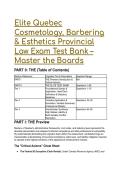
Elite Quebec
Cosmetology, Barbering
& Esthetics Provincial
Law Exam Test Bank –
Master the Boards
PART 0: THE (Table of Contents)
Section Reference Cognitive Tier & Description Question Range
PART I THE Preview (Introduction & N/A
Critical Axioms)
PART II THE ELITE TEST BANK Questions 1–60
Tier 1 Foundational Syntax & Questions 1–15
Application: Hard Deck
Definitions & Statutory
Baselines
Tier 2 Complex Application & Questions 16–35
Simulation: Variable Scenarios
& Sequence Mastery
Tier 3 Grandmaster Synthesis: Questions 36–60
High-Stakes Liability &
Multi-Variable Conflict
Resolution
PART I: THE Preview
Mastery of Quebec's administrative frameworks, civil codes, and statutory laws represents the
absolute demarcation line between functional competence and elite professional invulnerability.
By systematically dismantling the cognitive traps within this assessment, candidates forge an
impenetrable understanding of provincial compliance, labor laws, and liability mitigation required
to operate at the highest echelons of the appearance enhancement industry.
The "Critical Axioms" Cheat Sheet
● The Federal EI Exception (Chair Rental): Under Canada Revenue Agency (ARC) and
, Revenu Québec guidelines, a travailleur autonome (independent contractor) renting a
chair in a salon is exceptionally eligible for Employment Insurance (EI/AE). The salon
owner is legally deemed the employer solely for the purpose of calculating and remitting
both the employee and employer portions of EI, reporting this gross income in Box 83 of
the T4 slip.
● The CCQ 2089/2095 Doctrine: Non-compete clauses under Article 2089 of the Code civil
du Québec (CCQ) must be express, written, and strictly limited in time, territory, and
scope. Crucially, under CCQ 2095, an employer who terminates an employee without a
serious reason definitively forfeits the right to enforce any non-compete clause.
● The "Comité Paritaire" Anomaly: The Outaouais region is the sole jurisdiction in
Quebec still governed by a decree under the Loi sur les décrets de convention collective
(LDCC) for the hairdressing industry. This committee possesses the legal authority to
dictate minimum service prices, work hours, and qualification standards, superseding
standard free-market deregulation.
● Voluntary vs. Compulsory Certification: Unlike Ontario or Nova Scotia, trade
certification for hairstylists in Quebec is completely voluntary. Red Seal endorsement is
available but not mandated for provincial practice, making Quebec a highly accessible
market.
● The APESEQ Certification & Ethics Matrix: The Association des professionnels en
électrolyse et soins esthétiques du Québec (APESEQ) requires an 85% passing grade on
its pre-admission exam and mandates strict adherence to its Code of Ethics, including the
absolute requirement for professional liability insurance.
APESEQ Private Training Standard Requirements (2026 Paradigm)
Program Discipline Minimum Total Theory (In-Class) Practice (In-Class) Student-to-Station
Hours Ratio
Esthetics (Base) 450 hours 225 hours 225 hours 1 station
Esthetics 650 hours 275 hours 375 hours 1 station per
(Advanced) student
Electrolysis 550 hours 275 hours 275 hours 1 station per
student
PART II: THE ELITE TEST BANK
Tier 1: Foundational Syntax & Application
Q1: A newly licensed hairstylist relocates from Toronto, Ontario, to Montreal, Quebec. In
Ontario, trade certification is compulsory. Based on the principles of the Emploi-Québec
occupational frameworks, which action/conclusion is the MOST ACCURATE? A) The stylist
must immediately challenge the provincial board examination to obtain a mandatory Quebec
license. B) The stylist must register as an apprentice under the PAMT program before servicing
the public. C) Trade certification for hairstylists is voluntary in Quebec; the stylist may practice
legally without mandatory provincial certification. D) The stylist must obtain authorization from
the local Comité paritaire de la coiffure before seeking employment.
● The Answer: C (Trade certification for hairstylists is voluntary in Quebec; the stylist may
practice legally without mandatory provincial certification.)
● Distractor Analysis:
, ○ A is incorrect: Unlike Ontario, Nova Scotia, and Manitoba, Quebec does not legally
require compulsory trade certification for hairstylists.
○ B is incorrect: The Programme d'apprentissage en milieu de travail (PAMT) is a
voluntary upskilling pathway, not a mandatory legal prerequisite for practicing.
○ D is incorrect: Parity committees only govern specific localized regions (specifically
the Outaouais region), not the entire province of Quebec.
The Mentor's Analysis: The regulatory landscape in Canada is fragmented by province.
Quebec operates on a voluntary certification model for cosmetology, prioritizing market forces
over strict entry licensure, contrasting sharply with neighboring compulsory provinces.
Professional/Academic Intuition: Always verify provincial statutory jurisdiction; what is a
criminal offense of unlicensed activity in Ontario is standard deregulated practice in
Quebec.
Q2: A salon owner enters into a location de chaise (chair rental) agreement with a barber. The
barber operates as a travailleur autonome. Based on the principles of the Agence du revenu du
Canada (ARC) and Employment Insurance (EI) regulations, which action/conclusion is the
MOST ACCURATE? A) The barber is solely responsible for remitting their own EI premiums
directly to the CRA. B) The salon owner must remit the employer and employee portions of EI
on behalf of the self-employed barber based on insurable earnings. C) As an independent
contractor, the barber is completely exempt from EI and no remittances are required. D) The
salon owner must deduct income tax, RRQ, and EI, treating the barber exactly as a salaried
employee.
● The Answer: B (The salon owner must remit the employer and employee portions of EI
on behalf of the self-employed barber based on insurable earnings.)
● Distractor Analysis:
○ A is incorrect: Federal law specifically shifts the burden of EI remittance to the salon
owner (lessor) for chair-renting barbers and hairdressers.
○ C is incorrect: The salon industry possesses a highly unique statutory exception
making EI mandatory for these specific independent contractors.
○ D is incorrect: While EI is remitted by the owner, the independent contractor
remains responsible for their own income tax and RRQ (Régime de rentes du
Québec) contributions.
The Mentor's Analysis: The CRA categorizes the "Chair Renter" in a paradoxical state: legally
self-employed for income tax, but statutorily deemed an employee solely for Employment
Insurance purposes. Professional/Academic Intuition: In Canadian tax law, the facility
owner is always the ultimate guarantor of EI premiums for chair-renting cosmetologists.
Q3: An employer drafts an employment contract containing a non-compete clause. Based on
the principles of Article 2089 of the Code civil du Québec (CCQ), which action/conclusion is the
MOST ACCURATE? A) A verbal agreement prohibiting the employee from opening a salon
within 50 kilometers for five years. B) A written clause prohibiting the employee from working in
any capacity within the beauty industry anywhere in Quebec for one year. C) A written, express
clause prohibiting the employee from working as a hairstylist within a 5-kilometer radius for six
months. D) An implied clause based on standard industry practices preventing competition
during the severance period.
● The Answer: C (A written, express clause prohibiting the employee from working as a
hairstylist within a 5-kilometer radius for six months.)
● Distractor Analysis:
○ A is incorrect: CCQ 2089 explicitly mandates that non-compete clauses must be
established "in writing and in express terms".
, ○ B is incorrect: The scope is overly broad. Banning an employee from the entire
province and "any capacity" violates the requirement for reasonable limitations on
territory and nature of work.
○ D is incorrect: Implied non-compete clauses do not exist under Quebec civil law; the
duty of loyalty exists, but strict non-competition requires express written consent.
The Mentor's Analysis: The Civil Code of Quebec inherently favors the mobility of labor.
Therefore, any restriction on a worker's ability to earn a living must be surgically narrow,
explicitly written, and undeniably reasonable in scope. Professional/Academic Intuition: A
non-compete clause that is too broad in geography, time, or scope will be struck down
entirely by a Quebec judge, leaving the employer with zero protection.
Q4: An esthetician seeks membership in the Association des professionnels en électrolyse et
soins esthétiques du Québec (APESEQ). Based on the principles of the APESEQ Code of
Ethics, which action/conclusion is the MOST ACCURATE? A) The member must remit 5% of
gross annual income to the association to maintain standing. B) The member must operate
exclusively out of a commercially zoned medical clinic. C) The member is legally mandated to
maintain an active professional liability insurance policy. D) The member is restricted to utilizing
only APESEQ-branded retail products in the treatment room.
● The Answer: C (The member is legally mandated to maintain an active professional
liability insurance policy.)
● Distractor Analysis:
○ A is incorrect: APESEQ requires standard membership dues, not a percentage of
gross corporate income.
○ B is incorrect: Members may operate in various settings, including spas, home
salons, and clinics, provided hygiene standards are met.
○ D is incorrect: APESEQ does not dictate product branding, but rather professional
conduct, ethical boundaries, and educational standards.
The Mentor's Analysis: Professional associations shield the public from malpractice. The
foundational bedrock of this protection under Article 9 of the APESEQ Code is the absolute
requirement for liability insurance, guaranteeing financial recourse for client injury.
Professional/Academic Intuition: Ethical practice in esthetics is inextricably linked to
financial accountability; practicing without liability insurance is an immediate ethical
violation that warrants disciplinary radiation.
Q5: The Programme d'apprentissage en milieu de travail (PAMT) requires a senior stylist to
mentor an apprentice. Based on the principles of the Soins Personnels Québec framework,
which action/conclusion is the MOST ACCURATE prerequisite for the mentor (le compagnon)?
A) They must possess a university degree in adult education or pedagogy. B) They must hold a
mandatory management position within the salon's corporate hierarchy. C) They must complete
a designated 3-hour training session provided by Services Québec. D) They must have
previously won a recognized provincial hairstyling competition.
● The Answer: C (They must complete a designated 3-hour training session provided by
Services Québec.)
● Distractor Analysis:
○ A is incorrect: University degrees are entirely outside the scope of vocational skilled
trades apprenticeships.
○ B is incorrect: A companion must be an experienced practitioner, but managerial
status is not legally required.
○ D is incorrect: Competitions are irrelevant to statutory mentorship qualifications.
The Mentor's Analysis: The PAMT system relies on standardizing the transmission of
Cosmetology, Barbering
& Esthetics Provincial
Law Exam Test Bank –
Master the Boards
PART 0: THE (Table of Contents)
Section Reference Cognitive Tier & Description Question Range
PART I THE Preview (Introduction & N/A
Critical Axioms)
PART II THE ELITE TEST BANK Questions 1–60
Tier 1 Foundational Syntax & Questions 1–15
Application: Hard Deck
Definitions & Statutory
Baselines
Tier 2 Complex Application & Questions 16–35
Simulation: Variable Scenarios
& Sequence Mastery
Tier 3 Grandmaster Synthesis: Questions 36–60
High-Stakes Liability &
Multi-Variable Conflict
Resolution
PART I: THE Preview
Mastery of Quebec's administrative frameworks, civil codes, and statutory laws represents the
absolute demarcation line between functional competence and elite professional invulnerability.
By systematically dismantling the cognitive traps within this assessment, candidates forge an
impenetrable understanding of provincial compliance, labor laws, and liability mitigation required
to operate at the highest echelons of the appearance enhancement industry.
The "Critical Axioms" Cheat Sheet
● The Federal EI Exception (Chair Rental): Under Canada Revenue Agency (ARC) and
, Revenu Québec guidelines, a travailleur autonome (independent contractor) renting a
chair in a salon is exceptionally eligible for Employment Insurance (EI/AE). The salon
owner is legally deemed the employer solely for the purpose of calculating and remitting
both the employee and employer portions of EI, reporting this gross income in Box 83 of
the T4 slip.
● The CCQ 2089/2095 Doctrine: Non-compete clauses under Article 2089 of the Code civil
du Québec (CCQ) must be express, written, and strictly limited in time, territory, and
scope. Crucially, under CCQ 2095, an employer who terminates an employee without a
serious reason definitively forfeits the right to enforce any non-compete clause.
● The "Comité Paritaire" Anomaly: The Outaouais region is the sole jurisdiction in
Quebec still governed by a decree under the Loi sur les décrets de convention collective
(LDCC) for the hairdressing industry. This committee possesses the legal authority to
dictate minimum service prices, work hours, and qualification standards, superseding
standard free-market deregulation.
● Voluntary vs. Compulsory Certification: Unlike Ontario or Nova Scotia, trade
certification for hairstylists in Quebec is completely voluntary. Red Seal endorsement is
available but not mandated for provincial practice, making Quebec a highly accessible
market.
● The APESEQ Certification & Ethics Matrix: The Association des professionnels en
électrolyse et soins esthétiques du Québec (APESEQ) requires an 85% passing grade on
its pre-admission exam and mandates strict adherence to its Code of Ethics, including the
absolute requirement for professional liability insurance.
APESEQ Private Training Standard Requirements (2026 Paradigm)
Program Discipline Minimum Total Theory (In-Class) Practice (In-Class) Student-to-Station
Hours Ratio
Esthetics (Base) 450 hours 225 hours 225 hours 1 station
Esthetics 650 hours 275 hours 375 hours 1 station per
(Advanced) student
Electrolysis 550 hours 275 hours 275 hours 1 station per
student
PART II: THE ELITE TEST BANK
Tier 1: Foundational Syntax & Application
Q1: A newly licensed hairstylist relocates from Toronto, Ontario, to Montreal, Quebec. In
Ontario, trade certification is compulsory. Based on the principles of the Emploi-Québec
occupational frameworks, which action/conclusion is the MOST ACCURATE? A) The stylist
must immediately challenge the provincial board examination to obtain a mandatory Quebec
license. B) The stylist must register as an apprentice under the PAMT program before servicing
the public. C) Trade certification for hairstylists is voluntary in Quebec; the stylist may practice
legally without mandatory provincial certification. D) The stylist must obtain authorization from
the local Comité paritaire de la coiffure before seeking employment.
● The Answer: C (Trade certification for hairstylists is voluntary in Quebec; the stylist may
practice legally without mandatory provincial certification.)
● Distractor Analysis:
, ○ A is incorrect: Unlike Ontario, Nova Scotia, and Manitoba, Quebec does not legally
require compulsory trade certification for hairstylists.
○ B is incorrect: The Programme d'apprentissage en milieu de travail (PAMT) is a
voluntary upskilling pathway, not a mandatory legal prerequisite for practicing.
○ D is incorrect: Parity committees only govern specific localized regions (specifically
the Outaouais region), not the entire province of Quebec.
The Mentor's Analysis: The regulatory landscape in Canada is fragmented by province.
Quebec operates on a voluntary certification model for cosmetology, prioritizing market forces
over strict entry licensure, contrasting sharply with neighboring compulsory provinces.
Professional/Academic Intuition: Always verify provincial statutory jurisdiction; what is a
criminal offense of unlicensed activity in Ontario is standard deregulated practice in
Quebec.
Q2: A salon owner enters into a location de chaise (chair rental) agreement with a barber. The
barber operates as a travailleur autonome. Based on the principles of the Agence du revenu du
Canada (ARC) and Employment Insurance (EI) regulations, which action/conclusion is the
MOST ACCURATE? A) The barber is solely responsible for remitting their own EI premiums
directly to the CRA. B) The salon owner must remit the employer and employee portions of EI
on behalf of the self-employed barber based on insurable earnings. C) As an independent
contractor, the barber is completely exempt from EI and no remittances are required. D) The
salon owner must deduct income tax, RRQ, and EI, treating the barber exactly as a salaried
employee.
● The Answer: B (The salon owner must remit the employer and employee portions of EI
on behalf of the self-employed barber based on insurable earnings.)
● Distractor Analysis:
○ A is incorrect: Federal law specifically shifts the burden of EI remittance to the salon
owner (lessor) for chair-renting barbers and hairdressers.
○ C is incorrect: The salon industry possesses a highly unique statutory exception
making EI mandatory for these specific independent contractors.
○ D is incorrect: While EI is remitted by the owner, the independent contractor
remains responsible for their own income tax and RRQ (Régime de rentes du
Québec) contributions.
The Mentor's Analysis: The CRA categorizes the "Chair Renter" in a paradoxical state: legally
self-employed for income tax, but statutorily deemed an employee solely for Employment
Insurance purposes. Professional/Academic Intuition: In Canadian tax law, the facility
owner is always the ultimate guarantor of EI premiums for chair-renting cosmetologists.
Q3: An employer drafts an employment contract containing a non-compete clause. Based on
the principles of Article 2089 of the Code civil du Québec (CCQ), which action/conclusion is the
MOST ACCURATE? A) A verbal agreement prohibiting the employee from opening a salon
within 50 kilometers for five years. B) A written clause prohibiting the employee from working in
any capacity within the beauty industry anywhere in Quebec for one year. C) A written, express
clause prohibiting the employee from working as a hairstylist within a 5-kilometer radius for six
months. D) An implied clause based on standard industry practices preventing competition
during the severance period.
● The Answer: C (A written, express clause prohibiting the employee from working as a
hairstylist within a 5-kilometer radius for six months.)
● Distractor Analysis:
○ A is incorrect: CCQ 2089 explicitly mandates that non-compete clauses must be
established "in writing and in express terms".
, ○ B is incorrect: The scope is overly broad. Banning an employee from the entire
province and "any capacity" violates the requirement for reasonable limitations on
territory and nature of work.
○ D is incorrect: Implied non-compete clauses do not exist under Quebec civil law; the
duty of loyalty exists, but strict non-competition requires express written consent.
The Mentor's Analysis: The Civil Code of Quebec inherently favors the mobility of labor.
Therefore, any restriction on a worker's ability to earn a living must be surgically narrow,
explicitly written, and undeniably reasonable in scope. Professional/Academic Intuition: A
non-compete clause that is too broad in geography, time, or scope will be struck down
entirely by a Quebec judge, leaving the employer with zero protection.
Q4: An esthetician seeks membership in the Association des professionnels en électrolyse et
soins esthétiques du Québec (APESEQ). Based on the principles of the APESEQ Code of
Ethics, which action/conclusion is the MOST ACCURATE? A) The member must remit 5% of
gross annual income to the association to maintain standing. B) The member must operate
exclusively out of a commercially zoned medical clinic. C) The member is legally mandated to
maintain an active professional liability insurance policy. D) The member is restricted to utilizing
only APESEQ-branded retail products in the treatment room.
● The Answer: C (The member is legally mandated to maintain an active professional
liability insurance policy.)
● Distractor Analysis:
○ A is incorrect: APESEQ requires standard membership dues, not a percentage of
gross corporate income.
○ B is incorrect: Members may operate in various settings, including spas, home
salons, and clinics, provided hygiene standards are met.
○ D is incorrect: APESEQ does not dictate product branding, but rather professional
conduct, ethical boundaries, and educational standards.
The Mentor's Analysis: Professional associations shield the public from malpractice. The
foundational bedrock of this protection under Article 9 of the APESEQ Code is the absolute
requirement for liability insurance, guaranteeing financial recourse for client injury.
Professional/Academic Intuition: Ethical practice in esthetics is inextricably linked to
financial accountability; practicing without liability insurance is an immediate ethical
violation that warrants disciplinary radiation.
Q5: The Programme d'apprentissage en milieu de travail (PAMT) requires a senior stylist to
mentor an apprentice. Based on the principles of the Soins Personnels Québec framework,
which action/conclusion is the MOST ACCURATE prerequisite for the mentor (le compagnon)?
A) They must possess a university degree in adult education or pedagogy. B) They must hold a
mandatory management position within the salon's corporate hierarchy. C) They must complete
a designated 3-hour training session provided by Services Québec. D) They must have
previously won a recognized provincial hairstyling competition.
● The Answer: C (They must complete a designated 3-hour training session provided by
Services Québec.)
● Distractor Analysis:
○ A is incorrect: University degrees are entirely outside the scope of vocational skilled
trades apprenticeships.
○ B is incorrect: A companion must be an experienced practitioner, but managerial
status is not legally required.
○ D is incorrect: Competitions are irrelevant to statutory mentorship qualifications.
The Mentor's Analysis: The PAMT system relies on standardizing the transmission of


