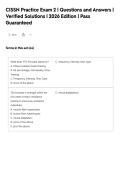
CISSN Practice Exam 2 | Questions and Answers |
Verified Solutions | 2026 Edition | Pass
Guaranteed
Save
Terms in this set (44)
What does FITT Principle stand for? C- frequency, intensity, time, type
A. Fitness Isolation Team Training
B. Fat percentage, Individuality, Tone,
Training
C. Frequency, Intensity, Time, Type
D. None of the above
The increase in strength within the C- neural adaptations
first week of heavy resistance
training in previously untrained
individuals
A. muscle fiber hyperplasia
B. muscle fiber hypertrophy
C. neural adaptation
D. none of the above
E. all of the above
, Generally it is recommended that B- 30%
athletes consume approximately
________ of their daily caloric intake as
fat.
A. 59%
B. 30%
C. 5%
D. 10%
Supplementing with alpha-hydroxy- B- leads to increases in skeletal muscle mass
isocaproic acid (1.5 g. per day for 4
weeks):
A. Promotes skeletal muscle fiber
hyperplasia.
B. Leads to increases in skeletal
muscle mass.
C. Leads to decreases in skeletal
muscle mitochondrial volume
density.
D. None of the answers are correct.
By applying the First Law of D- fat in adipose tissue
Thermodynamics to metabolism, if
total food calories exceed total daily
energy expenditure, excess calories
A. glycogen in the kidneys
B. protein in the liver
C. glycogen in the pancreas
D. fat in adipose tissue
Verified Solutions | 2026 Edition | Pass
Guaranteed
Save
Terms in this set (44)
What does FITT Principle stand for? C- frequency, intensity, time, type
A. Fitness Isolation Team Training
B. Fat percentage, Individuality, Tone,
Training
C. Frequency, Intensity, Time, Type
D. None of the above
The increase in strength within the C- neural adaptations
first week of heavy resistance
training in previously untrained
individuals
A. muscle fiber hyperplasia
B. muscle fiber hypertrophy
C. neural adaptation
D. none of the above
E. all of the above
, Generally it is recommended that B- 30%
athletes consume approximately
________ of their daily caloric intake as
fat.
A. 59%
B. 30%
C. 5%
D. 10%
Supplementing with alpha-hydroxy- B- leads to increases in skeletal muscle mass
isocaproic acid (1.5 g. per day for 4
weeks):
A. Promotes skeletal muscle fiber
hyperplasia.
B. Leads to increases in skeletal
muscle mass.
C. Leads to decreases in skeletal
muscle mitochondrial volume
density.
D. None of the answers are correct.
By applying the First Law of D- fat in adipose tissue
Thermodynamics to metabolism, if
total food calories exceed total daily
energy expenditure, excess calories
A. glycogen in the kidneys
B. protein in the liver
C. glycogen in the pancreas
D. fat in adipose tissue