NURS 5315 ADVANCED PATHO UTA Ultimate
Exam 1 | Questions and Answers | Verified
Solutions | 2026 Edition | Pass Guaranteed
Save
Practice questions for this set
Learn 1 /7 Study using Learn
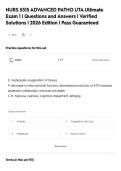
E. inadequate oxygenation of tissues
P. decrease in mitochondrial function, decreased production of ATP increases
anaerobic metabolism. eventual cell death.
C.M. hypoxia, cyanosis, cognitive impairment, lethargy
Choose an answer
1 Atrophy 2 Coagulative Necrosis
3 Metaplasia 4 Hypoxia injury
Don't know?
Terms in this set (93)
, Atrophy E. Cells decrease in size
P. Still functional
Physiologic: thymus gland in early childhood
Pathological: disuse
Hypertrophy E. Increase in cell size
P. Increased workload
Physiologic: weightlifting
Pathologic: cardiomegaly from HTN
Hyperplasia E. Increase in cell number
P. Increased cellular division
Physiologic: liver regeneration
Pathologic: endometrial- usually r/t hormones
Dysplasia E. Cells change in size, shape, organization
P. AKA atypical hyperplasia, a disorderly
proliferation
Physiologic: N/A
Pathologic: squamous dysplasia of cervix from HPV
Metaplasia E. one cell type replaced with another
P. reprogramming of stem cells, reversible
Physiologic: N/A
Pathologic: stratified squamous cells in bronchial
lining r/t cigarette smoke
Hypoxia injury E. inadequate oxygenation of tissues
P. decrease in mitochondrial function, decreased
production of ATP increases anaerobic metabolism.
eventual cell death.
C.M. hypoxia, cyanosis, cognitive impairment,
lethargy