

ECON 300 Exam 4
Study online at https://quizlet.com/_jd5pb7
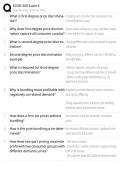
1. What is first-degree price discrimina- Charging each consumer their reservation price
tion? (max willingness to pay).
2. Why does first-degree price discrimi- If price equals willingness to pay, consumer surplus
nation capture all consumer surplus? is zero and the firm captures all surplus.
3. What is second-degree price discrim- Charging different per-unit prices based on quantity
ination? consumed.
4. Second-degree price discrimination Utility pricing (e.g., different rates for 0-500 kWh vs.
example 500-1000 kWh)
5. What is required for third-degree - Ability to separate consumers into groups
price discrimination? - Groups must have different elasticities of demand
- Ability to verify group membership (e.g., stu-
dent/senior discounts)
6. Why is bundling more profitable with Negatively correlated demand means consumers
negatively correlated demand? value goods differently.
Selling separately forces low prices, but bundling
combines values and increases revenue.
7. How does a firm set prices without the minimum of the two customers' reservation
bundling? prices
8. How is the pure bundling price deter- the minimum of the two customers' combined reser-
mined? vation prices for the bundle
9. How does two-part pricing maximize - With two consumers:
profit with two consumer groups with - Set entry fee = smaller consumer's surplus (to keep
different demand curves? both in the market)
- Set usage fee above MC, based on demand curves
1/5
, ECON 300 Exam 4
Study online at https://quizlet.com/_jd5pb7
10. What is monopolistic competition? A market with many firms selling differentiated but
highly substitutable products, with free entry and
exit.
11. What are common examples of mo- Candy bars, toothpaste, deodorant, breakfast cereal.
nopolistically competitive markets?
12. What happens to economic profits in Profits go to zero due to new firms entering the
the long run? market.
13. Why do firms lose profit over time in New entrants reduce demand for existing firms.
monopolistic competition?
14. Why is there deadweight loss in mo- Because price > marginal cost, leading to underpro-
nopolistic competition? duction.
15. How is perfect competition more effi- In perfect competition, price = marginal cost, so no
cient? deadweight loss.
16. Why should production occur where It maximizes total surplus and ensures efficiency.
MR = MC?
17. How do firms behave in an oligopoly? Firms are interdependent and must act strategically.
18. What is a Nash equilibrium? when firms use strategies that are "best responses"
to one another
each firm is doing the best they can, given what their
competitors are doing
19. What is a Cournot duopoly? Firms choose quantities based on competitors' out-
put.
20. What is a reaction curve?
2/5
Study online at https://quizlet.com/_jd5pb7
1. What is first-degree price discrimina- Charging each consumer their reservation price
tion? (max willingness to pay).
2. Why does first-degree price discrimi- If price equals willingness to pay, consumer surplus
nation capture all consumer surplus? is zero and the firm captures all surplus.
3. What is second-degree price discrim- Charging different per-unit prices based on quantity
ination? consumed.
4. Second-degree price discrimination Utility pricing (e.g., different rates for 0-500 kWh vs.
example 500-1000 kWh)
5. What is required for third-degree - Ability to separate consumers into groups
price discrimination? - Groups must have different elasticities of demand
- Ability to verify group membership (e.g., stu-
dent/senior discounts)
6. Why is bundling more profitable with Negatively correlated demand means consumers
negatively correlated demand? value goods differently.
Selling separately forces low prices, but bundling
combines values and increases revenue.
7. How does a firm set prices without the minimum of the two customers' reservation
bundling? prices
8. How is the pure bundling price deter- the minimum of the two customers' combined reser-
mined? vation prices for the bundle
9. How does two-part pricing maximize - With two consumers:
profit with two consumer groups with - Set entry fee = smaller consumer's surplus (to keep
different demand curves? both in the market)
- Set usage fee above MC, based on demand curves
1/5
, ECON 300 Exam 4
Study online at https://quizlet.com/_jd5pb7
10. What is monopolistic competition? A market with many firms selling differentiated but
highly substitutable products, with free entry and
exit.
11. What are common examples of mo- Candy bars, toothpaste, deodorant, breakfast cereal.
nopolistically competitive markets?
12. What happens to economic profits in Profits go to zero due to new firms entering the
the long run? market.
13. Why do firms lose profit over time in New entrants reduce demand for existing firms.
monopolistic competition?
14. Why is there deadweight loss in mo- Because price > marginal cost, leading to underpro-
nopolistic competition? duction.
15. How is perfect competition more effi- In perfect competition, price = marginal cost, so no
cient? deadweight loss.
16. Why should production occur where It maximizes total surplus and ensures efficiency.
MR = MC?
17. How do firms behave in an oligopoly? Firms are interdependent and must act strategically.
18. What is a Nash equilibrium? when firms use strategies that are "best responses"
to one another
each firm is doing the best they can, given what their
competitors are doing
19. What is a Cournot duopoly? Firms choose quantities based on competitors' out-
put.
20. What is a reaction curve?
2/5


