

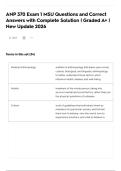
ANP 370 Exam 1 MSU Questions and Correct
Answers with Complete Solution | Graded A+ |
New Update 2026
Save
Terms in this set (34)
Medical Anthropology subfield of anthropology that draws upon social,
cultural, biological, and linguistic anthropology
to better understand those factors which
influence health, disease, and well-being
Holistic treatment of the whole person, taking into
account mental and social factors, rather than just
the physical symptoms of a disease.
Culture a set of guidelines that individuals inherit as
members of a particular society, and that tell
them how to behave, view the world, how to
experience emotions, and what to believe in.
, Western medicine/ biomedicine This comprises the organized, legally sanctioned
healing professions, such as modern Western
scientific medicine, also known as allopathy or
biomedicine.
It includes not only physicians of various types
and specialties, but also the recognized
paramedical professions such as nurses,midwives
and physiotherapists.
Bio-cultural approach examine physiological change, conditions, and
adaptations in the context of socio-economic,
demographic, availability and uses of resources,
and other factors
Ethnomedical approach examines the health conditions of populations in
historical context, and utilize archival,
documentary, oral history methods. Usually, this
approach also has an applied and critical
purpose, and draws on the range of other
common approaches utilized by medical
anthropologists.
Experimental approach focuses on how people experience illness and
make sense of their illness experience.
Critical Medical Anthropology Emphasizes structural, macro-level, large-scale,
(CMA) systemic influences on health status and health
inequalities, and is critical of strictly cultural or
individual behavioral approaches to health and
disease.
- It brings together analysis of culture in
historically delineated political economy, and
issues of power, control, and resistance as these
structure health and illness.
Answers with Complete Solution | Graded A+ |
New Update 2026
Save
Terms in this set (34)
Medical Anthropology subfield of anthropology that draws upon social,
cultural, biological, and linguistic anthropology
to better understand those factors which
influence health, disease, and well-being
Holistic treatment of the whole person, taking into
account mental and social factors, rather than just
the physical symptoms of a disease.
Culture a set of guidelines that individuals inherit as
members of a particular society, and that tell
them how to behave, view the world, how to
experience emotions, and what to believe in.
, Western medicine/ biomedicine This comprises the organized, legally sanctioned
healing professions, such as modern Western
scientific medicine, also known as allopathy or
biomedicine.
It includes not only physicians of various types
and specialties, but also the recognized
paramedical professions such as nurses,midwives
and physiotherapists.
Bio-cultural approach examine physiological change, conditions, and
adaptations in the context of socio-economic,
demographic, availability and uses of resources,
and other factors
Ethnomedical approach examines the health conditions of populations in
historical context, and utilize archival,
documentary, oral history methods. Usually, this
approach also has an applied and critical
purpose, and draws on the range of other
common approaches utilized by medical
anthropologists.
Experimental approach focuses on how people experience illness and
make sense of their illness experience.
Critical Medical Anthropology Emphasizes structural, macro-level, large-scale,
(CMA) systemic influences on health status and health
inequalities, and is critical of strictly cultural or
individual behavioral approaches to health and
disease.
- It brings together analysis of culture in
historically delineated political economy, and
issues of power, control, and resistance as these
structure health and illness.


